
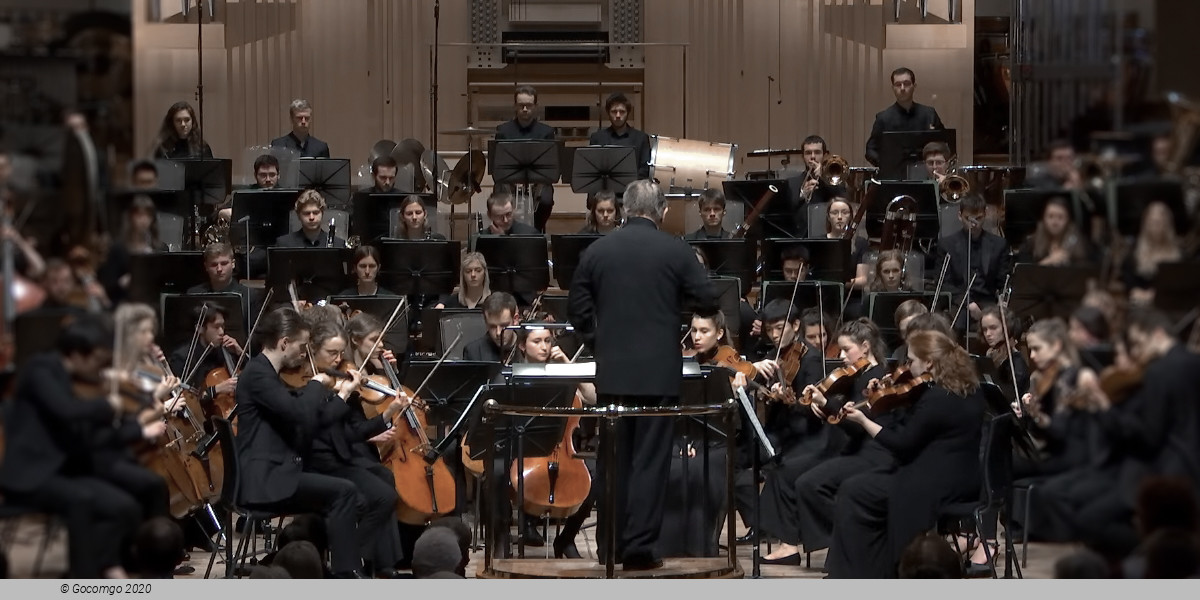
Chicago Symphony Center tickets 2 April 2027 - Jordan, Hadelich and Tchaikovsky 4 | GoComGo.com

Jordan, Hadelich and Tchaikovsky 4

Chicago Symphony Center, Chicago, USA
All photos (1)
Select date and time
7:30 PM
From
US$ 195

E-tickets: Print at home or at the box office of the event if so specified. You will find more information in your booking confirmation email.

You can only select the category, and not the exact seats.
If you order 2 or 3 tickets: your seats will be next to each other.
If you order 4 or more tickets: your seats will be next to each other, or, if this is not possible, we will provide a combination of groups of seats (at least in pairs, for example 2+2 or 2+3).

Important Info
Type:
City: Chicago, USA
Starts at: 19:30

E-tickets: Print at home or at the box office of the event if so specified. You will find more information in your booking confirmation email.

You can only select the category, and not the exact seats.
If you order 2 or 3 tickets: your seats will be next to each other.
If you order 4 or more tickets: your seats will be next to each other, or, if this is not possible, we will provide a combination of groups of seats (at least in pairs, for example 2+2 or 2+3).

Cast
Performers
Creators
Composer: Richard Wagner
Composer: Pyotr Tchaikovsky
Composer: Erich Wolfgang Korngold
Overview

Following his acclaimed and spellbinding appearance last season, violinist Augustin Hadelich returns to perform one of the most dazzling and beloved concertos of the twentieth century: Erich Wolfgang Korngold’s Violin Concerto.

Composed after Korngold’s celebrated career as a Hollywood film composer, the concerto radiates the lush melodies, sweeping lyricism, and cinematic grandeur that made his movie scores legendary. Drawing upon themes from several of his films, the work combines virtuosic brilliance with irresistible Romantic warmth, creating a showcase perfectly suited to Hadelich’s luminous tone, technical mastery, and expressive artistry.

The evening culminates with Pyotr Ilyich Tchaikovsky’s monumental Symphony No. 4, one of the most powerful and emotionally charged works in the orchestral repertoire. Written during a period of personal turmoil, the symphony explores themes of destiny, struggle, and resilience through music of extraordinary intensity and passion.

A recurring “fate” motif, announced by the brass in the opening measures, serves as a powerful symbol of the forces that Tchaikovsky felt shaped and challenged his life. Throughout the symphony, moments of longing, anxiety, joy, and defiance collide before culminating in a thrilling finale that transforms hardship into a triumphant affirmation of life.

Combining Korngold’s radiant cinematic Romanticism with Tchaikovsky’s deeply personal symphonic drama, this programme offers an unforgettable evening of virtuosity, emotion, and orchestral brilliance.

Venue Info

Chicago Symphony Center - Chicago
Location   220 South Michigan Avenue

Symphony Center is a music complex located at 220 South Michigan Avenue in the Loop area of Chicago, Illinois. Home to the Chicago Symphony Orchestra; Chicago Symphony Chorus; Civic Orchestra of Chicago; and the Institute for Learning, Access, and Training; Symphony Center includes the 2,522-seat Orchestra Hall, which dates from 1904; Buntrock Hall, a rehearsal and performance space; Grainger Ballroom, an event space overlooking Michigan Avenue and the Art Institute of Chicago; a public multi-story rotunda; Forte restaurant and café; and administrative offices.

In June 1993, plans to significantly renovate and expand Orchestra Hall were approved and the $110 million project resulting in Symphony Center began in 1995 and was completed in 1997.

Designed by architect Daniel Burnham, Orchestra Hall was designated a National Historic Landmark on April 19, 1994. It has been listed on the National Register of Historic Places since 1978.

Built in 1904, Orchestra Hall was designed by renowned Chicago architect Daniel Burnham. The new hall was specifically designed as a home for the Chicago Symphony Orchestra, which had previously performed in the larger Auditorium Theater. Construction began on May 1, 1904, and the first concert was given on December 14, 1904. The building has "Theodore Thomas Orchestra Hall" inscribed in its façade, after the orchestra's first music director who died less than a month after his conducting debut there. The names Bach, Mozart, Beethoven, Schubert, and Wagner are inscribed above the ballroom windows on the façade.

From 1907 through 1996 the ninth-floor penthouse of the building served as the home of the Cliff Dwellers Club, with interior architecture by Howard Van Doren Shaw and the first significant mural of John Warner Norton.

The administrative offices are located within the historic Chapin and Gore Building, which was built in 1904. The building was designed by architectural partners Richard E. Schmidt and Hugh M. G. Garden. The building was attached to the Symphony Center campus as part of the 1997 renovation.

Orchestra Hall was also used as a movie theater during the 1910s, to maintain income during the summer months, when the Chicago Symphony Orchestra was playing at the Ravinia Festival. Lectures and other programs were held at Orchestra Hall in with speakers including Harry Houdini, Richard E. Byrd, Amelia Earhart, Bertrand Russell and Orson Welles.

In 2008 the venue hosted the 2008 Green National Convention alongside the Palmer House Hilton.

In 2012 the venue hosted the World Summit of Nobel Peace Laureates alongside the UIC Pavilion. This was held in Chicago simultaneous to the 2012 Chicago Summit.

Important Info
Type:
City: Chicago, USA
Starts at: 19:30
Top of page