Prologue
The 12th century. Rus suffers from the attacks of the Polovtsians. The people pray that they will be saved from their travails.
Act 1
Scene 1
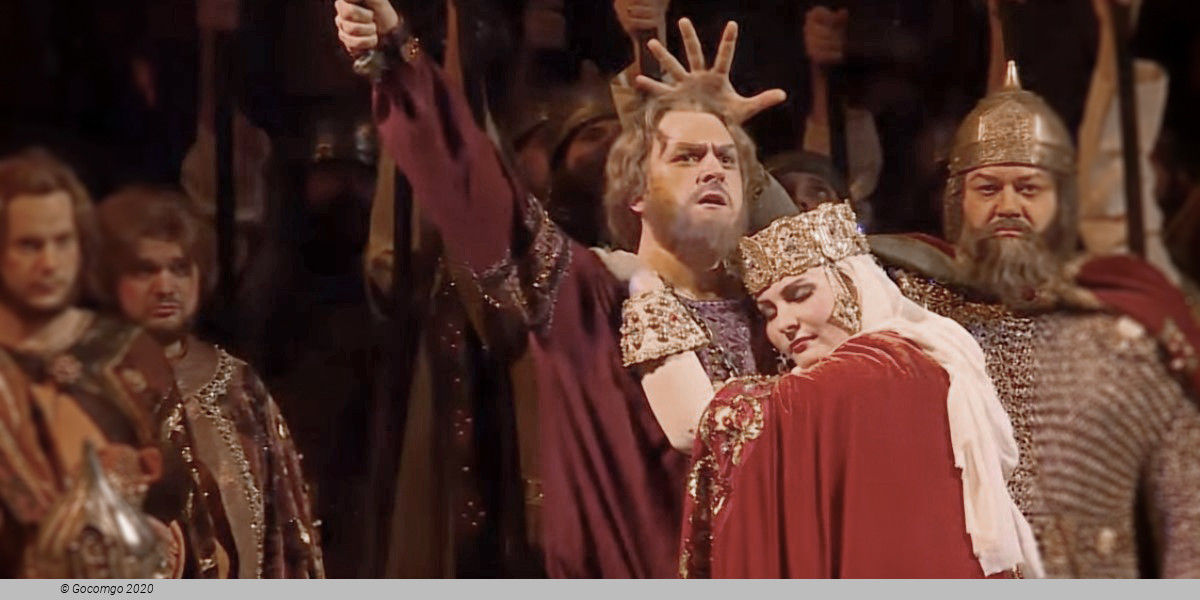
Prince Igor is preparing for a campaign against the Polovtsians. The people sing praise to Igor. All of a sudden, it grows dark – a solar eclipse begins. The people see an ill omen in it and plead with Igor to postpone the campaign. But the Prince has no doubt about the righteousness of the cause, he will defend his country from enemies, he will struggle for faith and his homeland. It is his duty.
Even the entreaties of Yaroslavna, the Prince’s faithful wife and partner cannot change his mind. Igor consoles her, giving assurances that she need not worry about him and should await his victorious return. He entrusts his wife to the care of her brother, Prince Vladimir Galitsky.
Igor, his son Vladimir and their army set out on the campaign. Unnoticed, two soldiers, Skula and Yeroshka, decide to desert. They drop their armour, intending to join the service of Prince Galitsky, where ‘there is mead, and ale, and food in plenty.’
Scene 2
Prince Galitsky’s courtyard. Drunken rabbles mock the abducted girl, another toy of the Prince, and sing praise to their master. Skula’s and Yeroshka’s buffoonery is entertaining and amusing. Prince Galitsky’s retinue is here, too, including all those dissatisfied with Igor’s rule. They support the power-seeking Galitsky in his lust for the throne.
Searching for his abducted daughter, the maiden’s father appears, but Galitsky’s guards prevent him from approaching their master. Girls run in the courtyard and implore Galitsky to set their friend free. But their entreaties are vain: Galitsky roughly banishes them. His retinue keeps on revelling, while the retainers, roused to fury and encouraged by Skula and Yeroshka, rush to the town square to praise their well-doer.
Scene 3
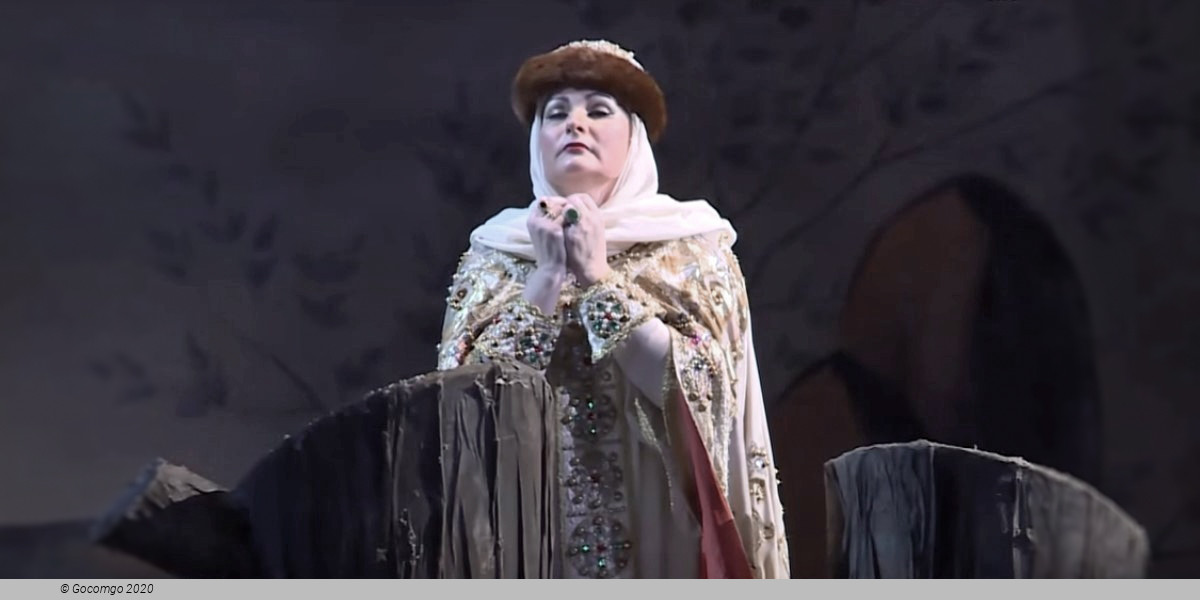
Princess Yaroslavna is tormented by alarm for her husband and his army: there has not been any news from Igor for a long time, so an unbearable sadness has gripped her heart. Her gloomy thoughts are interrupted by the abducted maiden’s girlfriends, joined by the rest of the women of Putivl. They beg the Princess to defend them from Galitsky’s high-handedness.
Galitsky enters and witnesses their complaints. With characteristic rudeness, he starts the conversation with accusations and abasements and threatens to depose Igor. Quite unexpectedly for Galitsky, the Princess stands up to him.
Boyars tell the Princess bad news that the Russian troop is defeated, and Igor and his son are taken, prisoner. The Princess is appalled at what has happened. Forced to prompt recovery, Yaroslavna leads the defence of Putivl. The boyars swear allegiance to her.
Galitsky rushes in the hall, followed by his retinue: the rebels demand that Yaroslavna be deposed and Galitsky be enthroned.
An alarm bell announces another tragedy: Gzak has approached Putivl, the suburbs are on fire, and the fields are ablaze. The critical moment forces everyone to face a challenge of fate and make their choice. The dwellers of Putivl thrust at the town walls. Galitsky leaves his retinue and attempts to flee. The boyars encircle Yaroslavna, ready to protect the Princess and the town.
Act 2
Scene 1
In Konchak’s camp, the Polovtsians carouse and revel, celebrating another victorious campaign against the Slavs. Khan Gzak has brought a number of Russian captives with him.
The khan’s daughter, Konchakovna, does not surrender to merriment: she is totally obsessed with the young prince Vladimir, Igor’s son. She craves a meeting with him, so she lets her maids go, hoping to see her beloved. The young man is consumed with the same desire. Night falls. The sweethearts meet at last. They tenderly and passionately vow love for each other. But the man’s confession that his father does not give his blessing to their marriage hurts Konchakovna and ruins her hopes for happiness. Hearing his father’s steps, Vladimir hurriedly bids farewell to his beloved. Konchakovna is intent on having him back.
Prince Igor has no peace. Not only the shame of defeat and the death of the squad oppress him: the terrible sight of hundreds of new prisoners, who are driven by the Polovtsians, and the realization of the impossibility to fight the enemy back and defend his land tears his heart. He knows that there is only one person who continues to believe in the return of his good name – his faithful and loving wife Yaroslavna.
Konchak, doing his best to make Igor his ally, holds him captive with honours. However, Igor remains adamant. To distract the Prince from his sobering thoughts, Konchak arranges a magnificent feast and Igor is designated a principal guest. Konchakovna, the khan’s dearest daughter, opens the celebration.
Everyone gets their trophy in exuberant and passionate, whirlwind and fiery Polovtsian dances: Konchakovna entices Vladimir, Konchak is triumphant and intoxicated with his own power, Gzak revels in the power of the Polovtsians... In the thick of the merriment, unbeknownst to all, Igor leaves the Polovtsian feast, but it cannot dampen Konchak’s good mood: the Polovtsian khans set out on sharing the booty.
In the dead of night, Igor decides to escape from captivity and takes his son with him. The Polovtsian encampment is asleep, but Konchakovna is not. Infatuated with Vladimir, she does not let her trophy go.
Scene 2
A square in Putivl. It’s been a long since Igor set off on his campaign. Again and again, Yaroslavna returns to the place where she took her to leave of her dearest husband. Her lamentation sounds like the lamentation of all women who have lost their husbands, sons, beloved ones on the battlefield.
Wandering around the town, Skula and Yeroshka are first to notice a rider approaching and recognize him as Igor. Hearing their cry, the people come running and joyfully welcome the return of the Prince. Yaroslavna can’t believe her happiness; she runs to her husband through the noisy crowd.
The people await the Prince’s word – it is the only thing that can raise their spirit and restore their faith in victory.
Epilogue
The people glorify Prince Igor and the unity of the defenders of Rus.
Time: The year 1185
Place: The city of Putivl (prologue, Acts 1 and 4); a Polovtsian camp (Acts 2 and 3)
Prologue
The cathedral square in Putivl
Prince Igor is about to set out on a campaign against the Cumans/Polovtsy and their Khans who have previously attacked the Russian lands. The people sing his praise and that of his son, the other leaders and the army (Chorus: "Glory to the beautiful Sun"). A solar eclipse takes place to general consternation. Two soldiers Skula and Yeroshka desert feeling sure that Vladimir Yaroslavich, Prince Galitsky, will offer them work more to their liking. Although Yaroslavna, Igor's wife, takes the eclipse for a bad omen, Igor insists that honour demands that he go to war. He leaves her to the care of her brother, Prince Galitsky, who tells of his gratitude to Igor for sheltering him after he was banished from his own home by his father and brothers. The people sing a great chorus of praise (Chorus: "Glory to the multitude of stars") as the host sets out on their campaign against the Polovtsy.
Act 1
Scene 1: Vladimir Galitsky's court in Putivl
Galitsky's followers sing his praise. Skula and Yeroshka are now working as gudok-players. They entertain the followers and all sing of how Galitsky and his men abducted a young woman and how she pleaded to be allowed to return to her father without being dishonoured. The prince arrives and sings of how, if he were Prince of Putivl, he would drink and feast all day while dispensing judgment and have the prettiest maidens with him all night (Galitsky's Song). The treasury would be spent on himself and his men while his sister would be praying in a monastery. A group of young women beg the prince to restore their abducted friend. He threatens them and drives them away, saying how she now lives in luxury in his quarters and does not have to work. The prince returns to his rooms having sent for wine for his followers. The gudok players and the prince's followers mock the women. They wonder what might happen if Yaroslavna hears of what happens, but then realise she would be helpless with all her men gone to war. They sing of how they are all drunkards and are supported by Galitsky. The men decide to go to the town square to declare Galitsky the Prince of Putivl, leaving just the two drunk musicians behind.
Scene 2: A room in Yaroslavna's palace
Yaroslavna is alone worrying about why she has not heard from Igor and his companions (Yaroslavna's Arioso). She sings of her tearful nights and nightmares and reminisces about when she was happy with Igor by her side. The nurse brings in the young women who tell Yaroslavna of their abducted friend. They are reluctant at first to reveal the culprit but eventually name Galitsky and talk of how he and his drunken followers cause trouble around Putivl. Galitsky enters and the women run away. Yaroslavna questions him as to the truth of their story and he mocks her saying she should treat him as a guest in her house. She threatens him with what Igor will do on his return, but Galitsky replies that he can seize the throne whenever he wants. Yaroslavna accuses him of repeating the betrayal that he carried out against their father, but he replies that he was only joking and asks if she has a lover now her husband is away. She threatens him with sending him back to their father. He replies that he will return the girl but will take another later and leaves. The council of boyars arrive to inform Yaroslavna that the Polovtsy under Khan Gzak are about to attack Putivl. Igor's army has been utterly destroyed and he has been wounded and captured with his son and brother. After a moment of faintness, Yaroslavna orders messengers sent to the city's allies, but the Boyars report that the roads are cut, some towns are in revolt and their princes will be captured. The Boyars say that they will organise the defence but Galitsky returns with his followers to demand that a new Prince be chosen. His retinue say it should be him as he is Yaroslavna's brother and Igor's brother-in-law. The boyars refuse. The argument is interrupted by the sight of flames and the sound of crying women. Some of the boyars flee; some join the battle, others guard the Princess. They call the attack God's judgment.
Act 2
Evening in the Polovtsian Camp
Polovtsian maidens sing comparing love to a flower that droops in the heat of the day and is revived by night. They dance together (Dance of the Polovtsian Maidens). Konchakovna joins in the singing hoping that her own lover will join her soon (Konchakovna's Cavatina). The Russian prisoners arrive from their day's work and express their gratitude when fed by Konchakovna and the maidens. Their guards retire for the night leaving just Ovlur, a Christian, in charge. Vladimir, son of Igor, sings of his hope that his love will soon join him now that the day is fading (Vladimir's Cavatina). His love is Konchakovna. She comes and the two sing of their love and their desire to marry (Love Duet). While her father will consent to the marriage, they know that his will not. They part when they hear Igor coming. He sings of his disgrace and torment at being captured with his followers dead (Prince Igor's Aria). Only his wife, he feels, will be loyal. He hopes for the chance to regain his honour. Ovlur urges Igor to escape and the prince agrees to think about it. Khan Konchak asks him if all is well (Konchak's Aria) and he replies that the falcon cannot live in captivity. Konchak says that as Igor did not ask for mercy he is not a prisoner but an honoured guest equal to a Khan. Igor reminds him that he too knows what it is to be a captive. Konchak offers Igor freedom if he will promise not to wage war on him again, but he refuses saying he cannot lie. Konchak regrets that they were not born to be allies. They would then have captured all of Russia. He summons the Polovtsian slaves to entertain Igor and himself and offers Igor his choice of them. As the slaves dance the Polovtsy sing of Konchak's glory (Polovtsian Dances).
Act 3
The Polovtsian camp
The Polovtsian army returns in triumph singing the praise of Khan Gzak (Polovtsian March). Konchak sings of the sack of Putivl and other victories and confidently predicts that they will soon capture all of Russia. Igor and his son Vladimir have their worst fears confirmed by the new captives. Vladimir and the other prisoners urge Igor to escape, but he is at first reluctant, singing of his shame and saying that it is the duty of the other Russian princes to save the homeland (Igor's Monologue, Mariinsky edition only). Ovlur now arrives to say that he has prepared horses for Igor and Vladimir and Igor now agrees to escape. The distressed Konchakovna comes, challenging Vladimir to show his love by either taking her with him or by staying. Igor urges his son to come, but Vladimir feels unable to leave Konchakovna who threatens to wake the camp. Eventually Igor flees alone and Konchakovna sounds the alarm. She and her father refuse to let the Polovtsy kill Vladimir. Instead Konchak orders the death of the guards and marries Vladimir to his daughter. As for Igor, Konchak thinks more of him for his escape.
Act 4
Dawn in Putivl
Yaroslavna weeps at her separation from Igor and the defeat of his army, blaming the very elements themselves for helping the enemy (Yaroslavna's Lament). Peasant women blame not the wind but Khan Gzak for the devastation. As Yaroslavna looks around to acknowledge the destruction, she sees two riders in the distance who turn out to be Igor and Ovlur. The two lovers sing of their joy of being reunited and of the expectation that Igor will lead the Russians to victory against the Khan. Unaware of Igor's return, Skula and Yeroshka, the drunken gudok players, sing a song that mocks him. Then they notice him in the distance. After a moment of panic about what will happen to them, Skula says that they should rely on their cunning and decides on a plan that will save them. They ring the church bells to summon a crowd. Although people at first treat them with suspicion, the gudok players manage to convince the crowd that Igor has returned and the boyars that they are loyal followers of the true prince and not Galitsky. All joyously celebrate Igor's return.




 Paryžskaj Kamuny Square, 1