
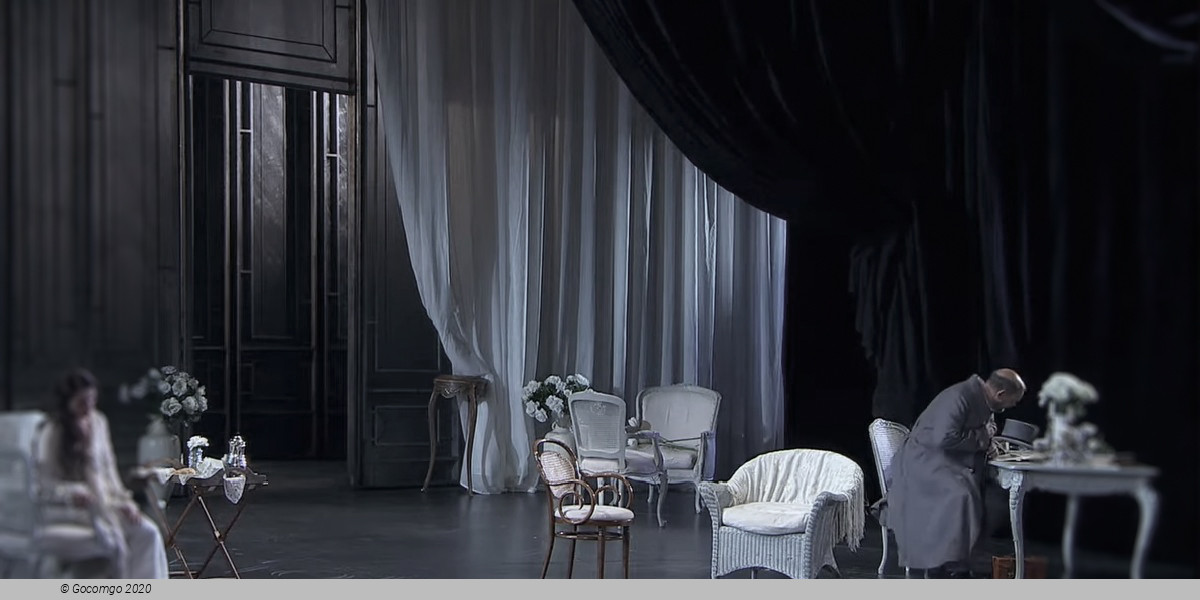
Belarus National Bolshoi Opera and Ballet Theater 29 May 2021 - La traviata | GoComGo.com

La traviata

Belarus National Bolshoi Opera and Ballet Theater, Minsk, Belarus
All photos (7)
Select date and time
7 PM
Request for Tickets
Important Info
Type: Opera
City: Minsk, Belarus
Starts at: 19:00
Acts: 4
Intervals: 3
Duration: 2h 45min
Sung in: Italian
Titles in: Russian

E-tickets: Print at home or at the box office of the event if so specified. You will find more information in your booking confirmation email.

You can only select the category, and not the exact seats.
If you order 2 or 3 tickets: your seats will be next to each other.
If you order 4 or more tickets: your seats will be next to each other, or, if this is not possible, we will provide a combination of groups of seats (at least in pairs, for example 2+2 or 2+3).

Overview
History
Premiere of this production: 06 March 1853, Teatro La Fenice, Venice

La traviata is an opera in three acts by Giuseppe Verdi set to an Italian libretto by Francesco Maria Piave. It is based on La Dame aux camélias (1852), a play adapted from the novel by Alexandre Dumas fils. The opera was originally titled Violetta, after the main character. It was first performed on 6 March 1853 at the La Fenice opera house in Venice.

Synopsis

Set in and around Paris in about 1850.

Act I

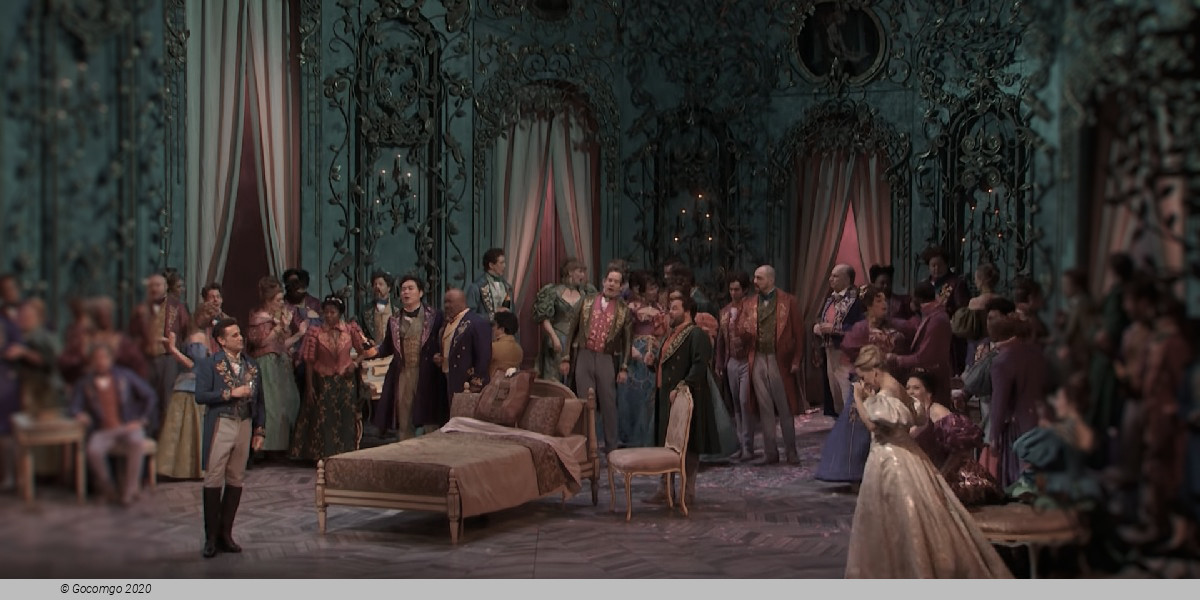
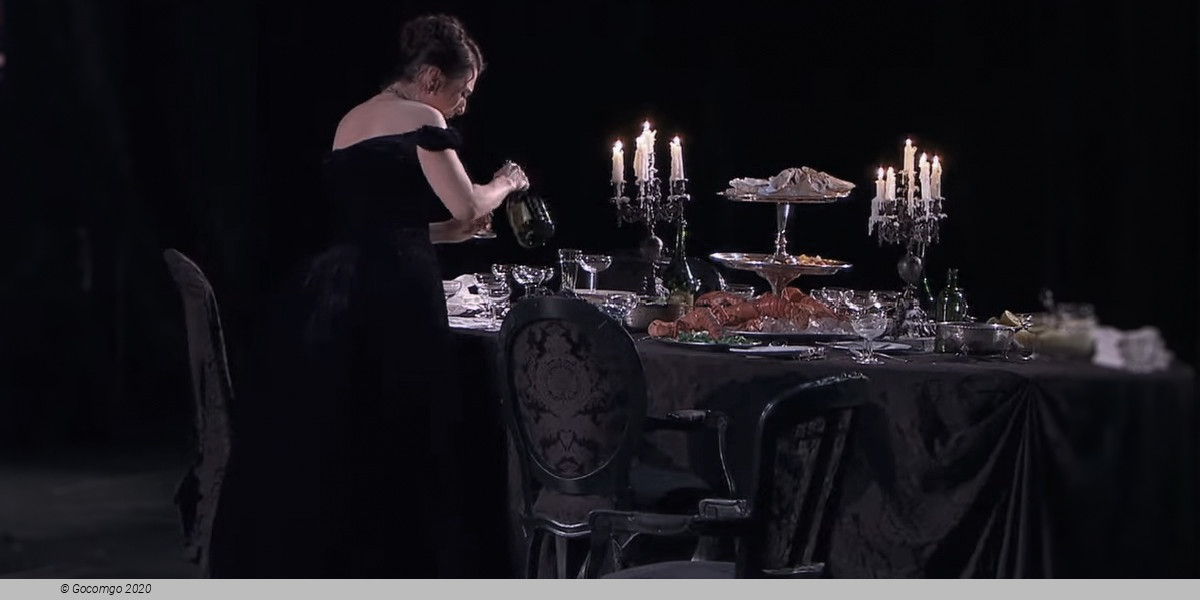
Violetta Valéry, a Parisian courtesan, greets the guests at her salon. Among them are Flora Bervoix, the Marchese D’Obigny, Baron Douphol and Gastone, who introduces Violetta to a new admirer of hers, Alfredo Germont. The young Germont, who has been admiring her from afar, joins her in a drinking song. An orchestra strikes up in an adjacent room, inviting the guests to dance. As the guests make their way to the ballroom, Violetta, who is suffering from consumption, feels faint; she therefore sends the guests on ahead and retires to her boudoir to recover. Alfredo enters and, realising that they are alone, admits his love for her. She replies that love means nothing to her. She
is, however, touched by the young man’s sincerity and promises to meet him the following day.
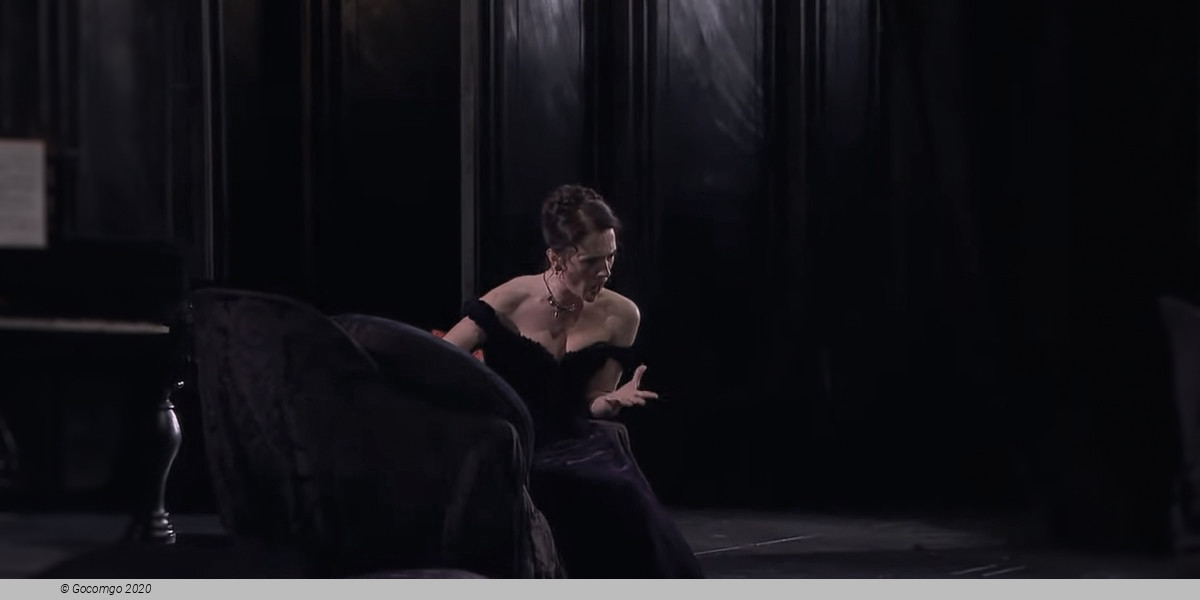
When the guests have departed, she asks herself whether Alfredo is the man she could love. Despite
the strains of Alfredo’s love song drifting in from outside, she decides she prefers her freedom.

Act II

scene 1
A few months later: Alfredo and Violetta have set up house together in the country, outside Paris. Alfredo says how happy they are, but when Violetta’s maid Annina lets on that Violetta has been selling her belongings to pay for the house, he hastens into town to raise the money himself. Violetta comes in search of him and discovers an invitation from her friend Flora to a soirée that very night. Violetta has no intention of returning to her former life, but she is forced to reconsider
on encountering Alfredo’s father. He is very taken with Violetta and her civilised manners but orders her to renounce Alfredo: his son’s scandalous liaison with Violetta is threatening his daughter’s forthcoming marriage. Violetta considers his demand unreasonable, but before long Germont succeeds in persuading her. Alone and desolate, Violetta sends a reply to Flora accepting her invitation and sits down to write a farewell letter to Alfredo. His return takes her by surprise, and she can barely restrain herself as she passionately reminds him how much she loves him before
rushing out. As the maid brings him Violetta’s farewell letter, Germont returns to console his son and reminds him of life in their family home in Provence. Alfredo spots Flora’s invitation and suspects that Violetta has left him for another man. In a rage, he decides to confront her at the soirée.

scene 2
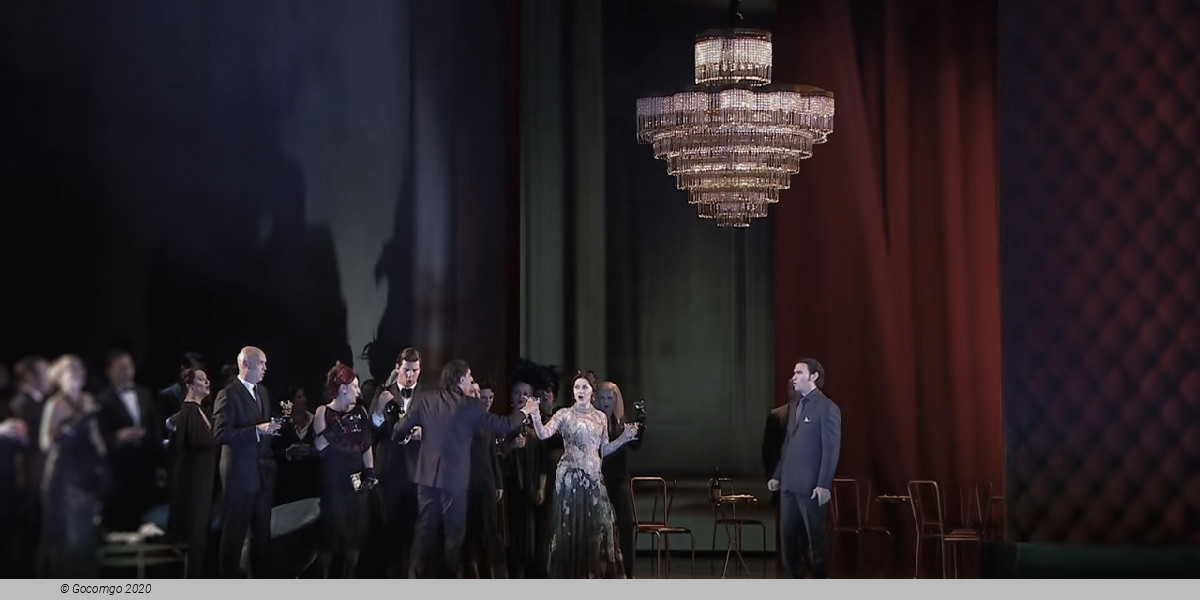
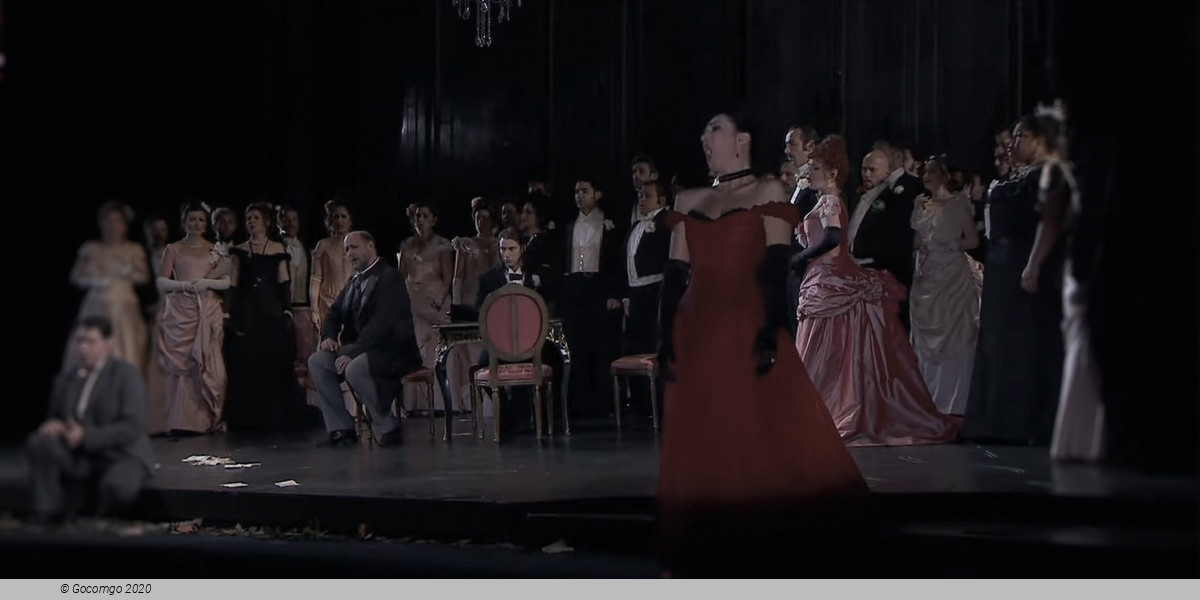
At the soirée, Flora hears from the Marchese that Violetta and Alfredo have parted. Flora asks the guests to make way for a visiting troupe of performing gypsies. They are followed by matadors and a song about Piquillo and his sweetheart. Alfredo rushes in and delivers some bitter comments about love and gambling. Violetta appears on the arm of Baron Douphol, who challenges Alfredo to a game of cards and loses a small fortune to him. As the guests go in to supper, Violetta asks to have a word with Alfredo in private. She is afraid the Baron will be enraged by his loss and urges Alfredo to leave. Alfredo misunderstands her and orders her to admit she loves the Baron. Disappointed by Alfredo’s reaction, Violetta lies and confesses that yes, she does. Alfredo calls the other guests to gather round in order to denounce his former beloved in public and throws the money he has won at her feet. Germont, arriving at that very moment, expresses his disapproval of his son’s behaviour. The guests likewise rebuke Alfredo and Douphol challenges him to a duel.

Act III

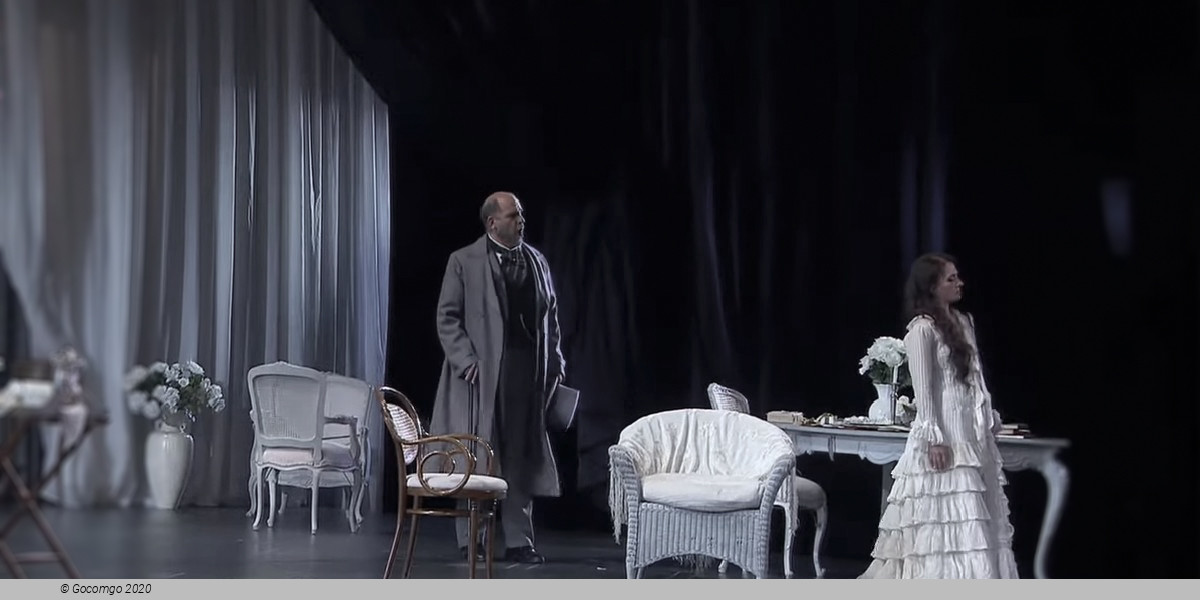
Violetta’s bedroom, six months later. Dr Grenvil tells Annina that her mistress has not long to live –
the consumption has taken its toll. Alone, Violetta rereads a letter from Germont saying that the Baron was only slightly wounded in his duel with Alfredo, that Alfredo has heard the truth and is
coming to beg her pardon. But Violetta realises it is too late. It is carnival time in Paris and, the sounds of the revellers having passed, Annina rushes in to announce Alfredo. The lovers ecstatically plan to leave Paris. Germont enters with the doctor just as Violetta rises from her bed with the last of her strength. Feeling a sudden rush of life, she sways and falls dead at her lover’s feet.

Venue Info

Belarus National Bolshoi Opera and Ballet Theater - Minsk
Location   Paryžskaj Kamuny Square, 1

The National Academic Grand Opera and Ballet Theatre of the Republic of Belarus is located in a park in the Trinity Hill district of Minsk. Local people call it the "Opierny Teatr" (Belarusian) or the "Opera and Ballet Theatre." While the theatre opened on 15 May 1933, in the beginning, it did not have its own performance venue. Until 1938, the troupe performed at the Belarusian Drama Theatre building.

The first permanent theatre was founded in Belarus in 1933 based on the Belarusian Opera and ballet school; the founder of the studio was a famous Russian Opera singer Anton Bonachich (Belarusian: Anton Bonatschitsch). Shortly after, Bonachich died in 1933.

The current theatre's building was opened in 1939. It was designed by the Belarusian architect from Leningrad, Iosif Langbard, whose original design was only partially implemented; some design details were omitted for financial reasons. The theatre has reliefs done by Zair Azgur.

Bizet's Carmen opened the theatre on 25 May 1933 with the title role being sung by Larisa Aleksandrovskaya. Several professional soloists and dancers were added to the troupe in the first few years at this location. Swan Lake, performed by K. Muller, was the first show on the stage of the new theatre. By 1940, Grand was added to the theatre's name to indicate its expansion. The performances by the theatre company during the "Decade of Belarusian Art" in Moscow in June 1940 was a great success which included the first Belarusian ballet, The Nightingale composed by Mikhail Kroshner, as well as other national operas such as "In the Dense Forest of Palesse", "The Flower of Fortune", and the second version of "Mikhas Podgorny". Performances continued during the war in Nizhny Novgorod, then known as Gorky until the liberation of Minsk in 1944; after that performances took place in Kovrov.

Enrichment of post World War 2 repertoire and expansion

During this time the repertoire was greatly enriched. The most famous operas staged in this theatre include Boris Godunov by Modest Mussorgsky, Otello and Don Carlo by Giuseppe Verdi, Jacques Offenbach's The Tales of HoffmannSadko and The Golden Cockerel by Nikolai Rimsky-Korsakov, and Lohengrin by Richard Wagner. Socialist realist operas by Belarusian composers such as Yuri Semenyako, Yevgeny Glebov (Your Spring, 1963) and Heinrich Wagner were included.

Among the most notable composers has been Kulikovich Shcheglov, who like some of the writers went into exile after the war. Others include Yevgeny Glebov, composer of the opera Your Spring (1963) and the ballet Alpine Ballad (1967), ..." In 1967, the theatre was awarded the title of Academic for its status in the progression of the performing arts.

In 1996 the State Theater was divided into two independent theatres: the National Academic Grand Ballet Theatre of the Republic of Belarus and the National Academic Opera Theatre of Belarus, but in 2008 they once again combined to become the present name, National Academic Grand Opera and Ballet Theatre of the Republic of Belarus.

The building was renovated and it reopened in 2009. Many sculptures were added around the theatre, its stage was slightly moved and audience space expanded. The most up-to-date lighting and motion equipment were added while adhering to the original design. The ballet company is considered one of the foremost companies in the world.

The theatre today

Works by Belarus composers in the company's repertoire today include Dmitry Smolsky's The Grey Legend (Russian "Седая легенда" 1978).

The troupe tours internationally. Fans from Spain, Russia, Germany, Poland, Switzerland, Israel, Portugal, and China are well acquainted with the repertoire of the Belarusian theatre. National Opera and Ballet of Belarus performs annually at the German festival "Classic Open Air."

Important Info
Type: Opera
City: Minsk, Belarus
Starts at: 19:00
Acts: 4
Intervals: 3
Duration: 2h 45min
Sung in: Italian
Titles in: Russian
Top of page