
Teatro Nacional de Sao Carlos 25 January 2020 - Maria Stuarda | GoComGo.com

Maria Stuarda

Teatro Nacional de Sao Carlos, Lisbon, Portugal
All photos (6)
Select date and time
8 PM
Request for Tickets
Important Info
Type: Opera
City: Lisbon, Portugal
Starts at: 20:00
Duration:

E-tickets: Print at home or at the box office of the event if so specified. You will find more information in your booking confirmation email.

You can only select the category, and not the exact seats.
If you order 2 or 3 tickets: your seats will be next to each other.
If you order 4 or more tickets: your seats will be next to each other, or, if this is not possible, we will provide a combination of groups of seats (at least in pairs, for example 2+2 or 2+3).

Overview

'IMPURA,… MERETRICE, INDEGNA, OSCENA,… VIL BASTARDA' (Act I)

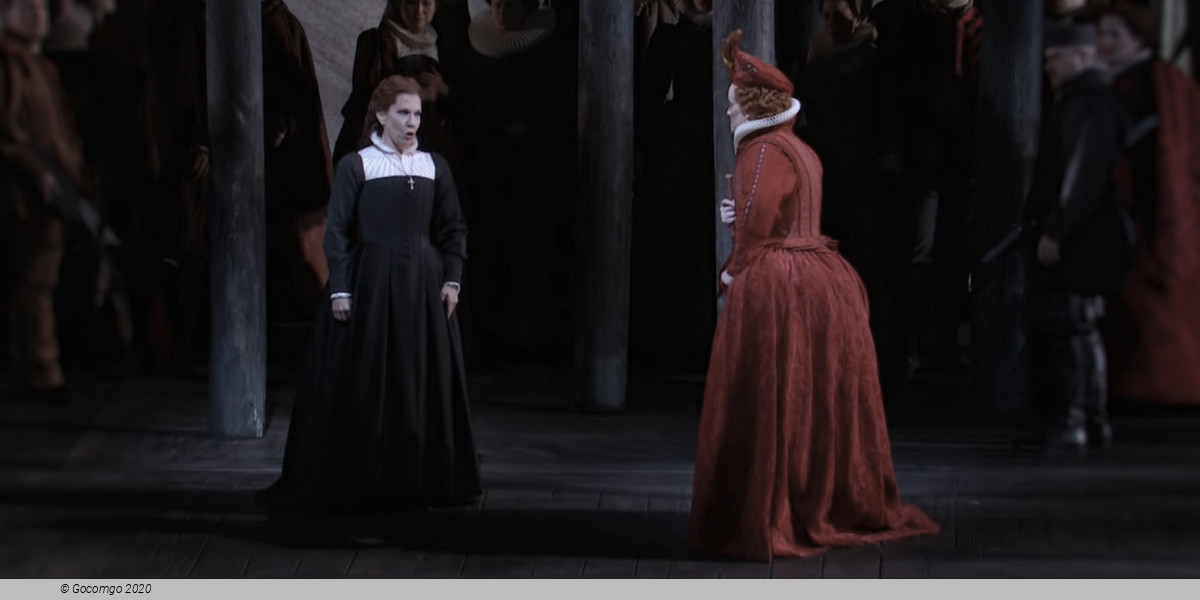
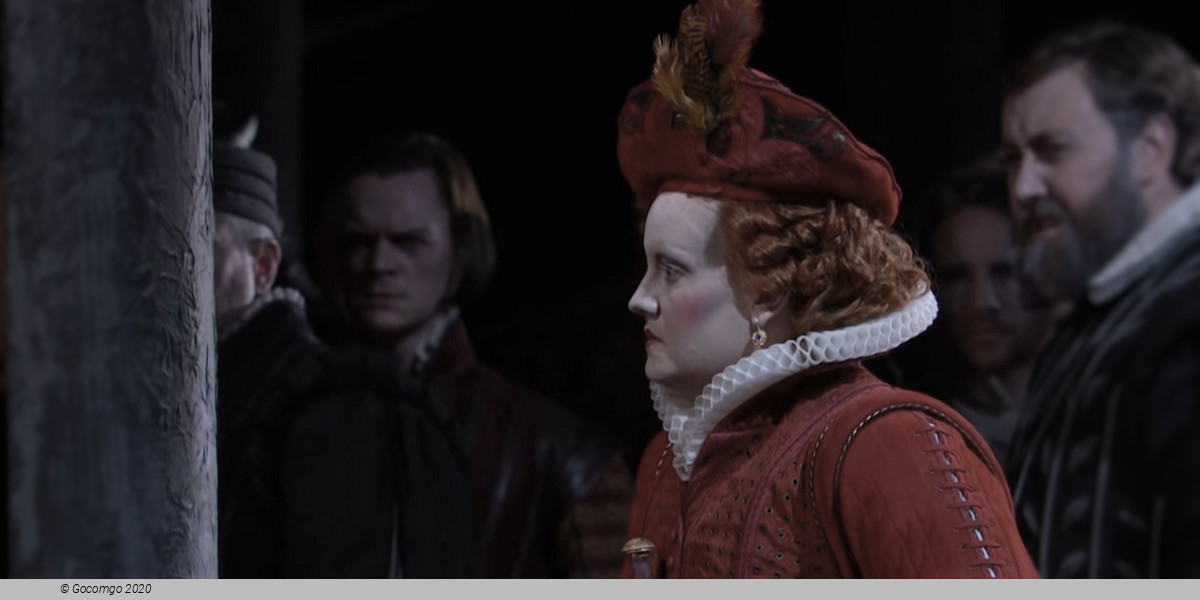
The bloody English Tudor Period exerted enormous attraction over romantic lyrical composers, especially Italians. Gaetano Donizetti's Maria Stuarda (which culminates in a beheading!) Is one of the strongest proofs of this fascination. In this opera, the historic relentless struggle between Maria Stuarda and Elisabetta can easily turn into a true vocal 'star war', with weapons, arguments (and insults) drawn from Belcanto's prodigious arsenal.
Having been premiered in San Carlos in 1844 and listened to once a century, the title returns in the 21st century under the musical direction of Fabrizio Maria Carminati. As interpreters of the two queens we will have singers already known and applauded by our audience: Ekaterina Bakanova (La traviata) will express the anguish of Maria Stuarda and Alessandra Volpe (I Capuleti and i Montecchi) will give voice to Elisabetta.

History
Premiere of this production: 30 December 1835, La Scala, Milan

Maria Stuarda (Mary Stuart) is a tragic opera (tragedia lirica), in two acts, by Gaetano Donizetti, to a libretto by Giuseppe Bardari, based on Andrea Maffei's translation of Friedrich Schiller's 1800 play Maria Stuart.

Synopsis

Place: Palace of Westminster, London and Fotheringhay Castle, Northamptonshire, England.
Time: The year 1587.

Act 1

Scene 1: Elisabetta's court at Westminster

The Lords and Ladies of the Court enter after a tournament to honor the French ambassador, who has brought a marriage proposal to Queen Elizabeth from the Dauphin François. They express their joy as Elizabeth enters. She considers the proposal, one which would create an alliance with France, but she is reluctant to give up her freedom and also pardon her cousin Mary Stuart, the former Queen of Scots, whom she has imprisoned because of various plots against her throne (Cavatina: Ahi! quando all'ara scórgemi / "Ah! when at the altar a chaste love from heaven singles me out"). Elizabeth expresses her uncertainty while at the same time, Talbot and the courtiers plead for Mary's life (Cabaletta: Ah! dal Ciel discenda un raggio / "Ah! may some ray descend from heaven").

Just as Elizabeth inquires where Leicester is, he enters and Elizabeth tells him to inform the French ambassador that she will indeed marry François. He betrays no signs of being jealous, and the Queen assumes that she has a rival.

Alone with Leicester, Talbot reveals to him that he has just returned from Fotheringay and gives a letter and a miniature portrait of Mary. Joyously, Leicester recalls his love for Mary (Aria of Leicester, then duet with Talbot: Ah! rimiro il bel sembiante / "Ah! Again I see her beautiful face"). Talbot asks what he intends to do and Leicester swears to try to free her from her imprisonment (Vuò liberarla! Vuò liberarla! / "I want to set her free").

Talbot leaves and, as Leicester is about to do so, Elizabeth enters. Clearly knowing what has gone on between the two men, she questions him, asks about a letter from Mary, and then demands to see it. Reluctantly, Leicester hands it over, noting that Mary has asked for a meeting with her cousin and he pleads with the Queen to agree to do so. Also, upon her questioning, he confesses his love for Mary (Duet of Leicester and Elizabeth: Era d'amor l'immagine / "She was the picture of love"). Told that Elizabeth can join a hunting party on the estates where Mary is imprisoned, she agrees to the meeting, albeit with revenge on her mind (Cabaletta to the duet: Sul crin la rivale la man mi stendea / "Over my head my rival stretched out her hand").

Scene 2: Fotheringay Castle

[In many modern performances this scene is called Act 2, with the final act becoming Act 3. Donizetti scholar William Ashbrook in Grove Dictionary notes that the opera is "in two or three acts".]
Mary reflects on her youth in France with her companion, Anna (Cavatina: Oh nube! che lieve per l'aria ti aggiri / "Oh cloud! that wanders light upon the breeze"). The sounds of a royal hunt are heard and, hearing the hunters cry out that the Queen is close by, Mary expresses her disgust (Cabaletta: Nella pace del mesto reposo / "In the peace of my sad seclusion, she would afflict me with a new terror"). To her surprise, Leicester approaches and warns Mary of Elizabeth's imminent arrival, counseling her to behave humbly towards the Queen, who is then despondent (Duet: Da tutti abbandonata / "Forsaken by everyone… my heart knows no hope"). But assuring Mary that he will do whatever is necessary to obtain her freedom, Leicester leaves her to meet Elizabeth. He then attempts to plead with the Queen for her forbearance.

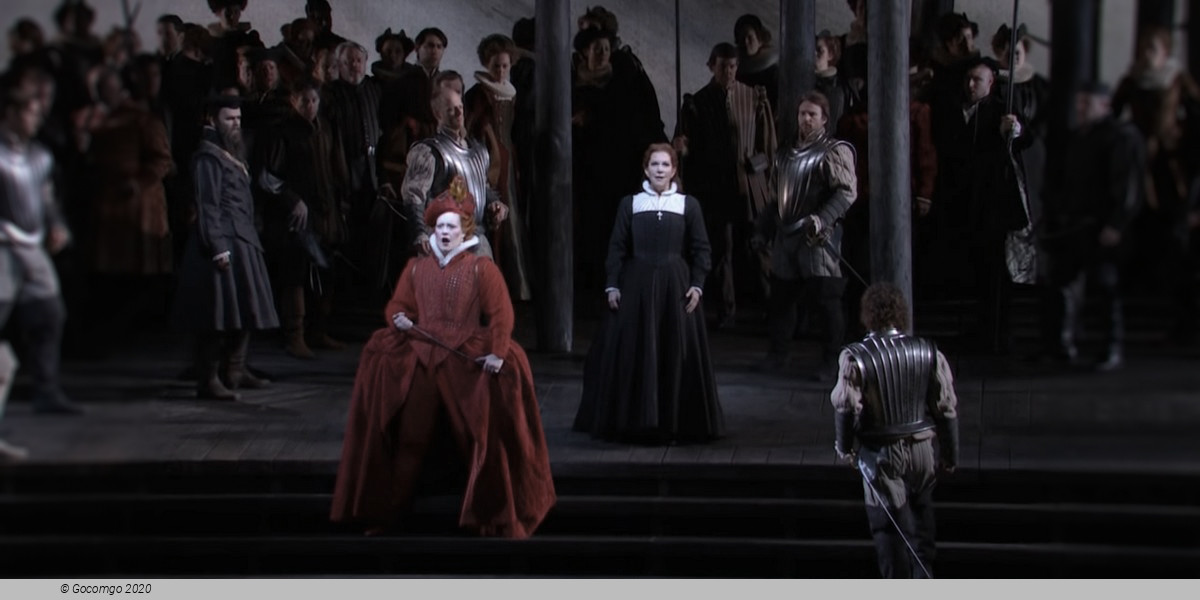
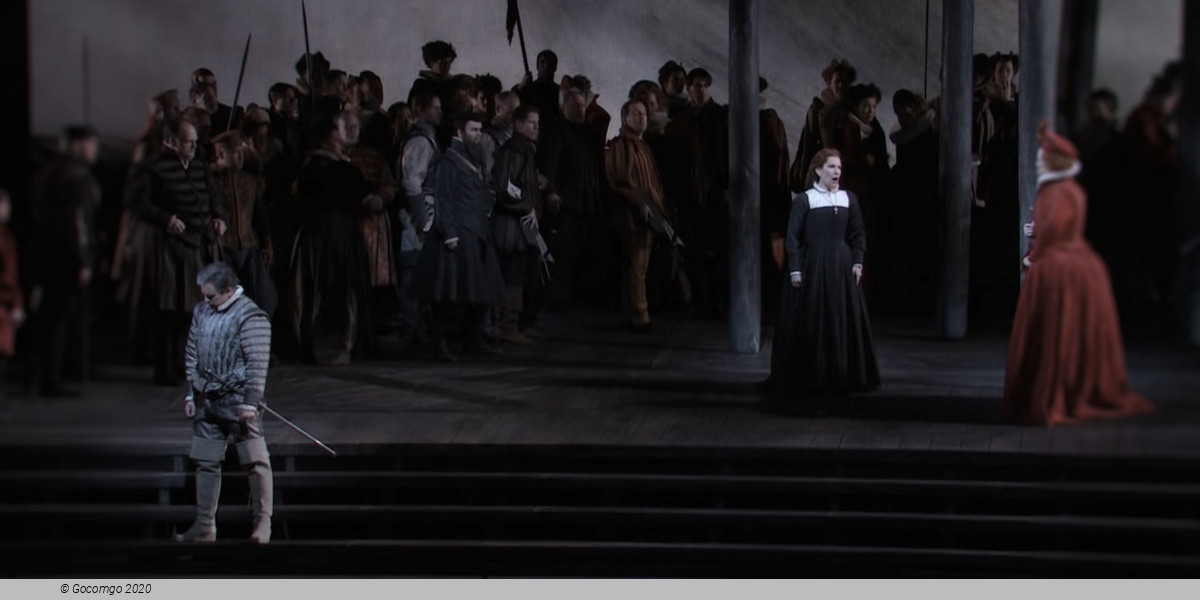
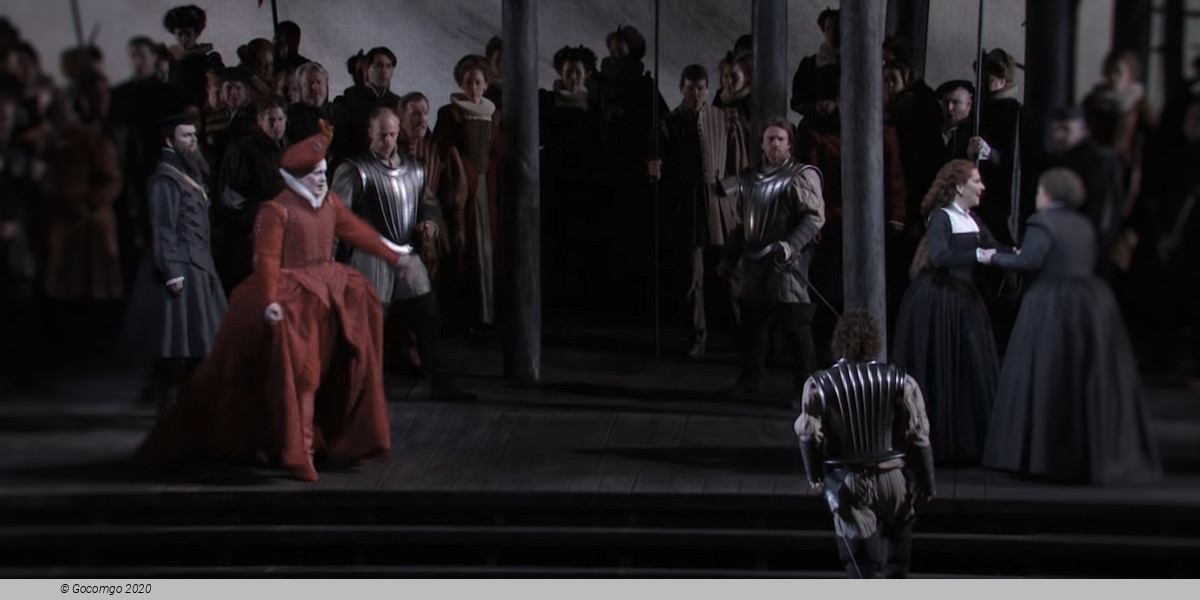
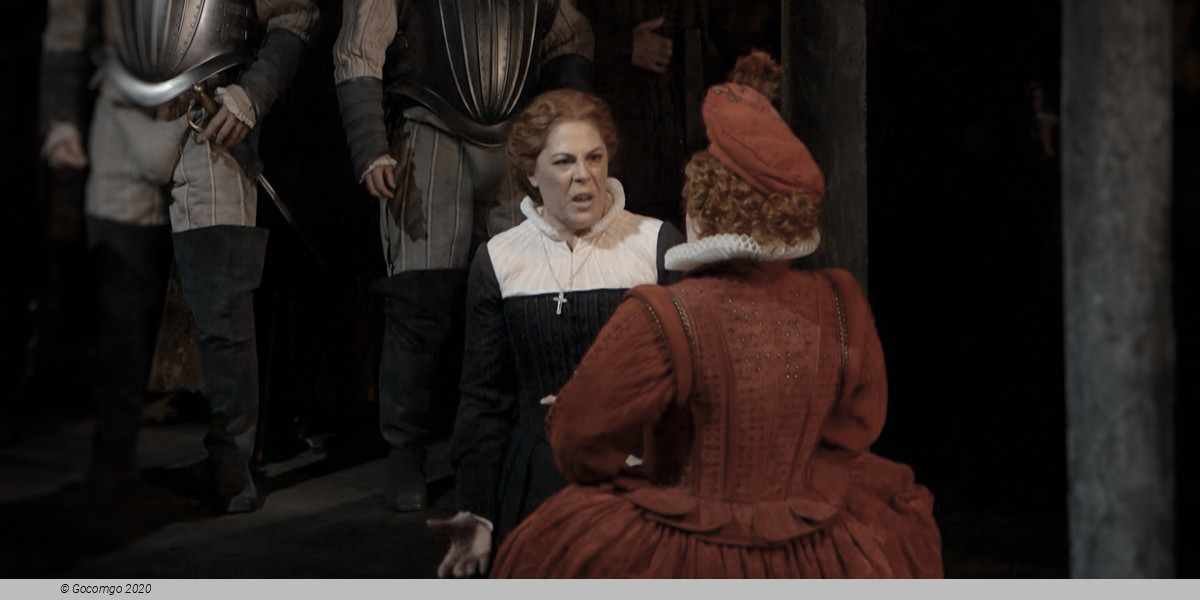
When Mary is brought in by Talbot, Elizabeth reacts with hostility (È sempre la stessa: superba, orgogliosa / She is always the same, proud, overbearing") and, after each character collectively expresses his or her feelings, Mary approaches and kneels before the Queen (Aria: Morta al mondo, ab! morta al trono / "Dead to the world, and dead to the throne… I come to beg your pardon"). The confrontation soon becomes hostile. Elizabeth accuses Mary of having murdered her husband, Lord Darnley, as well as acts of treason and debauchery, all the while Leicester attempting to calm both sides. Stung by Elizabeth's false accusations, Mary calls her the Figlia impura di Bolena ("Impure daughter of Boleyn") and continues with the final insult: Profanato è il soglio inglese, vil bastarda, dal tuo piè! ("The English throne is sullied, vile bastard, by your foot"). Elizabeth is horrified and demands that the guards take Mary away, declaring "The axe that awaits you will show my revenge". Mary is returned to captivity.

Act 2

Scene 1: A room in Elisabetta's apartments

Cecil enters with the death warrant and attempts to persuade her to sign it. While she hesitates, Elizabeth contemplates the situation (Aria: Quella vita a me funesta / "That life, so threatening to me"). Cecil urges her to sign it "so that every ruler will know how to pardon you for it" and, as she is about to do so, Leicester arrives. Seeing him, Elizabeth exclaims "you are hastening the execution" and signs the death warrant. Leicester pleads for mercy, Elizabeth rejects the plea, and Cecil urges her to remain firm (Trio Deh! per pietà sospendi l'estremo colpo almeno / "Alas! For pity's sake spare the final blow at least"). The confrontation ends with Elizabeth holding firm despite Leicester's accusations of cruelty; she orders him to witness Mary's execution.

Scene 2: Maria's room

Mary contemplates her fate, and that of Leicester also: "I have brought misfortune to all". Talbot and Cecil enter and Cecil tells Mary that he holds her death warrant. After Cecil leaves the room, Talbot informs her that Leicester has been ordered to witness her execution. Beside herself with grief, Mary imagines that the ghost of Lord Darnley is in the room with her, while Talbot offers comfort (Duet: Quando di luce rosea il giorno a me splendea / "While with the light of dawn my life still sparkled"). However, Talbot then presses her about "one more sin": her "unity with" ("uniti eri") Babington, to which she initially responds "Ah! be silent; it was a fatal error", but, when he insists, adds that "dying my heart affirms it."

Scene 3: The courtyard at Fotheringay

People gather at the site of the execution, lamenting that a queen's death will bring shame upon England. Mary enters and says her farewells to the crowd, which includes Talbot, telling them she will be going to a better life. She calls them to a final prayer (Mary, with Chorus: Deh! Tu di un úmile preghiera il suono odi / "Ah! May Thou hear the sound of our humble prayer") and, together, she and the crowd pray for God's mercy. When Cecil arrives to tell her that the time for her execution has come, he informs her that Elizabeth has granted her final wishes, including allowing Anna to accompany her to the scaffold. Then Mary offers a pardon to the queen (Mary, Anna, Talbot, Cecil, chorus: Di un cor che more reca il perdóno / "From a heart that is dying, may pardon be granted"). Leicester comes to bid her farewell. Both are distraught and he expresses outrage. Mary asks him to support her at the hour of her death and protests her innocence once again (Aria: Ah! se un giorno da queste ritorte / "Ah! Though one day from this prison your arm wanted to abduct me, now you lead me to my death"). She is then led to the scaffold.

Venue Info

Teatro Nacional de Sao Carlos - Lisbon
Location   R. Serpa Pinto 9

The Teatro Nacional de São Carlos is an opera house in Lisbon, Portugal. It was opened on July 30, 1793 by Queen Maria I as a replacement for the Tejo Opera House, which was destroyed in the 1755 Lisbon earthquake. The theatre is located in the historical center of Lisbon, in the Chiado district.

In 1792, a group of Lisbon businessmen decided to finance the construction of a new Opera House in the city. The theatre was built in only six months following a design by Portuguese architect José da Costa e Silva, with neoclassical and rococo elements. The general project is clearly inspired by great Italian theatres like the San Carlo of Naples (interior) and La Scala in Milan (interior and façade). In the early 19th century, when the Portuguese Royal Court had to flee to the Portuguese colony of Brazil to escape the invading Napoleonic troops, a theatre modelled on the São Carlos was built in Rio de Janeiro.

The theatre was erected in honor of Princess Charlotte of Spain who had been married in 1785 at the age of 10 to the future King, Prince John and resided with him from 1790 once she was of childbearing age: Carlos (Portuguese form of Charles) is the masculine form of Charlotte. A Latin commemorative inscription dedicates the theatre to the princess.

The first opera presented here, in 1793, was La Ballerina Amante, by Domenico Cimarosa. The most famous Portuguese composer of the time, Marcos Portugal, became musical director of the São Carlos in 1800 after returning from Italy, and many of his operas were staged here.

Between 1828 and 1834, the São Carlos was closed during the Portuguese Civil War, fought between kings Miguel I and Pedro IV. In 1850, the lighting of the interior was changed to gas illumination, the latest technology available. Shortly afterwards, the Portuguese state bought the theatre from private investors. After a few failed attempts, electrical illumination was installed in 1887. From 1935 to 1940, the theatre was closed for repairs.

In 1974, a resident opera company was established. In 1993, the Orquestra Sinfónica Portuguesa was created as the Teatro's affiliate orchestra, with Álvaro Cassuto as the orchestra's first principal conductor. Subsequent principal conductors of the Orquestra Sinfónica Portuguesa have included José Ramón Encinar (1999–2001), Zoltán Peskó (2001–2004) and Julia Jones (2008–2011). Since January 2014, the orchestra's principal conductor is Joana Carneiro.

The theatre building was classified as Property of Public Interest in 1928 and has been reclassified as a National Monument since 1996.

Longitudinal and composite building with articulated parts has a sober facade. The frontispiece is divided into 3 parts: 2 floors on mezzanine and a third floor on the central body. This central body is torn by a portico (entrance hall), and has a loggia at the ground level composed of 3 frontal arches and a lateral, in perfect round. The loggia is crowned by a perfect terrace of balustrade in stonework. Here, the windows are framed by parastase, that supports a highlighted cornice. They also have a crown composed of panels with inscription and two high reliefs. At the level of the third floor, this same central body presents a clock surrounded by garlands and two windows, all of which is surmounted by two pinnacles and the Portuguese coats-of-arms.

At the level of the first floor, the two side bodies have two straight-polished doors crowned by low windows. Although with the same two windows, at the second floor level they feature balustrade in stonework, protruding cornice and a small window in the mezzanine area.

The main room (performance hall) is elliptic, has five tiers of boxes and seats 1148 people. The luxurious royal box was lavishly decorated by the Italian Giovanni Appianni. The ceiling was painted by Manuel da Costa and the stage by Cirilo Wolkmar Machado.

Important Info
Type: Opera
City: Lisbon, Portugal
Starts at: 20:00
Duration:
Top of page