
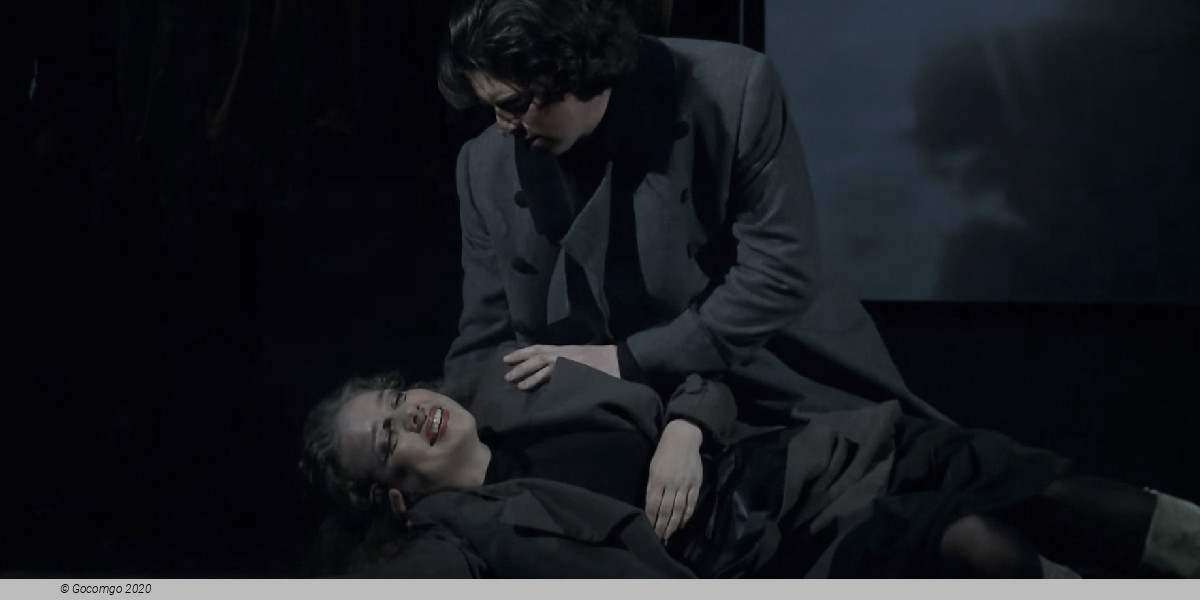
Bregenz Festspielhaus 24 July 2022 - Siberia | GoComGo.com

Siberia

Bregenz Festspielhaus, Bregenz, Austria
All photos (6)
Select date and time
11 AM
Request for Tickets
Important Info
Type: Opera
City: Bregenz, Austria
Starts at: 11:00
Acts: 3
Sung in: Italian
Titles in: German

E-tickets: Print at home or at the box office of the event if so specified. You will find more information in your booking confirmation email.

You can only select the category, and not the exact seats.
If you order 2 or 3 tickets: your seats will be next to each other.
If you order 4 or more tickets: your seats will be next to each other, or, if this is not possible, we will provide a combination of groups of seats (at least in pairs, for example 2+2 or 2+3).

Festival

Bregenz Festival 2022

Enthusiastic visitors, impressive productions and a lot of positive reporting in the media – three days before the 76th season ends, the Bregenz Festival can look back on a highly varied summer of culture, the first production of which was staged back at Easter. The opera on the lake stage attracted visitors in droves again. Madame Butterfly production played on 26 dates in all, including dress rehearsal and Crossculture Night. The opera by Giacomo Puccini, which was staged for the first time on the Bregenz lake stage, has played to capacity audiences. The festival season began on the Easter weekend with guest performances of the play No Exit (Huis clos) presented by Vienna’s Burgtheater.

Overview

Two young artists from Moscow bring the stirring opus to the Festspielhaus: the internationally aspiring director Vasily Barkhatov and Valentin Uryupin, who already conducted Eugen Onegin in Bregenz.

It is a dreadful act of love when Stephana gives up her life as a mistress at an elegant townhouse in St. Petersburg to follow her true love Vassili to a Siberian prison camp. In their exile, Stephana turns into a fearless hero, fights inequality and slander. In the middle of this dead end situation, hope flickers among the prisoners. What seemed impossible is now suddenly in reach: the couple is about to flee. Then, a shot is fired.

In his Italian opera Siberia, Umberto Giordano portrays asensational and dense plot, emotionally charged characters and an impressive choir in the style of Verismo. Fascinating Russian sounds ranging from the former national anthem of Russia, “God Save the Tsar!” to the traditional “Song of the Volga Boatmen” are embedded within the dramatic music.
For Giordano, who also composed Andrea Chénier and Fedora, Siberia is a universally applicable human drama despite its local color: "Love and pain do not have a nationality".

As a member of the "Giovane Scuola", the "Young School", Giordano opposes Giuseppe Verdi’s omnipresence in the playbills, fuels realism in the opera and orientates himself towards Richard Wagner and Jules Massenet. Siberia premiered in 1903 in La Scala in Milan replacing Giacomo Puccini’s postponed Madama Butterfly.

History
Premiere of this production: 19 December 1903, La Scala, Milan

Siberia is an opera in three acts by Umberto Giordano from a libretto by Luigi Illica. It premiered on 19 December 1903 at La Scala in Milan. There is no direct source for the plot of Siberia and it is quite possible that this is an original work by Illica. It was suggested at the New York premiere that it was based on Leo Tolstoy's 1899 novel Resurrection or one of the novels within it.

Synopsis

Place: Russia
Time: First half of the 19th century.

Act 1: "The Woman"
Saint Petersburg, August, during the Festival of Saint Alexander

Stephana is the mistress of Prince Alexis, living in an elegant palace, who was once seduced by Gleby, a scoundrel, who sold her to the Prince and has been living off a pension granted to him by the Prince. Stephana loves Vassili, a Lieutenant who corresponds with her but assumes she is a simple working girl, because they always meet in disguise outside her house. When summoned to war he goes to meet Stephana and learns the truth about her, but he is still smitten with her. The Prince enters and demands an explanation which develops into a duel during which Vassili kills the Prince with his sword; he is detained and sent to the police.

Act 2: "The Lover"
The frontier between Russia and Siberia in winter

Several prisoners are making their way through the snow on foot to the mines where they are forced to work. Amongst them is Vassili worn almost out, he is despairing, a group of women and children are waiting along the road to bid farewell to the prisoners. Stephana arrives in a sleigh, she has left all to join her beloved in whatever fate awaits him, she does not listen to his pleas to return, when ordered to, they both march into the vastness of Siberia.

Act 3: "The Heroine"
A hut of convicts in the mines of Trans-Baikal on the eve of Russian Easter

Due to the upcoming festivities, the prisoners are allowed to organize a feast. Stephana, excited by this, devises a scheme with an old convict to escape with Vassili, but Gleby has arrived to the prison camp after finally being arrested in one of his many crimes. He recognizes Stephana and insults her in front of everybody, including Vassili, who tries to defend her but is stopped by the other inmates. The church bell rings and prayers start. During the night Vassili and Stephana execute their plan to escape, but Gleby gives the alarm, the troops pursue the prisoners and a shot is heard, they bring Vassili back and carry Stephana, who was wounded, she bids farewell to Vassili and dies.

Venue Info

Bregenz Festspielhaus - Bregenz
Location   Platz der Wr. Symphoniker

The Bregenz Festspielhaus is an event center in Bregenz and was opened in July 1980. It is the venue for the Bregenz Festival and the venue for conferences, congresses, and events. The operator of the Congress culture Bregenz GmbH, a wholly-owned subsidiary of the state capital Bregenz is.

In 1990, architectural competition for an extension of the building was announced, which was won by the architects Helmut Dietrich and Much Untertrifaller, based in Bregenz and Vienna, with their architectural office of the same name, Dietrich/Untertrifaller. The concept envisaged a two-stage expansion of the existing building.

The first part of the extension was built in 1996/1997, including the workshop stage with side stage, lake studio, lake foyer, central kitchen, and the new administrative part of the house.

In 2005/2006, the existing building from 1980 was completely renovated and expanded by 10,000 cubic meters. The "Platz der Wiener Symphoniker" in front of the Festival and Congress Hall was redesigned as part of an "Art and Construction" project.

The approximately 7-meter high sculpture "Ready Maid" was created by Gottfried Bechtold. According to the renowned Vorarlberg artist, the inverted tree made of polished bronze is a striding tree woman, an antipode, a diametrically opposed art object to the performances. The sculpture stands in a slight depression, which, depending on the amount of precipitation, turns into a water-based paint and mirror surface up to 15 centimeters deep.

Cerith Wyn Evans created an installation of white neon light that reads "299,792,458 m/s" - the speed of light. The installation was mounted on the Festspielhaus and can be perceived as a light object itself, as a reflection in window panes and in the water, as shadows, etc.
The multifunctional orientation of the Festspielhaus now enables the implementation of a wide variety of event types. Conferences and congresses, cultural events, entertainment as well as company events, and social events form the portfolio of the house. In 2009 the Festspielhaus in Bregenz was voted one of the best event centers of its size in Europe by the European Association of Event Centers (EVVC) and received the corresponding award "Best Center 2009". In 2013, the Bregenz Festival Hall again received an award from the EVVC, this time in cooperation with the German Convention Bureau, namely the “Meeting Experts Green Award” in the “Sustainable Event Center” category.

In addition to the annual Bregenz Festival, performances of the Bregenz Spring Dance Festival, the Bregenz master concerts, concerts of the Vorarlberg Symphony Orchestra, and shows and concerts of all genres take place in the Festspielhaus.

At the Seebühne Stars like Falco, Peter Gabriel, Supertramp, Herbert Grönemeyer, Elton John, Udo Jürgens, Xavier Naidoo and Cro gave concerts. In 2008, film recordings of James Bond 007: a Quantum consolation were recorded there.

Important Info
Type: Opera
City: Bregenz, Austria
Starts at: 11:00
Acts: 3
Sung in: Italian
Titles in: German
Top of page