
Vienna State Opera 15 September 2023 - Daphne | GoComGo.com

Daphne

Vienna State Opera, Main Stage, Vienna, Austria
All photos (4)
Select date and time
8 PM

E-tickets: Print at home or at the box office of the event if so specified. You will find more information in your booking confirmation email.

You can only select the category, and not the exact seats.
If you order 2 or 3 tickets: your seats will be next to each other.
If you order 4 or more tickets: your seats will be next to each other, or, if this is not possible, we will provide a combination of groups of seats (at least in pairs, for example 2+2 or 2+3).

Important Info
Type: Opera
City: Vienna, Austria
Starts at: 20:00

E-tickets: Print at home or at the box office of the event if so specified. You will find more information in your booking confirmation email.

You can only select the category, and not the exact seats.
If you order 2 or 3 tickets: your seats will be next to each other.
If you order 4 or more tickets: your seats will be next to each other, or, if this is not possible, we will provide a combination of groups of seats (at least in pairs, for example 2+2 or 2+3).

Overview

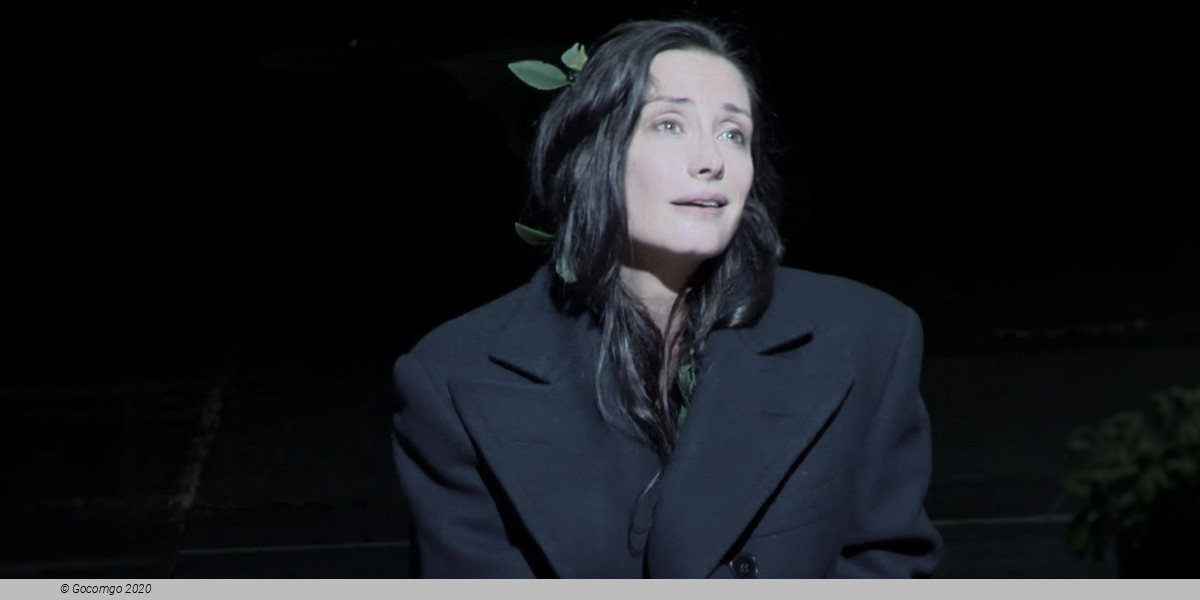
The stage setting is a drawing room „à la grec“. In the gloomy half-light, a young woman lies dreaming on a couch in the middle of the room. The drawing room is dominated by two large antique statues: at the feet of Apollo, sitting in a chair, one can just make out a dark figure. The young woman stirs uneasily in her sleep. Is she dreaming? The man is watching her – is it perhaps her husband? The sound of a solitary oboe is heard. The figures in the wall paintings appear to come alive. The statue of Dionysus, whose gaze is directed at the sleeping woman, lights up in the darkness. The sound of voices penetrates the walls, reaching the young woman’s ears. She sits up, the painted trees exerting a magical attraction on her, and wistfully laments: „O stay, beloved day.“ She is afraid of the night, particularly the one now falling.

The walls become transparent. A young man lying amidst the foliage suddenly gets up and approaches the woman as she sings. The veil between them falls, and from now on their two worlds become one. The woman becomes Daphne, the young man is Leukippos, the mother becomes Gaea, the father Peneios, and the husband is transformed into Apollo. When Leukippos starts making improper advances, Daphne flees from the reality of the drawing room. Leukippos grumbles to the maid who enters the room. She advises him to put on Daphne’s clothes in order to get closer to her.

Peneios arrives with his herdsmen and sings the praises of Olympus. This idyllic scene is disrupted by the arrival of a stranger. It is Apollo in disguise.Startled, they all flee. Left alone for a moment, Apollo is filled with misgivings about having humiliated himself. Daphne rises from her couch. By the enchanted light of the moon, the sight of her reminds Apollo of his sister Artemis, and he is seized by a great affection for her. Daphne, however, regards the man with suspicion. The stranger confesses that he knows her very well, repeating some of the words that she addressed to the daylight on her first appearance. Believing she has found a kindred soul in Apollo, Daphne rests her head against his chest. When he kisses her passionately, however, she tries to flee.

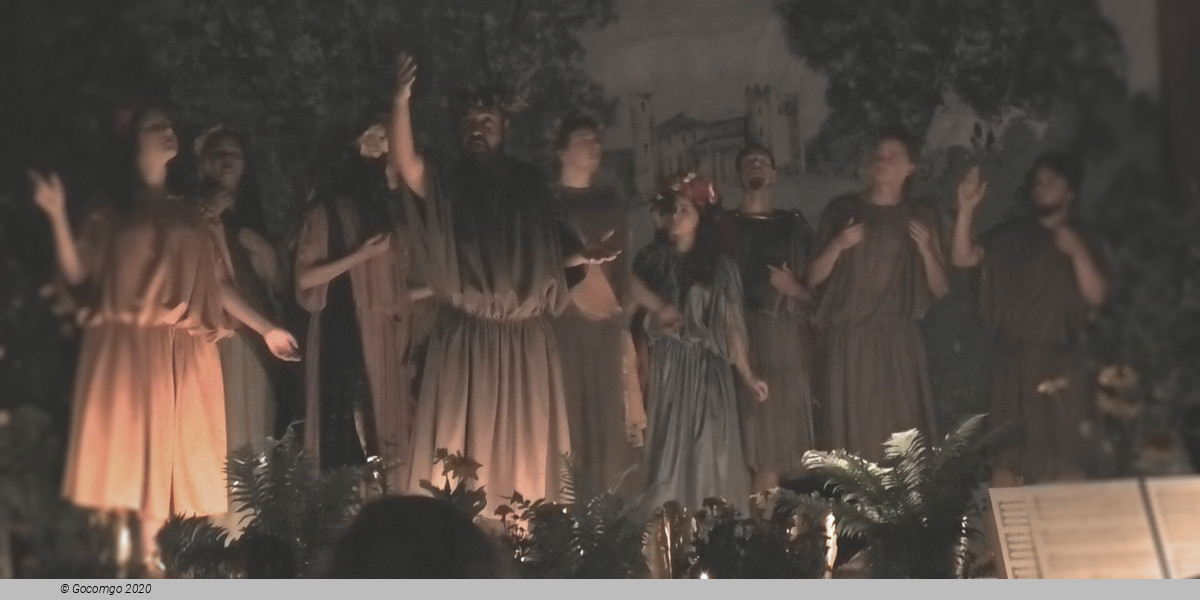
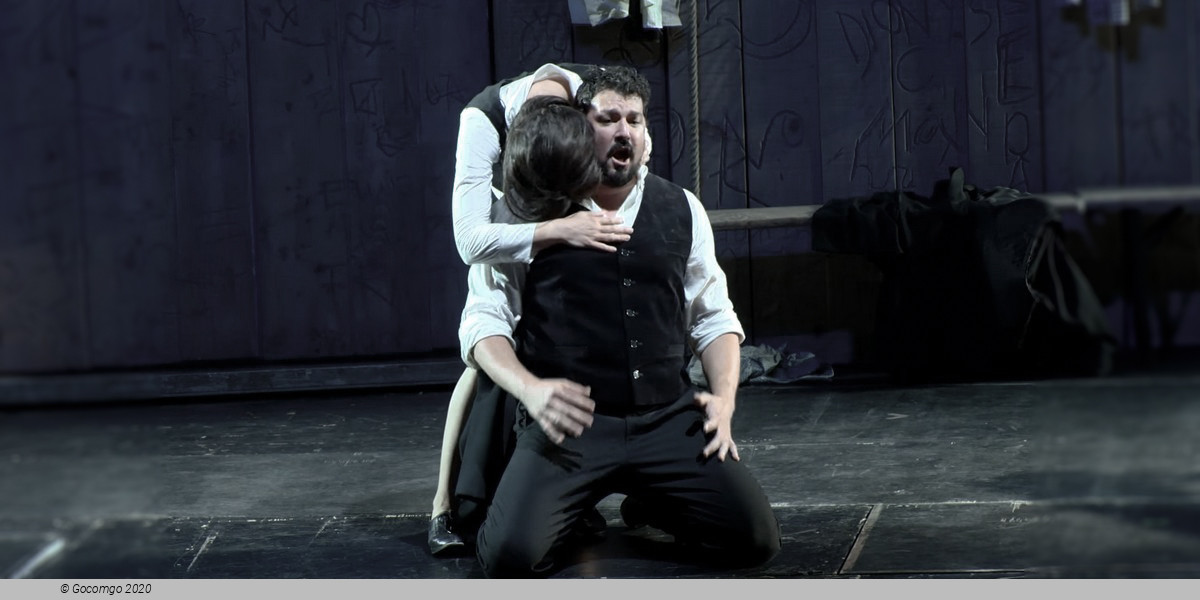
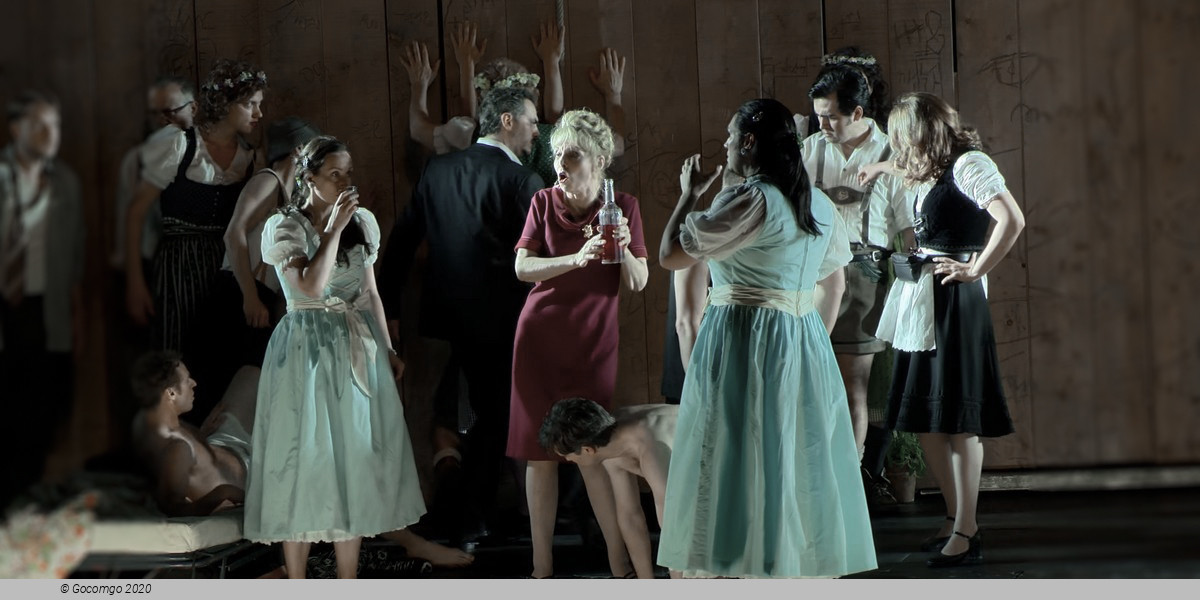
The celebrations in honour of the god Dionysus are about to begin. A huge mask comes into view. Fauns and nymphs jump out of its mouth, a large wine fountain is produced, and everyone drinks freely from it. Amongst them is Leukippos in disguise, who sidles up to Daphne. She is attracted to this „girl“ by a great affection. They start to dance. When Daphne tries to remove the stranger’s mask, Leukippos becomes violent, throwing Daphne to the groundin order to rape her. At this moment Apollo sees through Leukippos’s disguise,and lets out a cry of rage. He conjures up a storm, and everyone flees: only Daphne, Apollo and Leukippos remain behind. Leukippos demands that Apollo reveal his identity. When Daphne does the same, he tells them who he is: „I am Apollo, god of the sun and the daylight.“ Leukippos curses the god, who immediately kills him. Daphne mourns over the corpse of her erstwhile companion, realising that she belongs to him. Bitterly she rejects Apollo’s advances. Deeply moved, he implores the gods to forgive him for deceiving these mortals. He begs his father Zeus to turn Daphne into a laurel tree. Her branches will be adorn the brows of the finest of men, and she will love Apollo like a sister. As Daphne’s transformation begins, her voice can still be heard for a time. The wall closes up again. The man is still sitting in the dark room, but the couch is now empty.

History
Premiere of this production: 02 October 1938, Semperoper, Dresden

Daphne is an opera in one act by Richard Strauss, subtitled "Bucolic Tragedy in One Act". The German libretto was by Joseph Gregor. The opera is based loosely on the mythological figure Daphne from Ovid's Metamorphoses and includes elements taken from The Bacchae by Euripides.

Synopsis

The chaste girl Daphne sings a hymn of praise to nature. She loves the sunlight as trees and flowers do, but she has no interest in human romance. She cannot return the love of her childhood friend Leukippos, and she refuses to put on the ceremonial clothes for the coming festival of Dionysos, leaving Leukippos with the dress she has rejected.

Daphne's father Peneios tells his friends he is certain that the gods will soon return among men. He advises preparing a feast to welcome Apollo. Just then a mysterious herdsman appears. Peneios sends for Daphne to care for the visitor.

The strange herdsman tells Daphne that he has watched her from his chariot, and repeats to her phrases from the hymn to nature she sang earlier. He promises her that she need never be parted from the sun, and she accepts his embrace. But when he begins to speak of love she becomes fearful and runs out.

At the festival of Dionysos, Leukippos is among the women wearing Daphne's dress, and he invites her to dance. Believing him to be a woman she agrees, but the strange herdsman stops the dance with a thunderclap and says she has been deceived. Daphne answers that both Leukippos and the stranger are in disguise, and the stranger reveals himself as the sun-god Apollo. Daphne refuses both her suitors, and Apollo pierces Leukippos with an arrow.

Daphne mourns with the dying Leukippos. Apollo is filled with regret. He asks Zeus to give Daphne new life in the form of one of the trees she loves. Daphne is transformed, and she rejoices in her union with nature. This transformation scene, the metamorphosis, is opulently silvery in the string section.

Venue Info

Vienna State Opera - Vienna
Location   Opernring 2

The Vienna State Opera is one of the leading opera houses in the world. Its past is steeped in tradition. Its present is alive with richly varied performances and events. Each season, the schedule features 350 performances of more than 60 different operas and ballets. The members of the Vienna Philharmonic are recruited from the Vienna State Opera's orchestra. The building is also the home of the Vienna State Ballet, and it hosts the annual Vienna Opera Ball during the carnival season.

The 1,709-seat Renaissance Revival venue was the first major building on the Vienna Ring Road. It was built from 1861 to 1869 following plans by August Sicard von Sicardsburg and Eduard van der Nüll, and designs by Josef Hlávka. The opera house was inaugurated as the "Vienna Court Opera" (Wiener Hofoper) in the presence of Emperor Franz Joseph I and Empress Elisabeth of Austria. It became known by its current name after the establishment of the First Austrian Republic in 1921. The Vienna State Opera is the successor of the Vienna Court Opera, the original construction site chosen and paid for by Emperor Franz Joseph in 1861.

The opera house was the first major building on the Vienna Ringstrasse commissioned by the Viennese "city expansion fund". Work commenced on the house in 1861 and was completed in 1869, following plans drawn up by architects August Sicard von Sicardsburg and Eduard van der Nüll. It was built in the Neo-Renaissance style by the renowned Czech architect and contractor Josef Hlávka.

Gustav Mahler was one of the many conductors who have worked in Vienna. During his tenure (1897–1907), Mahler cultivated a new generation of singers, such as Anna Bahr-Mildenburg and Selma Kurz, and recruited a stage designer who replaced the lavish historical stage decors with sparse stage scenery corresponding to modernistic, Jugendstil tastes. Mahler also introduced the practice of dimming the lighting in the theatre during performances, which was initially not appreciated by the audience. However, Mahler's reforms were maintained by his successors.

Herbert von Karajan introduced the practice of performing operas exclusively in their original language instead of being translated into German. He also strengthened the ensemble and regular principal singers and introduced the policy of predominantly engaging guest singers. He began a collaboration with La Scala in Milan, in which both productions and orchestrations were shared. This created an opening for the prominent members of the Viennese ensemble to appear in Milan, especially to perform works by Wolfgang Amadeus Mozart and Richard Strauss.

Ballet companies merge

At the beginning of the 2005–2006 season, the ballet companies of the Staatsoper and the Vienna Volksoper were merged under the direction of Gyula Harangozó.

From the 2010–2011 season a new company was formed called Wiener Staatsballet, Vienna State Ballet, under the direction of former Paris Opera Ballet principal dancer Manuel Legris. Legris eliminated Harangozós's policy of presenting nothing but traditional narrative ballets with guest artists in the leading roles, concentrated on establishing a strong in-house ensemble and restored evenings of mixed bill programs, featuring works of George Balanchine, Jerome Robbins, Jiří Kylián, William Forsythe, and many contemporary choreographers, as well as a reduced schedule of the classic ballets.

Opera ball

For many decades, the opera house has been the venue of the Vienna Opera Ball. It is an internationally renowned event, which takes place annually on the last Thursday in Fasching. Those in attendance often include visitors from around the world, especially prominent names in business and politics. The opera ball receives media coverage from a range of outlets.

Important Info
Type: Opera
City: Vienna, Austria
Starts at: 20:00
Top of page