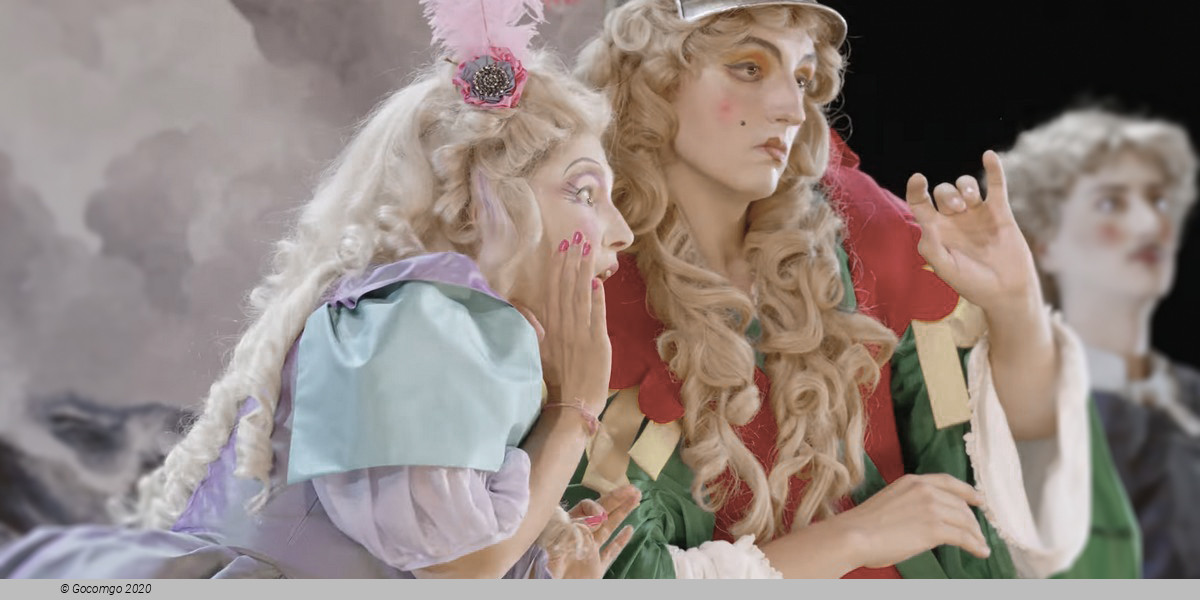
Tyrolean State Theatre tickets 8 August 2026 - Il pomo d'oro | GoComGo.com

Il pomo d'oro

Tyrolean State Theatre, Großes Haus, Innsbruck, Austria
All photos (1)
Select date and time
6:30 PM
From
US$ 186

E-tickets: Print at home or at the box office of the event if so specified. You will find more information in your booking confirmation email.

You can only select the category, and not the exact seats.
If you order 2 or 3 tickets: your seats will be next to each other.
If you order 4 or more tickets: your seats will be next to each other, or, if this is not possible, we will provide a combination of groups of seats (at least in pairs, for example 2+2 or 2+3).

Important Info
Type: Opera
City: Innsbruck, Austria
Starts at: 18:30
Acts: 5
Intervals: 1
Duration: 4h
Sung in: Italian
Titles in: German,English

E-tickets: Print at home or at the box office of the event if so specified. You will find more information in your booking confirmation email.

You can only select the category, and not the exact seats.
If you order 2 or 3 tickets: your seats will be next to each other.
If you order 4 or more tickets: your seats will be next to each other, or, if this is not possible, we will provide a combination of groups of seats (at least in pairs, for example 2+2 or 2+3).

Cast
Performers
Conductor: Ottavio Dantone
Orchestra: Accademia Bizantina
Soprano: Jone Martínez (Sardinia)
Soprano: Jone Martínez (Venus)
Baritone: Mauro Borgioni (The Kingdom Of Hungary)
Choir: NovoCanto
Countertenor: Paul Figuier (The Kingdom Of Bohemia)
Soprano: Shira Patchornik (Sardinia)
Mezzo-Soprano: Sophie Rennert (The Austrian Glory)
Mezzo-Soprano: Sophie Rennert (Juno)
Creators
Composer: Antonio Cesti
Director: Fabio Ceresa
Librettist: Francesco Sbarra
Festival

Innsbruck Festival of Early Music 2026

The Innsbruck Festival of Early Music 2026 marks its 50th anniversary with a programme that celebrates five decades of excellence in historically informed performance. From 24 July to 30 August 2026, Innsbruck welcomes internationally acclaimed artists, outstanding ensembles, and music lovers from around the world to one of Europe's leading festivals dedicated to Renaissance and Baroque music. Concerts and opera performances unfold in the city's historic theatres, churches, and palaces, creating an atmosphere perfectly suited to this remarkable repertoire.

Overview

2 evenings, 1 opera. Tickets can only be purchased in combination for 7th & 8th August, 11th & 12th August and 15th & 16th August.

Splendour, excess, spectacle: Pietro Antonio Cesti’s Il pomo d’oro was unique even at its premiere in 1668—and at the same time an almost unperformable undertaking. The enormous scale, the multitude of roles and, not least, the absence of the music for two acts – only the libretto has survived – have made the opera legendary over time. On the occasion of the 50th anniversary of the Innsbrucker Festwochen, Ottavio Dantone has reconstructed the missing parts from fragments and other works by Cesti, allowing this festive opera to be heard in its entirety for the first time since its premiere – magnificently staged by Fabio Ceresa and his team.

Over two consecutive evenings, the Festwochen not only evokes the pomp and spectacle that characterised Baroque opera in general – none more so than Il pomo d’oro– but also portrays on stage the origins of what was perhaps the most famous war of antiquity.

All the Olympian deities were invited to the wedding of the beautiful sea nymph Thetis to the mortal Peleus. Only one was left out: Eris, the goddess of discord. In her wounded anger, she devised a prank: she threw a golden apple into the banquet hall, inscribed with the fateful words “To the fairest.” Juno, Venus, and Pallas Athena immediately claimed the apple for themselves, sparking a contest in which divine dignity swiftly gave way to all-too-human vanity. Paris, deemed the most beautiful of all mortals, was appointed by Jupiter to arbitrate the dispute over Il pomo d’oro. Thus began the judgement that shapes Cesti’s opera over two evenings: intrigues, rivalries, and amorous entanglements unfold in sparkling scenes, while behind all the pomp, the shadow of the coming catastrophe – the Trojan War – is already looming.

Yet the opera is far more than a mere display of mythological grandeur. Amidst gods, heroes, and allegories, flashes of comedy appear time and again. The Olympians reveal themselves to be delightfully human and wonderfully “ungodly,” their jealousy, self-praise, and petty malice lending the work an almost cabaret-like wit. Il pomo d’oro thus moves between two intertwined planes—heavenly splendour and earthly life—whose shifting relationship drives the drama.

Historical background

Il pomo d’oro was commissioned in 1666 to celebrate the marriage of Leopold I and the Infanta Margherita Teresa of Spain. As her arrival in Vienna was delayed and the court theatre on the Cortina not yet completed, the performance was postponed. It was initially planned for the winter of 1667/68 to mark the birth of their son Ferdinand Wenzel; following his early death in January 1668, the festivities were naturally cancelled. The opera finally premiered on 12 and 13 July 1668, in honour of Margherita’s birthday, and was staged once more – a week later – for the final time.

Leopold, a passionate musician, composed the music for Act II, Scene 9, and Act V, Scene 5 himself; Johann Heinrich Schmelzer provided the ballet music. The remaining music was written by Cesti, who had become imperial court conductor in 1665 after appointments at the Sistine Chapel and, earlier, as music director of Archduke Ferdinand Karl’s private orchestra in Innsbruck. The stage sets by Burnacini were later engraved in copper by Matthäus Küsel and published in several editions of the libretto. The names of those who appeared in the premiere are unknown, with the exception of one – “Vincentino”, a castrato who sang the role of Venus. The librettist Francesco Sbarra, who had already collaborated with Cesti in Innsbruck, wrote in the afterword to the lavishly printed libretto:

    “The music, performed by the foremost virtuosi of this century and composed by Signor Cavalier Cesti, His Majesty’s Honorary Kapellmeister, who always proved himself unrivalled in his compositions, contributed greatly to its success.”

With its five acts and prologue, no fewer than 47 roles in the unabridged original version, and a total duration of more than eight hours – presented by the Innsbrucker Festwochen, as at the premiere, over two consecutive evenings – Il pomo d’oro stands as the very epitome of the Baroque court opera. Its demands eclipse almost all other Italian operas of the 17th century; even Lully’s elaborate spectacles for Louis XIV require no greater resources. The diversity of the instrumental ensemble, the blend of comic and serious elements, the arias and ensembles, the stage machinery and scenic effects – all make this opera worthy of the Olympian status it has held in operatic history since Guido Adler’s publication in the Denkmäler der Tonkunst in Österreich (Monuments of Music in Austria) at the end of the 19th century.

What more fitting work could there be to mark the 50th anniversary of the Innsbrucker Festwochen der Alten Musik? And where else, if not here – and under the musical direction of Ottavio Dantone – could the “unperformable” be brought to life once more?


History
Premiere of this production: 30 November 1667, Vienna, Austria

Il pomo d'oro (The Golden Apple) is an opera in a prologue and five acts by the Italian composer Antonio Cesti with a libretto by Francesco Sbarra (1611-1668). It was first performed before the imperial court in a specially constructed open-air theatre Vienna in 1668. The work was so long it had to be staged over the course of two days: the Prologue, Acts One and Two were given on July 12; Acts Three, Four and Five on July 14. Originally planned to mark the wedding of the Habsburg Holy Roman Emperor Leopold I and Margaret Theresa of Spain in 1666, the production was rescheduled to mark the Empress's 17th birthday in 1668. The staging was unprecedented for its magnificence (and expense). The designer Ludovico Ottavio Burnacini provided no fewer than 24 sets and there were plenty of opportunities for spectacular stage machinery, including shipwrecks and collapsing towers.

Synopsis

The opera tells the story of the Judgement of Paris. The gods ask the Trojan prince Paris to decide which of the goddesses Venus, Juno and Pallas (Minerva) is the most beautiful and thus deserving of the Golden Apple of Discord. Paris gives the prize to Venus. The spurned goddesses try to get their revenge until Jupiter decides to end the confusion, turns to the audience and awards the golden apple to the Empress Margaret Theresa.

Venue Info

Tyrolean State Theatre - Innsbruck
Location   Rennweg 2

Standing in the historic centre of Innsbruck, just steps from the Imperial Palace and the Hofkirche, the Tiroler Landestheater is one of Austria's leading performing arts venues and a principal stage of the Innsbruck Festival of Early Music. Combining modern theatrical technology with a centuries-old musical tradition, the theatre provides an ideal setting for the festival's acclaimed Baroque opera productions.

The history of theatrical performance on this site dates back to the 17th century, when Innsbruck was an important cultural centre of the Habsburg Empire and one of the earliest cities north of the Alps to embrace Italian opera. The present theatre, inaugurated in 1846 and extensively modernized over the years, continues this rich artistic legacy while meeting the highest contemporary production standards.

During the Innsbruck Festival of Early Music, the Tiroler Landestheater becomes the home of the festival's fully staged operas. Rarely performed masterpieces, rediscovered works, and celebrated Baroque operas are brought to life by internationally renowned singers, period-instrument orchestras, conductors, directors, and creative teams dedicated to historically informed performance practice.

The theatre's elegant auditorium and excellent acoustics allow audiences to experience the dramatic richness and musical sophistication of 17th- and 18th-century opera in exceptional comfort. Equipped with state-of-the-art stage technology, the venue supports visually imaginative productions while preserving the intimacy essential to early opera.

Beyond the festival, the Tiroler Landestheater serves as the cultural heart of Tyrol, presenting a year-round programme of opera, ballet, musical theatre, drama, concerts, and productions for young audiences. Its close partnership with the Innsbruck Festival of Early Music has helped establish Innsbruck as one of Europe's foremost centres for the performance and rediscovery of early opera.

Important Info
Type: Opera
City: Innsbruck, Austria
Starts at: 18:30
Acts: 5
Intervals: 1
Duration: 4h
Sung in: Italian
Titles in: German,English
Top of page