
Teatro Alla Scala 2 November 2023 - Peter Grimes | GoComGo.com

Peter Grimes

Teatro Alla Scala, Milan, Italy
All photos (6)
Select date and time
8 PM

E-tickets: Print at home or at the box office of the event if so specified. You will find more information in your booking confirmation email.

You can only select the category, and not the exact seats.
If you order 2 or 3 tickets: your seats will be next to each other.
If you order 4 or more tickets: your seats will be next to each other, or, if this is not possible, we will provide a combination of groups of seats (at least in pairs, for example 2+2 or 2+3).

Important Info
Type: Opera
City: Milan, Italy
Starts at: 20:00
Acts: 3

E-tickets: Print at home or at the box office of the event if so specified. You will find more information in your booking confirmation email.

You can only select the category, and not the exact seats.
If you order 2 or 3 tickets: your seats will be next to each other.
If you order 4 or more tickets: your seats will be next to each other, or, if this is not possible, we will provide a combination of groups of seats (at least in pairs, for example 2+2 or 2+3).

Overview

Among the greatest triumphs of 20th-century musical theatre, Peter Grimes returns in a new production by Robert Carsen, marking the La Scala debut of Simone Young, a conductor at home in the world’s preeminent theatres who built her reputation as conductor of the Hamburg State Opera.

Teatro alla Scala New Production

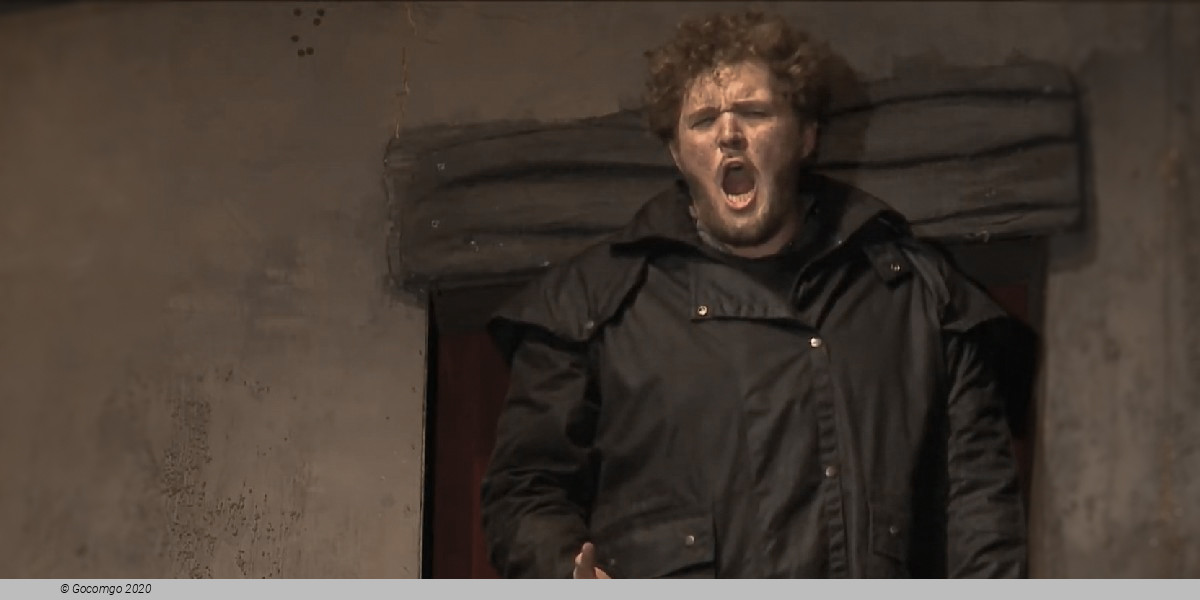
The disturbing story is taken from the narrative poem The Borough, where George Crabbe relates the distorted dynamics of a small community distressed at the death of the cabin boy of a fisherman named Grimes, an isolated and aggressive character interpreted at La Scala by Brandon Jovanovich.

History
Premiere of this production: 07 June 1945, Sadler`s Wells, London

Peter Grimes is an opera by Benjamin Britten, with a libretto adapted by Montagu Slater from the narrative poem, "Peter Grimes", in George Crabbe's book The Borough. The "borough" of the opera is a fictional village which shares some similarities with Crabbe's, and later Britten's, own home of Aldeburgh, a town on England's east coast.

Synopsis

Prologue

A Suffolk coastal village, mid-19th century (The date is not specified, but the foghorn in Act III places it later than the date of Crabbe's poem)

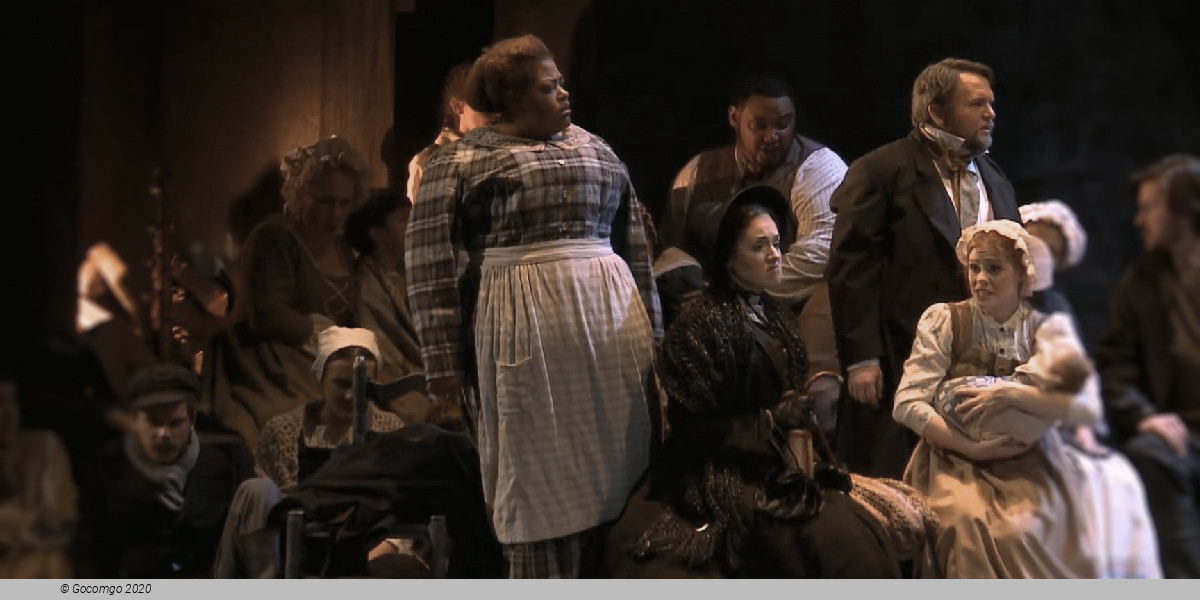
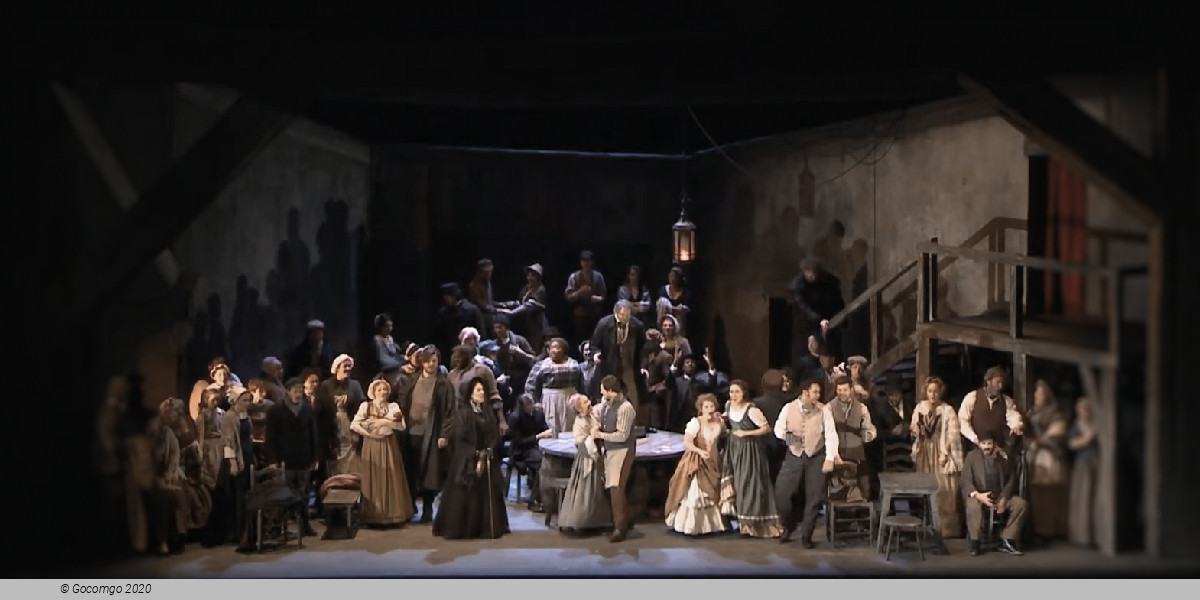
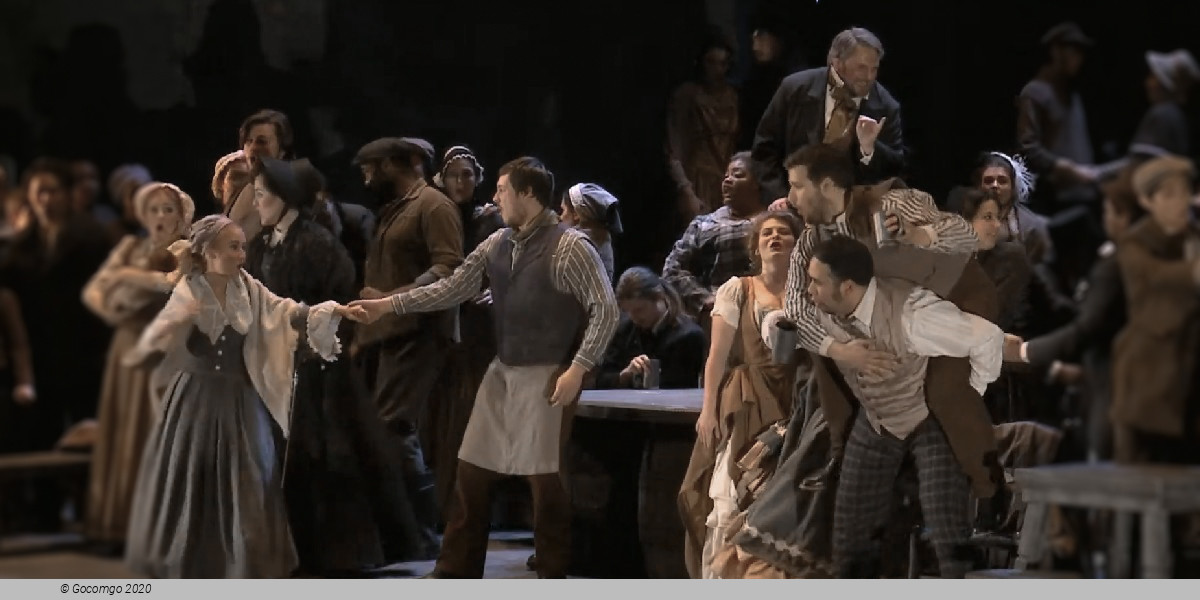
Peter Grimes is questioned at an inquest over the death at sea of his apprentice. The townsfolk, all present, make it clear that they think Grimes is guilty and deserving of punishment. Although the coroner, Mr Swallow, determines the boy's death to be accidental and clears Grimes without a proper trial, he advises Grimes not to get another apprentice—a proposal against which Grimes vigorously protests. As the court is cleared, Ellen Orford, the schoolmistress whom Grimes wishes to marry as soon as he gains the Borough's respect, attempts to comfort Grimes as he rages against what he sees as the community's unwillingness to give him a true second chance.

Act 1

The same, some days later

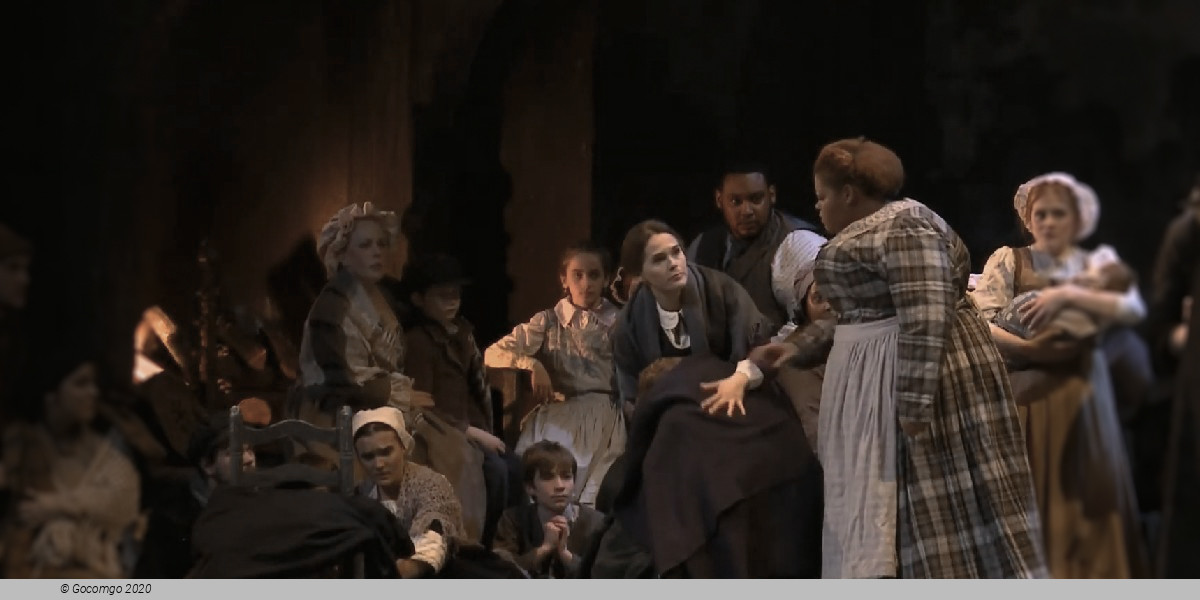
After the first orchestral Interlude (in the Four Sea Interludes concert version entitled "Dawn"), the chorus, who constitute "the Borough", sing of their weary daily round and their relationship with the sea and the seasons. Grimes calls for help to haul his boat ashore, but is shunned by most of the community. Belatedly, Balstrode and the apothecary, Ned Keene, assist Grimes by turning the capstan. Keene tells Grimes that he has found him a new apprentice (named John) from the workhouse. Nobody will volunteer to fetch the boy, until Ellen offers ("Let her among you without fault...").

As a storm approaches, most of the community—after securing windows and equipment—take shelter in the pub. Grimes stays out, and alone with Balstrode confesses his ambitions: to make his fortune with a "good catch", buy a good home and marry Ellen Orford. Balstrode suggests "without your booty Ellen will have you now", only to provoke Grimes's furious "No, not for pity!" Balstrode abandons Grimes to the storm, as the latter ruminates "What harbour shelters peace?" The storm then breaks with a vengeance (second orchestral Interlude).

In the pub, tensions are rising due both to the storm and to the fiery Methodist fisherman, Bob Boles, getting increasingly drunk and lecherous after the pub's main attraction, the two "nieces". Grimes suddenly enters ("Now the Great Bear and Pleiades..."), and his wild appearance unites almost the entire community in their fear and mistrust of his "temper". Ned Keene saves the situation by starting a round ("Old Joe has gone fishing"). Just as the round reaches a climax, Ellen arrives with the apprentice, both drenched. Grimes immediately sets off with the apprentice to his hut, despite the terrible storm.

Act 2

The same, some weeks later

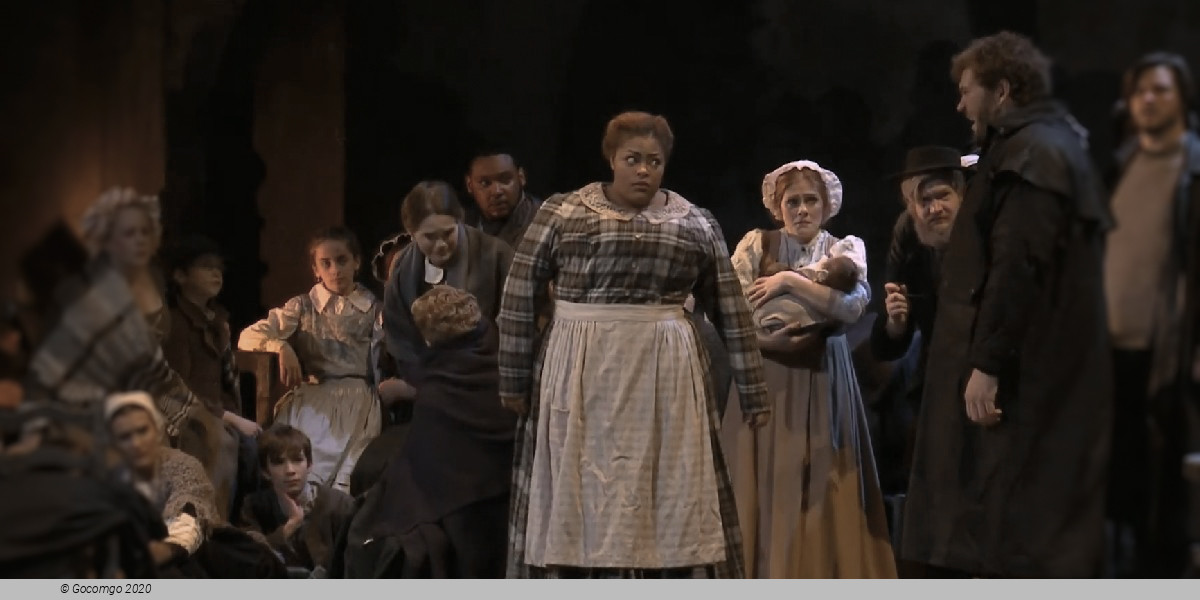
On Sunday morning (the third orchestral Interlude), while most of the Borough is at church, Ellen talks with John, the apprentice. She is horrified when she finds a bruise on his neck. When she confronts Grimes about it, he brusquely claims that it was an accident. Growing agitated at her mounting concern and interference, he strikes her and runs off with the boy. This does not go unseen: first Keene, Auntie, and Bob Boles, then the chorus comment on what has happened, the latter developing into a mob to investigate Grimes's hut. As the men march off, Ellen, Auntie, and the nieces sing sadly of the relationship of women with men. The fourth interlude (Passacaglia) follows as the scene changes.

At the hut, Grimes impatiently drives the ever silent John into changing out of his Sunday clothes and into fisherman's gear, and then becomes lost in his memories of his previous, now dead apprentice, reliving the boy's death of thirst. When he hears the mob of villagers approaching, he quickly comes back to reality, stirred both by a paranoid belief that John has been "gossiping" with Ellen, so provoking the "odd procession", and at the same time feeling defiant. He gets ready to set out to sea, and he tells John to be careful climbing down the cliff to his boat, but to no avail: the boy falls to his death. When the mob reaches the hut Grimes is gone, and they find nothing out of order, so they disperse.

Act 3

The same, two days later, night time in the Borough ("Moonlight" in the Sea Interludes).

While a dance is going on, Mrs Sedley tries to convince the authorities that Grimes is a murderer, but to no avail. Ellen and Captain Balstrode confide in each other: Grimes has disappeared, and Balstrode has discovered a jersey washed ashore: a jersey that Ellen recognises as one she had knitted for John. Mrs Sedley overhears this, and with the knowledge that Grimes has returned, she is able to instigate another mob. Singing "Him who despises us we'll destroy", the villagers go off in search of Grimes. The sixth interlude, not included in the Sea Interludes, covers the change of scene.

While the chorus can be heard searching for him, Grimes appears onstage, singing a long monologue sparsely accompanied by cries from the off-stage chorus, and a fog horn (represented by a solo tuba): John's death has seemingly shattered Grimes's sanity. Ellen and Balstrode find him, and the old captain encourages Grimes to take his boat out to sea and sink it. Grimes leaves. The next morning, the Borough begins its day anew, as if nothing has happened. There is a report from the coastguard of a ship sinking off the coast. This is dismissed by Auntie as "one of these rumours."

Venue Info

Teatro Alla Scala - Milan
Location   Via Filodrammatici, 2

Teatro Alla Scala is an opera house in Milan. Most of Italy's greatest operatic artists, and many of the finest singers from around the world, have appeared at La Scala. The theatre is regarded as one of the leading opera and ballet theatres globally. It is home to the La Scala Theatre Chorus, La Scala Theatre Ballet, La Scala Theatre Orchestra, and the Filarmonica della Scala orchestra.

The Teatro alla Scala was founded, under the auspices of the Empress Maria Theresa of Austria, to replace the Royal Ducal Theatre, which was destroyed by fire on 26 February 1776 and had until then been the home of opera in Milan. The cost of building the new theatre was borne by the owners of the boxes at the Ducal, in exchange for possession of the land on which stood the church of Santa Maria alla Scala (hence the name) and for renewed ownership of their boxes. Designed by the great neoclassical architect Giuseppe Piermarini, La Scala opened on 3 August 1778 with Antonio Salieri's opera L'Europa riconosciuta, to a libretto by Mattia Verazi.

With the advent of Rossini in 1812 (La pietra del paragone), the Teatro alla Scala was to become the appointed place of Italian opera seria: of its history dating back more than a century and of its subsequent tradition up till the present. The catalogue of Rossini's works performed until 1825 included: Il turco in Italia, La Cenerentola, Il barbiere di Siviglia, La donna del lago, Otello, Tancredi, Semiramide and Mosé. During that period the choreographies of Salvatore Viganò (1769-181) and of Carlo Blasis (1795-1878) also widened the theatre's artistic supremacy to include ballet.

An exceptional new season of serious opera opened between 1822 and 1825, with Chiara e Serafina by Gaetano Donizetti (1797-1848) and Il pirata by Vincenzo Bellini (1801-1835). The later operas of Donizetti performed at La Scala were (until 1850) Anna Bolena, Lucrezia Borgia, Torquato Tasso, La fille du régiment, La favorita, Linda di Chamonix, Don Pasquale, and Poliuto. These were followed (until 1836) by Bellini's I Capuleti e i Montecchi, Norma, La sonnambula, Beatrice di Tenda and I puritani.

In 1839 Oberto Conte di San Bonifacio inaugurated the cycle of operas by Giuseppe Verdi (1813-1901), the composer whose name is linked more than any other to the history of La Scala. After the dismal failure of Un giorno di regno, Nabucco was performed in 1842. It was the first, decisive triumph of Verdi's career. At the same time, the strong patriotic feelings stirred by Nabucco founded the "popularity" of opera seria and identified its image with the Scala.

Arturo Toscanini (1867-1957) became the artistic director and introduced radical reform into the theatre, both in its organisational aspects and in its relations with the public. Toscanini, one of the greatest conductors of all time, took up Verdi's musical inheritance and launched a tradition of interpretation that continued uninterruptedly and was renewed during the twentieth century. It was he who reappraised and regularly performed at the Scala the works of Richard Wagner (hitherto only belatedly and inadequately recognised). He also firmly extended the Scala's orchestral repertoire to include symphonic music.

In 1948 maestro Guido Cantelli (1920-1956) made his debut and established himself as one of the leading postwar conductors. Numerous opera performances productions (the Wagnerian cycle conducted in 1950 by Wilhelm Furtwängler, the Verdi repertoire by Victor De Sabata, etc), concerts (Herbert von Karajan, Dimitri Mitropoulos, Bruno Walter, etc), singers (Maria Callas, Renata Tebaldi, Giuseppe Di Stefano, Mario Del Monaco, etc), ballet performances (Margot Fonteyn, Serge Lifar, Maya Plissetskaya, Rudolf Nureyev), and productions (Luchino Visconti, Giorgio Strehler) belong not only to the history of the Scala, but to that of the history of musical theatre since the war.

In 1965 Claudio Abbado made his début at the Scala and in 1972 was named conductor of the Scala Orchestra. Until 1986 he directed among other works Il barbiere di Siviglia, Cenerentola, L'Italiana in Algeri by Rossini, Simon Boccanegra, Macbeth and Don Carlo by Verdi, the recent Al gran sole carico d'amore by Luigi Nono, and Pelléas et Mélisande by Claude Debussy. He also conducted numerous concerts. The chorus-master was Romano Gandolfi. In 1975 the ballet dancer Oriella Dorella debuted at La Scala. Among other contemporary composers, up till 1986 the Theatre continued to give works by Luciano Berio (La vera storia), Franco Donatoni (Atem) and Karlheinz Stockhausen (Samstag aus Licht).

In 1981 Riccardo Muti debuted at the Scala as an opera conductor (Mozart, Le nozze di Figaro). Giulio Bertola was appointed to direct the Chorus. In 1982 the Orchestra Filarmonica della Scala was established. In 1985 Alessandra Ferri made her debut at the Scala. In 1986 Riccardo Muti was appointed musical director. From 1989 to 1998 he reintroduced the best-loved works (Rigoletto, La traviata, Macbeth, La forza del destino) and numerous other titles by Verdi including Falstaff and Don Carlo.

In 1991 Roberto Gabbiani took over the directorship of the chorus. In 1997 La Scala was converted into a Foundation under private ownership, thus opening a decisive phase of modernisation.

On 7 December 2001 a new production of Otello, conducted by Muti, concluded the Verdi Year and, for the time being, performances at Piermarini’s original building in Piazza Scala. Major restoration and modernisation works of the Theatre began in January 2002.

The 2005-2006 Season, dedicated to the 250th anniversary of Mozart’s birth, was inaugurated by Idomeneo conducted by Daniel Harding. The 2006/07 season saw the return on 7 December of an opera by Verdi, Aida, conducted by Riccardo Chailly, and the launch of the Celebrations for the 50th Anniversary of Arturo Toscanini’s Death. On 7 December 2007 the 2007/08 season opened with Tristan und Isolde conducted by Daniel Barenboim. The opera marked the beginning of a closer collaboration between the Teatro alla Scala and the Israeli-Argentinian Maestro.

Important Info
Type: Opera
City: Milan, Italy
Starts at: 20:00
Acts: 3
Top of page