Chief Conductor David Robertson conducts Olivier Messiaen’s magnum opus, a dedication to joy and love on a colossal scale.
Widely regarded as one of the most powerful pieces of music created in the 20th century Messiaen’s Turangalîla-Symphonie is nothing short of monumental.
Calling for a massive orchestra of almost 100 musicians, solo piano and one of the earliest of electronic instruments, the ondes martinot, Messiaen creates a spellbinding, transcendent world filled with drama and mysticism.
Its first performances in the 1940s were considered nothing short of a revelation from a composer whose musical bombshells seemed to belie his gentle spirituality and humanism. Turangalîla, a word from the ancient Sanskrit reflects the work’s fascinating dualities: east and west; tonality and lyricism, joy, time, life and death.
This singular event, bringing together enormous musical forces, will display Messiaen’s brilliance in one
Cyclic themes
In writing about the work, Messiaen identified four cyclic themes that reappear throughout; there are other themes specific to each movement. In the score the themes are numbered, but in later writings he gave them names to make them easier to identify, without intending the names to have any other, literary meaning.
 Introduced by trombones and tuba, this is the statue theme. According to Messiaen, it has the oppressive, terrible brutality of ancient Mexican monuments, and has always evoked dread. It is played in a slow tempo, pesante.
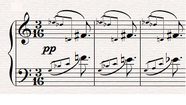 This is the flower theme. It is introduced by two clarinets.
 This theme, the most important of all, is the love theme. It appears in many different guises, from hushed strings in movement 6, to a full orchestral treatment in the climax of the finale.
 A simple chain of chords, used to produce opposing chords on the piano and crossing counterpoints in the orchestra.
Structure
The work is in ten movements, linked by the common themes identified above, and other musical ideas:
- Introduction. Modéré, un peu vif: A "curtain raiser" introducing the "statue theme" and the "flower theme", followed by the body of the movement, which superimposes two ostinato groups with rhythmic punctuations. A reprise of the "statue" theme closes the introduction.
- Chant d’amour (Love song) 1. Modéré, lourd: After an atonal introduction, this movement is built on an alternation of a fast and passionate theme dominated by the trumpets, and a soft and gentle theme for the strings and ondes.
- Turangalîla 1. Presque lent, rêveur: Three themes are stated: one starting with a solo clarinet, the second for low brass and strings, and the third a sinuous theme on the woodwinds. The movement then develops and, later, overlaps the themes, with the addition of a new rhythm in the percussion.
- Chant d’amour 2. Bien modéré: Introduced by a scherzo for piccolo and bassoon, this movement is in nine sections, some of which recall and develop music heard earlier. A calm coda in A major brings it to a close.
- Joie du Sang des Étoiles (Joy of the Blood of the Stars). Vif, passionné avec joie: A frenetic dance whose main theme is a fast variant of the "statue theme". For Messiaen, it represented the union of two lovers seen as a transformation on a cosmic scale. The dance is interrupted by a shattering piano cadenza before a brief orchestral coda.
- Jardin du Sommeil d’amour (Garden of Love’s Sleep). Très modéré, très tendre: The first full rendition of the "love" theme in the strings and ondes is accompanied by idealized birdsong played by the piano, and by other orchestral coloristic effects. According to Messiaen, "The two lovers are enclosed in love's sleep. A landscape comes out from them..."
- Turangalîla 2. Un peu vif, bien modéré: A completely atonal movement that is intended to invoke terror, with a predominant role for the percussion ensemble.
- Développement d’amour (Development of Love). Bien modéré: For Messiaen, the title can be considered in two ways. For the lovers, it is terrible: united by the love potion, they are trapped in a passion growing to the infinite. Musically, this is the work's development section.
- Turangalîla 3. Bien modéré: A theme is introduced by the woodwind. A five-part percussion ensemble introduces a rhythmic series that then sustains a set of superimposed variations on the woodwind theme.
- Final. Modéré, presque vif, avec une grande joie: The movement is in sonata form: A brass fanfare, coupled with a fast variation of the "love theme", is developed and leads to a long coda, a final version of the "love" theme played fortissimo by the entire orchestra. The work ends on an enormous F♯ major chord. In Messiaen's words, "glory and joy are without end".
The composer's initial plan was for a symphony in the conventional four movements, which eventually became numbers 1, 4, 6, and 10. Next, he added the three Turangalîla movements, which he originally called tâlas, a reference to the use of rhythm in Indian classical music. Finally, the 2nd, 5th, and 8th movements were inserted. Early on, Messiaen authorized separate performance of movements 3, 4, and 5, as Three tâlas (not to be confused with the original use of the term for the three Turangalîla movements), but later came to disapprove of the performance of extracts.




 Bennelong Point, Sydney NSW 2000