
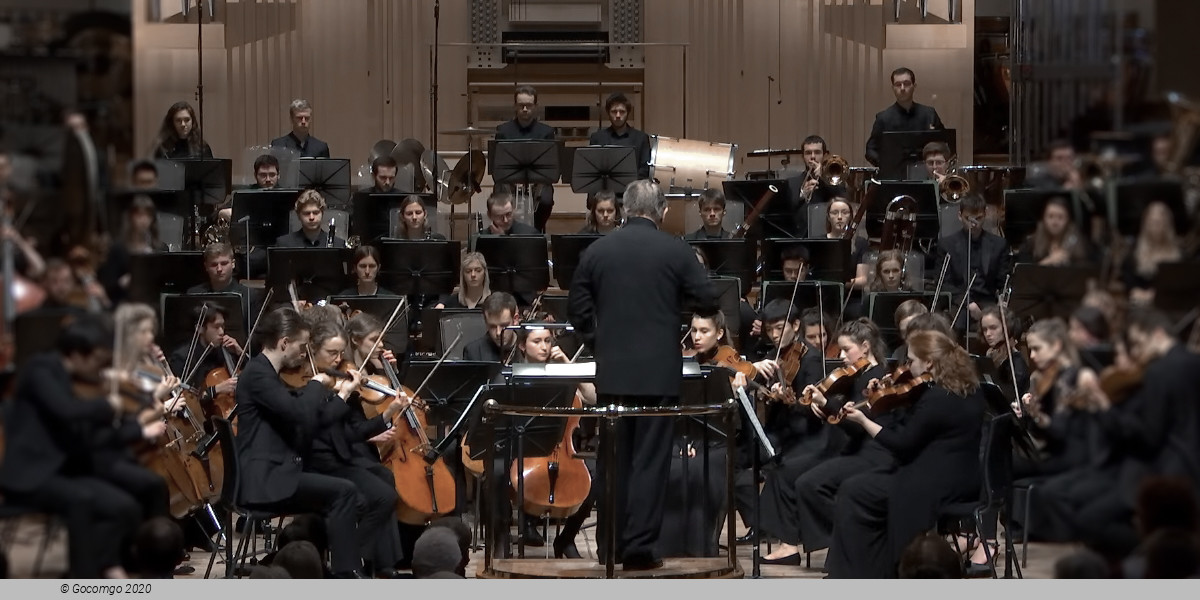
Philharmonie de Paris tickets 20 February 2027 - Daniil Trifonov and Berliner Barock Solisten | GoComGo.com

Daniil Trifonov and Berliner Barock Solisten

Philharmonie de Paris, Grande salle Pierre Boulez, Paris, France
All photos (1)
Select date and time
8 PM
From
US$ 89

E-tickets: Print at home or at the box office of the event if so specified. You will find more information in your booking confirmation email.

You can only select the category, and not the exact seats.
If you order 2 or 3 tickets: your seats will be next to each other.
If you order 4 or more tickets: your seats will be next to each other, or, if this is not possible, we will provide a combination of groups of seats (at least in pairs, for example 2+2 or 2+3).

Important Info
Type: Classical Concert
City: Paris, France
Starts at: 20:00
Duration: 1h 55min

E-tickets: Print at home or at the box office of the event if so specified. You will find more information in your booking confirmation email.

You can only select the category, and not the exact seats.
If you order 2 or 3 tickets: your seats will be next to each other.
If you order 4 or more tickets: your seats will be next to each other, or, if this is not possible, we will provide a combination of groups of seats (at least in pairs, for example 2+2 or 2+3).

Cast
Performers
Conductor: Gottfried von der Goltz
Ensemble: Berliner Barock Solisten
Violin: Gottfried von der Goltz
Creators
Composer: Wolfgang Amadeus Mozart
Programme
Wolfgang Amadeus Mozart: Adagio and Fugue in C Minor, K. 546
Ludwig van Beethoven : Piano Concerto no. 4 in G major, Op.58
Ludwig van Beethoven : Grosse Fuge in B-flat major, Op. 133
Carl Philipp Emanuel Bach: Symphony in E flat major Wq 179
Ludwig van Beethoven : Rondo for Piano and Orchestra in B-flat Major, WoO 6
Overview

After juxtaposing Beethoven’s youthful voice, revealed by Daniil Trifonov, with his mature mastery, explored by the Berliner Barock Solisten, the programme culminates with Carl Philipp Emanuel Bach, the most inventive of the Cantor’s sons.

The Große Fuge (or Grosse Fuge, also known in English as Great Fugue or Grand Fugue), Op. 133, is a single-movement composition for string quartet by Ludwig van Beethoven. An immense double fugue, it was universally condemned by contemporary critics. A reviewer writing for Allgemeine musikalische Zeitung in 1826 described the fugue as "incomprehensible, like Chinese" and "a confusion of Babel". However, critical opinion of the work has risen steadily since the beginning of the 20th century. The work is now considered among Beethoven's greatest achievements. Igor Stravinsky said that "[it is] an absolutely contemporary piece of music that will be contemporary forever."

The Große Fuge originally served as the final movement of his Quartet No. 13 in B♭ major (Op. 130), written in 1825. But Beethoven's publisher, who was concerned about the dismal commercial prospects of the piece, urged Beethoven to replace the fugue with a new finale. Beethoven complied, and the Große Fuge was published separately in 1827 as Op. 133. It was composed when Beethoven was almost completely deaf, and is considered to be part of his set of late quartets. It was first performed in 1826, as the finale of the B♭ quartet, by the Schuppanzigh Quartet.

Analysts describe the Große Fuge as "inaccessible", "eccentric", "filled with paradoxes", and "Armaggedon". "[It] stands out as the most problematic single work in Beethoven's output and … doubtless in the entire literature of music", writes critic and musicologist Joseph Kerman of the fugue. Moreover, according to violinist and composer David Matthews, "it is fiendishly difficult to play."

History of composition
Beethoven originally composed the Große Fuge as the final movement of his String Quartet No. 13 (Op. 130). His choice of a fugal form for the last movement was well grounded in tradition: Haydn, Mozart, and Beethoven himself had used fugues as final movements of quartets. But in recent years, Beethoven had become increasingly concerned with the challenge of integrating this Baroque form into the Classical structure. "In my student days I made dozens of [fugues]... but [imagination] also wishes to exert its privileges... and a new and really poetic element must be introduced into the traditional form," Beethoven wrote. The resulting movement was a mammoth work, longer than all the other movements of the quartet together. Beethoven wrote at the top of the score, "Grande fugue tantôt libre, tantôt recherchée" (a grand fugue, somewhat free, somewhat researched), an indication of his ambition to reconcile the academic and the romantic. The fugue is dedicated to the Archduke Rudolf of Austria, his student and patron.

At the first performance of the quartet, other movements were received enthusiastically, but the fugue was not a success. A review of the performance in the Allgemeine musikalische Zeitung, one of Vienna's leading music periodicals, called the fugue "incomprehensible, like Chinese" and "a confusion of Babel". Composer and violinist Louis Spohr called the fugue, and the other late quartets, "an indecipherable, uncorrected horror."

Despite the contemporary criticism, Beethoven himself never doubted the value of the fugue. Karl Holz, Beethoven's confidant and second violinist of the Schuppanzigh quartet that performed the work, brought Beethoven the news that the audience had demanded encores of two middle movements. Beethoven, enraged, was reported to have growled, "And why didn't they encore the Fugue? That alone should have been repeated! Cattle! Asses!"

However, the fugue was so roundly condemned by critics and audience alike that Beethoven's publisher, Matthias Artaria (1793–1835), decided to try to convince Beethoven to publish it separately. Holz was given the task of convincing Beethoven to separate the fugue from the rest of the quartet. Holz wrote:

Artaria...charged me with the terrible and difficult task of convincing Beethoven to compose a new finale, which would be more accessible to the listeners as well as the instrumentalists, to substitute for the fugue which was so difficult to understand. I maintained to Beethoven that this fugue, which departed from the ordinary and surpassed even the last quartets in originality, should be published as a separate work and that it merited a designation as a separate opus. I communicated to him that Artaria was disposed to pay him a supplementary honorarium for the new finale. Beethoven told me he would reflect on it, but already on the next day I received a letter giving his agreement.

Why the notoriously stubborn Beethoven agreed so readily to replace the fugue is an enigma in the history of this quintessentially enigmatic piece. Historians have speculated that he did it for the money (given that Beethoven was extremely bad at managing his personal finances), or to satisfy his critics, or because he simply came to believe the fugue stood best on its own. The fugue is connected to the other movements of opus 130 by various hints of motifs, and by a tonal link to the preceding Cavatina movement (the Cavatina ends on a G, and the fugue begins with the same G). The replacement final movement, on the other hand (which also begins on a G), is relatively light in character and completely uncontroversial. (Beethoven composed it, the last substantial piece of music he was to write, in late 1826.) In May 1827, about two months after Beethoven's death, Matthias Artaria published the first edition of Op. 130 with the new finale, and the Große Fuge as Op. 133, as well as a four-hand piano arrangement, Op. 134.

Venue Info

Philharmonie de Paris - Paris
Location   221 Avenue Jean Jaurès

The Philharmonie de Paris is a complex of concert halls in Paris, France. The buildings also house exhibition spaces and rehearsal rooms. The main buildings are all located in the Parc de la Villette at the northeastern edge of Paris in the 19th arrondissement. At the core of this set of spaces is the symphonic concert hall of 2,400 seats designed by Jean Nouvel and opened in January 2015. Its construction had been postponed for about twenty years to complete the current musical institution la Cité de la Musique designed by Christian de Portzamparc and opened since 1995. Mainly dedicated to symphonic concerts, the Philharmonie de Paris also present other forms of music such as jazz and world music.

Designed by Jean Nouvel, the Philharmonie 1 is an organic design with innovative forms rising like a hill within the Parc de la Villette. Aluminium panels in a basketweave design swirl tightly around the structure and contrast with the rest of its matte exterior. The exterior features the images of 340,000 birds etched into the surface in seven different shapes and four shades ranging from light grey to black to symbolize a grand take-off. The rooftop, 37 metres high, will be open to the public and will give visitors an expansive view of the city blending into the suburbs.

The building houses the site's largest concert hall, called the Grande Salle Pierre Boulez. The design of the auditorium follows the model pioneered by the Berlin Philharmonie to intensify the feeling of intimacy between the performers and their audience. Indeed, the auditorium adapted the way the 2400 seats are distributed, between the parterre, behind the stage and on floating balconies around the central stage. The farthest spectator is only 32 metres from the conductor (compared to 40 or 50 metres in most large symphony halls). The hall's enveloping configuration is designed to immerse the spectator in the music. Its walls are composed of moving panels designed to redirect the sound in multiple directions. These panels alternate with sound absorbing surfaces, specially treated to increase reflection and reverberation, the sound resonates throughout the vast acoustic volume (30,500 cubic metres).The tiers and parterre seating are retractable, offering an increased capacity of 3,650 people for events such as amplified concerts that require special configurations.

A number of spaces for use by musicians are situated around the hall, including dressing rooms but also rehearsal rooms. In all, the hall is encircled by five rehearsal rooms for various ensembles and ten chamber music studios. An entire section of the building is occupied by an 1,800-square-metre (19,000 sq ft) educational centre. With various rooms designed for collective practice, it will host workshop cycles for many groups. The site also boasts an 800-square-metre (8,600 sq ft) exhibition space, a conference hall and two restaurants.

Important Info
Type: Classical Concert
City: Paris, France
Starts at: 20:00
Duration: 1h 55min
Top of page