House of Music Innsbruck: Atalanta Tickets | Event Dates & Schedule | GoComGo.com

Atalanta Tickets

House of Music Innsbruck, Innsbruck, Austria
All photos (1)
1 / 1
Available Dates: 21 - 26 Aug, 2026 (4 events)
Important Info
Type: Opera
City: Innsbruck, Austria
Duration: 2h 30min with 1 interval
Acts: 3
Intervals: 1
Sung in: Italian
Titles in: German

E-tickets: Print at home or at the box office of the event if so specified. You will find more information in your booking confirmation email.

You can only select the category, and not the exact seats.
If you order 2 or 3 tickets: your seats will be next to each other.
If you order 4 or more tickets: your seats will be next to each other, or, if this is not possible, we will provide a combination of groups of seats (at least in pairs, for example 2+2 or 2+3).

Cast
Performers
Choose the date to see the peformers
Creators
Composer: George Frideric Handel
Director: François de Carpentries
Overview

Join the singers and musicians of the Barockoper:Jung to celebrate Handel’s pastoral comedy about two young couples who must pretend to be someone else before they can truly find themselves. It promises to be a splendid celebration!

Why do aristocrats go incognito in search of true love, only to feel obliged in the end to renounce it for reasons of social standing? The answer, of course, is simple: otherwise there would be one Handel opera fewer! The fact that the festive opera "Atalanta", composed for a real aristocratic wedding — that of the English heir to the throne Frederick Louis of Hanover and Princess Augusta of Saxe-Gotha-Altenburg — is relatively seldom performed today is probably due less to its exquisite music than to its rather outdated plot.

It was one of George Frideric Handel’s great triumphs at the Royal Theatre, Covent Garden. The libretto recounts the hunt for the Calydonian boar, as told in Ovid’s "Metamorphoses": the mighty creature can only be defeated when Atalanta, Princess of Arcadia, strikes it with her arrow. Before that dramatic climax unfolds, several amorous entanglements develop — between Atalanta, disguised as the shepherdess Amarilli, and the mysterious Tirsi, who is in fact King Meleager in disguise, as well as between the shepherd Aminta and his clever lover Irene, whose relationship is riddled with jealousy and misunderstanding.

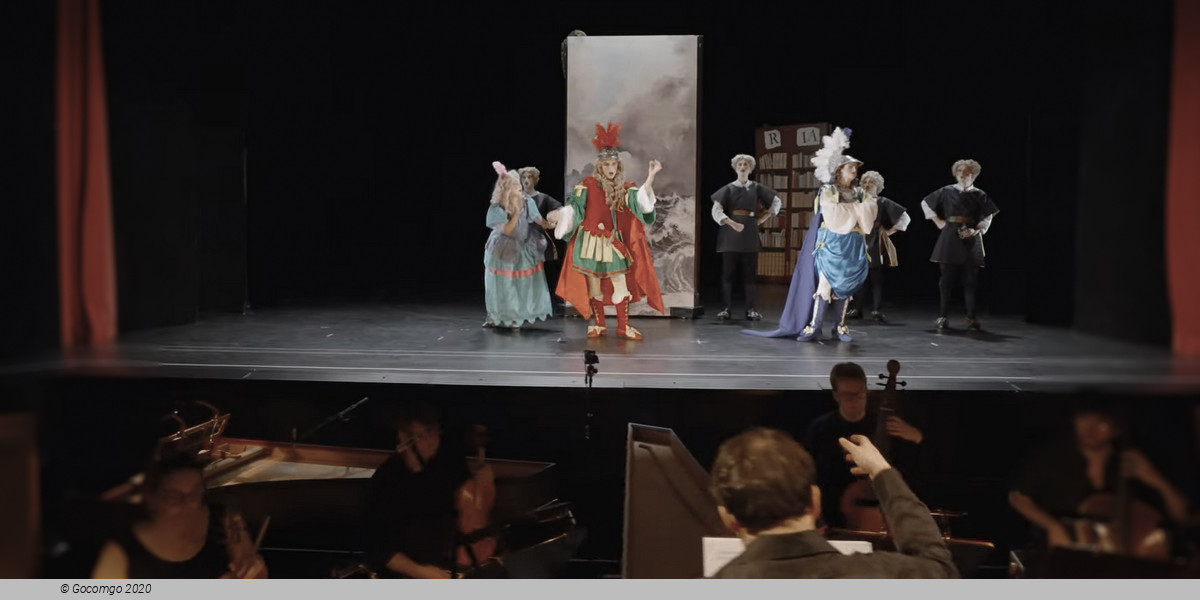
All this takes place in a mythical, pastoral landscape of glades and mountains, where hunters, shepherds, nymphs, and villagers revel together. The interplay of personalities and disguises, combined with a rich array of costumes, gives rise to endless confusions and secret plots.

In the final scene, Mercury, the messenger of the gods, blesses the couples and assures them of lasting happiness amid the love of their people. True to the occasion, Handel designed the finale as a dazzling sequence of jubilant choruses and festive instrumental music — a veritable musical fireworks display to crown the anniversary celebrations of the Festwochen.

As tradition has it, singers who have distinguished themselves in the "Pietro Antonio Cesti" Singing Competition will take on the tangled romances and hunt for the legendary boar: Silvia Porcellini, Oda Nysæter, Justina Vaitkute, Peter Edge, third-place winner Pierre Gennaï, and 2025 winner Salvador Simão.

The directing team will already be familiar to Innsbruck audiences: François de Carpentries and Karine Van Hercke created a striking visual world with "La fida ninfa", which captivated both critics and the public. Andrea Buccarella conducts, leading the orchestra of the Schola Cantorum Basiliensis — an ensemble that impressed audiences at the Cesti Competition with its vitality and finesse.

History
Premiere of this production: 12 May 1736, Covent Garden Theatre, London

Atalanta is a pastoral opera in three acts by George Frideric Handel composed in 1736. It is based upon the mythological female athlete, Atalanta, the libretto (which is in Italian) being derived from the book La Caccia in Etolia by Belisario Valeriani. The identity of the librettist is not known. Handel composed it for the London celebrations of the marriage in 1736 of Frederick, Prince of Wales, eldest son of King George II, to Princess Augusta of Saxe-Gotha. The first performance took place on 12 May 1736 in the Covent Garden Theatre. It closed with a spectacular display of fireworks, which was highly popular with the royal family and the London audience, and the opera and fireworks display were revived a number of times in the year of its first performance.

Synopsis

Loosely based on the mythological story of Atalanta, the opera is set in legendary times of ancient Greece.

Act 1
King Meleagro of Aetolia has disguised himself as a shepherd, taking the pseudonym Tirsi, and is enjoying his life in the countryside away from the cares of state. He is very much in love with the huntress "Amarilli", whom he does not realise is the Princess Atalanta. He meets up with Aminta, a real shepherd, who is desperately in love with the shepherdess Irene, who however when she appears, does nothing but pour scorn on Aminta. He declares he is ready to die for his love but will always be faithful to her.

Nicandro, Irene's father and Meleagro's friend, tells Meleagro that Irene really loves Aminta too but she wants to be sure that he will be true to her.

Princess Atalanta of Arcadia now comes on to the scene. She too has taken another name, Amarilli, and has retreated to the country disguised as a huntress. Everyone prepares to go hunting, but Atalanta will not permit Meleagro to remain by her side during the hunt, although she is really in love with him. When a wild boar comes running out of the woods, Aminta tries to throw himself into its path, so distraught is he by Irene's seeming rejection, but the others prevent him. Atalanta kills the boar and rejoices in her triumph.

Act 2
Everyone is celebrating Atalanta's triumph in killing the wild boar, but she herself is feeling sad because she is in love with "Tirsi". However she, a princess in disguise, cannot marry the simple shepherd "Tirsi", who she does not realise is really King Meleagro, in disguise himself. Meleagro overhears her musing on this unfortunate state of affairs and tries to make his identity known to her but he is painfully shy and so is she and so they do not manage to clear things up. Irene pretends to be in love with Meleagro, but she is only trying to torment Aminta further. Meleagro gives Irene a ribbon and asks her to give it to Atalanta and tell her how much he loves her.

Irene flaunts the ribbon Meleagro has given her to Aminta, pretending that she is really in love with Meleagro. Aminta protests against her cruelty. Atalanta gives Aminta an arrow which she asks him to present to Meleagro without mentioning her name. Meleagro knows she is really in love with him and is quite cheerful, but Atalanta feels that her duty will prevent her from ever confessing her love for him.

Act 3
Irene presents Atalanta with the ribbon Meleagro gave her. Atalanta is touched and sends word to Meleagro that he can learn all about her through Aminta.

Irene then encounters Aminta, who decides to give her some of her own medicine by flaunting the arrow Atalanta gave to him to give to Meleagro. Aminta says Atalanta gave the arrow to him because she is madly in love with him and he loves her too. Irene is furious and Meleagro, who has been watching and listening to this unobserved, is in despair. Irene confesses she has been in love with Aminta all along; Meleagro, left by himself and exhausted from all this emotional turmoil, falls asleep.

Atalanta enters, pondering over the strange coincidence that the ribbon sent to her by the shepherd "Tirsi" looks like the ribbon belonging to King Meleagro. Meleagro wakes up and Atalanta can restrain herself no more; she admits she loves him and they embrace.

Nicandro, Irene and Aminta enter; Irene and Aminta have sorted everything out and admit they love each other. Nicandro tells the shepherd "Tirsi" that the huntress "Amarilli" is really Princess Atalanta and Atalanta that "Tirsi" is really King Meleagro. There is now nothing to stop their marriage and both couples are joyous.

The heavens part and Mercury, messenger from Jove himself, descends on a cloud surrounded by cupids and the Graces. Mercury brings Jove's blessings on the royal couple, assuring them of personal happiness and the love of their people. The work ends with general rejoicings, celebrations, and a display of fireworks.


Venue Info

House of Music Innsbruck - Innsbruck
Location   Universitätstraße 1

Opened in 2018 in the heart of Innsbruck, the Haus der Musik Innsbruck (House of Music Innsbruck) is one of Austria's most modern cultural centres and an important venue of the Innsbruck Festival of Early Music. Located next to the Tiroler Landestheater and close to the city's historic landmarks, the building has quickly established itself as a vibrant home for concerts, opera, chamber music, and educational events.

Designed as a multidisciplinary performing arts centre, the Haus der Musik brings together several of Innsbruck's leading cultural institutions under one roof, including the Tyrolean Symphony Orchestra Innsbruck, the Mozarteum University Salzburg – Department of Innsbruck, and regional music organizations. Its contemporary architecture and flexible performance spaces complement the city's rich musical heritage while supporting innovative artistic projects.

During the Innsbruck Festival of Early Music, the House of Music hosts chamber concerts, vocal recitals, lectures, masterclasses, and special festival events. Its intimate halls and outstanding acoustics provide an ideal setting for historically informed performances, allowing audiences to experience Renaissance and Baroque repertoire with exceptional clarity and immediacy.

The venue's modern design creates a striking contrast with the historic churches, castles, and theatres that also form part of the festival. Together, these spaces illustrate the festival's unique ability to combine centuries-old musical traditions with contemporary concert presentation, enriching the audience's experience while remaining faithful to the spirit of early music.

Beyond the festival, the Haus der Musik serves as one of Tyrol's principal cultural hubs, presenting a year-round programme of classical music, opera, chamber music, jazz, contemporary works, and educational initiatives that support both established artists and emerging talent.

Important Info
Type: Opera
City: Innsbruck, Austria
Duration: 2h 30min with 1 interval
Acts: 3
Intervals: 1
Sung in: Italian
Titles in: German

E-tickets: Print at home or at the box office of the event if so specified. You will find more information in your booking confirmation email.

You can only select the category, and not the exact seats.
If you order 2 or 3 tickets: your seats will be next to each other.
If you order 4 or more tickets: your seats will be next to each other, or, if this is not possible, we will provide a combination of groups of seats (at least in pairs, for example 2+2 or 2+3).

From
$ 127
Top of page