
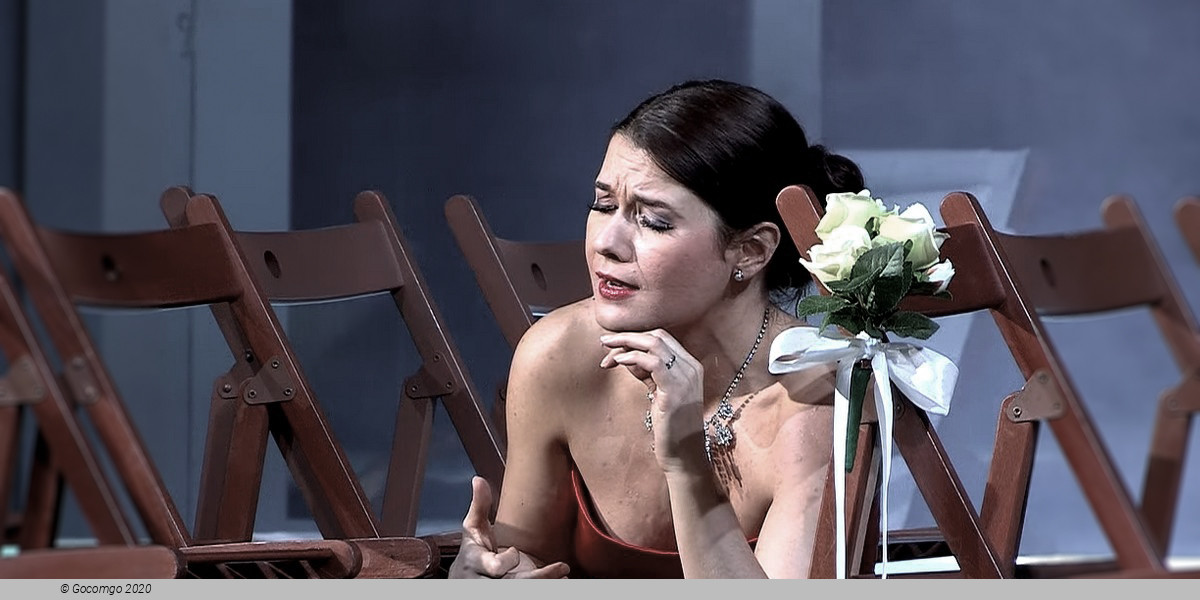
Hong Kong City Hall 1 September 2023 - La Finta Giardiniera | GoComGo.com

La Finta Giardiniera

Hong Kong City Hall, Theatre, Hong Kong, China
All photos (1)
Select date and time
7:30 PM
Request for Tickets
Important Info
Type: Opera
City: Hong Kong, China
Starts at: 19:30
Acts: 3
Intervals: 1
Duration: 2h 30min
Sung in: Italian
Titles in: Chinese,English

E-tickets: Print at home or at the box office of the event if so specified. You will find more information in your booking confirmation email.

You can only select the category, and not the exact seats.
If you order 2 or 3 tickets: your seats will be next to each other.
If you order 4 or more tickets: your seats will be next to each other, or, if this is not possible, we will provide a combination of groups of seats (at least in pairs, for example 2+2 or 2+3).

Overview

A comic opera in 3 acts

History
Premiere of this production: 13 January 1775, Salvatortheater, Munich

La finta giardiniera ("The Pretend Garden-Girl") is an Italian-language opera by Wolfgang Amadeus Mozart. Mozart wrote it in Munich in January 1775 when he was 18 years old and it received its first performance on 13 January at the Salvatortheater in Munich. 

Synopsis

Time: 18th century
Place: Podestà's estate in Lagonero, near Milan

Summary: The story follows Count Belfiore and the Marchioness Violante Onesti, who were lovers before Belfiore stabbed Violante in a fit of rage. The story begins with the revived Violante and her servant Roberto disguised as "Sandrina" and "Nardo," and quietly working in the mansion of the town Podestà. Violante discovers that Belfiore has become engaged to Arminda, the niece of the Podestà, and when Belfiore confesses his lingering love for Violante, Arminda jealously conspires to abduct the other woman. When Violante is found, she and Belfiore lose their minds and believe themselves to be Greek gods. When they regain their senses Violante forgives the Count and they fly to each other's arms. Arminda returns to Cavalier Ramiro, her spurned suitor, and Roberto finds love with Serpetta, another servant of the Podestà.

Act 1
A garden with a wide staircase leading to the mansion of the Podestà.

The Podestà, Cavalier Ramiro and Serpetta descend the staircase as Sandrina and Nardo work in the garden. Together they praise the lovely day, but their happiness is feigned ("Che lieto giorno"). Sandrina is wretched because Don Anchise, the Podestà, is in love with her. Nardo is frustrated by Serpetta, who teases him but refuses to respond to his affections. Ramiro is bitter after being tossed aside by Arminda, and, because she has set her own cap at the Podestà, Serpetta is angry at Sandrina. The Podestà attempts to console Ramiro, but Ramiro can think of none but Arminda ("Se l'augellin sen fugge"). When they are left alone, Don Anchise professes love to Sandrina ("Dentro il mio petto"). Sandrina refuses his advances as politely as possible and, when Serpetta rudely interrupts, makes her escape.

Arminda's betrothed, Count Belfiore, arrives and is swept off his feet by her beauty ("Che beltà"). Arminda is quick to let him know that she is someone to be reckoned with ("Si promette facilmente"), but the Count is not deterred. The Count then boasts of his deeds and ancestry to the Podestà, tracing his family tree to Scipio, Cato and Marcus Aurelius ("Da Scirocco"). Don Anchise responds with a mixture of awe and skepticism, not caring who this buffoon of a Count is as long as he marries his niece.

In the garden, Arminda sees Sandrina and casually mentions her engagement to Belfiore. Stunned, Sandrina faints. When the Count arrives, Arminda leaves him to watch over Sandrina and rushes off to fetch her smelling salts. Belfiore is shocked to find that the gardener's girl is none other than his lost Violante (Finale: "Numi! Che incanto è questo?"). Arminda returns and is surprised to come face to face with Ramiro. Sandrina awakens and finds herself looking directly into the eyes of Belfiore. The Podestà enters and demands an explanation, but no one knows quite what to say. Sandrina wavers but decides not to reveal herself as Violante, while Arminda suspects that she's being deceived. The Podestà blames everything on Serpetta, who in turn blames Sandrina, and Ramiro is only certain of the fact that Arminda still does not love him.

Act 2
A hall in the mansion of the Podestà.

Ramiro discovers Arminda and upbraids her for her inconstancy. When she refuses to listen, he departs, but not before promising revenge upon his rival. Belfiore enters in some distress, muttering that he has had no peace since he found Sandrina. Arminda overhears and confronts him, then leaves ("Vorrei punirti indegno"). Sandrina encounters Belfiore, and nearly betrays herself as Violante when she asks why he stabbed and deserted her. Belfiore is surprised by this outburst and once again sure that he has found his love, but Sandrina quickly reconstructs her disguise. She explains that she is not Violante, but that those were the Marchioness's dying words. Belfiore is nonetheless entranced, since "Sandrina" has the face of Violante, and he begins to serenade her ("Care pupille"). The Podestà interrupts them, and after mistakenly taking the Podestà's hand instead of Sandrina's, Belfiore retreats in embarrassment.

Alone with Sandrina, the Podestà again attempts to woo her. Ramiro interrupts, arriving from Milan with the news that Count Belfiore is wanted for the murder of Marchioness Violante Onesti. Don Anchise summons Belfiore for questioning and the Count, thoroughly baffled, implicates himself. Sandrina says she is Violante and the proceedings break up in confusion. The Count approaches Sandrina but she again denies him. She claims to have pretended to be the Marchioness to save him, and exits. Serpetta arrives moments later to tell the Podestà, Nardo and Ramiro that Sandrina has run away, when she has in fact been abducted by Arminda and Serpetta. The Podestà immediately organizes a search party.

A deserted, mountainous spot.

Abandoned in the wilderness, Sandrina is nearly frightened out of her wits ("Crudeli, fermate!"). Small search parties composed of the Count and Nardo, Arminda, Serpetta, and the Podestà soon arrive (Finale: "Fra quest'ombra"). In the darkness the Podestà mistakes Arminda for Sandrina and she him for the Count, while the Count thinks Serpetta is Sandrina and she takes him for the Podestà. Nardo manages to find Sandrina by following her voice, and Ramiro then appears with footmen and torches. As the embarrassed and mismatched pairs separate, Belfiore and Sandrina find each other and lose their senses. They see themselves as the Greek gods Medusa and Alcides, and the astonished onlookers as forest nymphs. Oblivious of their surroundings, the two begin to dance.

Act 3
The courtyard.

Still believing they are gods from classical Greece, Sandrina and Belfiore pursue Nardo until he distracts them by pointing at the sky ("Mirate che contrasto"). They are entranced, and Nardo is able to make his escape. Sandrina and Belfiore leave, and Arminda and Ramiro enter with a harried Don Anchise. Arminda begs her uncle for permission to marry the Count, and Ramiro demands that the Podestà order Arminda to marry him. Don Anchise becomes confused and tells them to both do what they want, as long as they leave him alone ("Mio Padrone, io dir volevo"). After scorning Ramiro's affections yet again, Arminda leaves. Alone, Ramiro furiously swears he will never love another and that he'll die in misery, far from Arminda ("Va pure ad altri in braccio").

A garden.

No longer delusional, the Count and Sandrina awaken after having slept a discreet distance from one another ("Dove mai son?"). Belfiore makes a final appeal, to which Sandrina admits she is Violante but claims that she loves him no more. The Count is saddened but agrees to leave her. They begin to part, but falter in a matter of minutes and fall into each other's arms ("Tu mi lasci?"). Arminda returns to Ramiro, and Serpetta gives way to Nardo's suit. Left alone, the Podestà accepts his fate philosophically. Perhaps, he says, he will find another Sandrina (Finale: "Viva pur la giardiniera").

Venue Info

Hong Kong City Hall - Hong Kong
Location   Central, Edinburgh Place, 5

Opened in 1962, the Hong Kong City Hall is the first multi-purpose cultural complex ever built for the community of Hong Kong. Occupying an area of 11 000 square metres on the reclaimed seafront of Edinburgh Place, Central, the City Hall was designated as a Grade 1 historic building in 2009. Its major facilities, including a Concert Hall renowned for its outstanding acoustics, a Theatre well-received by professional theatre groups, as well as an Exhibition Hall capturing view of the Victoria Harbour, are housed in the Low Block.

Other minor facilities, such as the Recital Hall, the Exhibition Gallery and the Committee Rooms, which are located in the High Block, are suitable for holding different kinds of events on a small scale.

The old City Hall, built by public contributions in 1869, was a two - storey building with European style colonnades and archways. The building was totally demolished in 1947. During the post-war reconstruction, the idea of rebuilding the City Hall was nurtured due to an imminent need for the revival of culture. The building complex subsequently erected at the present site based on the original design by Professor Gordon Brown, the first Head of Department of Architecture of Hong Kong University, together with his team, was completed by British architects Ronald Phillips and Alan Fitch at the cost of HK$20 million. Its opening ceremony was officiated by Sir Robert Black, the then Governor of Hong Kong, on 2 March 1962. The complex comprises two buildings (High Block and Low Block) and a memorial garden. Its Modernist style with clean lines is a bold deviation from the magnificent Renaissance style of the old City Hall. It has not only greatly enhanced the status of the architectural profession in Hong Kong, but has also taken on the role of popularising arts activities in Hong Kong, promoting eastern and western cultures, as well as expanding the parameters of community activities.

Reputed as one of the most prominent local arts and cultural venues, the Hong Kong City Hall embodies the history of important cultural events and is synonymous with the local cultural development.  Milestone events, such as the early Festival of Hong Kong, the first Hong Kong Arts Festival (1973), the first Festival of Asian Arts (1976), the first Hong Kong International Film Festival (1977) and the first International Arts Carnival (1982), all had their inaugurations at the Hong Kong City Hall.  Its significant role in promoting arts and cultural exchanges is indeed the pride of Hong Kong people.

Over the past five decades, the Hong Kong City Hall has played host to thousands of outstanding local and overseas artists/arts groups, including world-renowned cellist Yo-Yo Ma, the late violinist Isaac Stern, the New York Philharmonic Orchestra, the Vienna Boys’ Choir, the Stuttgart Ballet, the National Theatre of China, Xiang Opera Theatre of Hunan,  Fu Ts’ong, choral master Dame Kiri Te Kanawa and Barbara Fei, Chor Fung Ming Cantonese Opera Troupe and many local professional artists/art groups.  The rich array of programmes staged here has never failed to enthral the audience. Apart from providing opportunities for the audiences to appreciate performances of various art forms, the Hong Kong City Hall has also contributed greatly to the nurturing of local artistic and cultural talent through the provision of rental subsidy and use of professional venues and auxiliary facilities.

The City Hall High Block also housed the first public library and art museum in Hong Kong. Being the first public library in Hong Kong, the City Hall Public Library was officially opened on 5 March 1962. It is also one of the first six public libraries which apply the Radio Frequency Identification (RFID) technology to provide readers with convenient and efficient smart identification self-charging and self-returning services. Its facilities and services have expanded over the past five decades. Various computer facilities are provided to facilitate the search, reservation and renewal of library materials, as well as the use of electronic resources, databases and digitalised audio-visual materials. Its collection increases from an initial stock of 20 000 items to over 537 000 items, and special reference libraries and thematic collections, such as the Business and Industry Library, the Creativity and Innovation Resource Centre, and the Basic Law Library have been set up. In mid-2014, the Cultural and Historical Resources Corner of Central and Western District was also established to provide information on the culture, history and community development of the District. 

The inauguration of the Hong Kong City Hall also gave birth to modern museum services in Hong Kong. City Museum and Art Gallery, the predecessor of the Hong Kong Museum of History and the Hong Kong Museum of Art, was located on the top floors of the High Block. With an increasing number of exhibition programmes and museum collections after years of acquisition and collection efforts, City Museum and Art Gallery was officially split into the two said museums and relocated to Tsim Sha Tsui for further enhanced services.    

Over the past decades, the Hong Kong City Hall has remained an important cultural hub for the community despite the opening of new civic centres.  Like any fine musical instrument which needs to be maintained and fine-tuned from time to time for the best performance, the City Hall underwent renovations in 1993 and 2010 respectively to keep abreast of social changes and the development of arts and culture in Hong Kong.  While the original architectural style of the City Hall has been retained, modern elements were added to the outlook of the venue.

For the people of Hong Kong, the significance of the Hong Kong City Hall goes far beyond the boundaries of arts and culture.  This 1960s building remains a landmark of the Central District.  While the shrine at the Memorial Garden houses records of wartime sufferings in the territory, the Marriage Registry, which was opened in the same year as the City Hall, bears witness to an important milestone for countless couples who have moved on to a new stage in their life.

Over the past 50 years, the Hong Kong City Hall has stood by the people of Hong Kong through thick and thin.  It not only offers a stage for artists to display their talent, but also forms part of our collective memories.  In the years to come, it will continue to serve as a source of inspiration for artists and contribute to the continual and multi-faceted development of the arts in Hong Kong.

Important Info
Type: Opera
City: Hong Kong, China
Starts at: 19:30
Acts: 3
Intervals: 1
Duration: 2h 30min
Sung in: Italian
Titles in: Chinese,English
Top of page