
Felsenreitschule tickets 15 August 2026 - Saint François d’Assise | GoComGo.com

Saint François d’Assise

Felsenreitschule, Salzburg, Austria
All photos (2)
Select date and time
5 PM
From
US$ 101

E-tickets: Print at home or at the box office of the event if so specified. You will find more information in your booking confirmation email.

You can only select the category, and not the exact seats.
If you order 2 or 3 tickets: your seats will be next to each other.
If you order 4 or more tickets: your seats will be next to each other, or, if this is not possible, we will provide a combination of groups of seats (at least in pairs, for example 2+2 or 2+3).

Important Info
Type: Opera
City: Salzburg, Austria
Starts at: 17:00
Acts: 3
Sung in: French
Titles in: German,English

E-tickets: Print at home or at the box office of the event if so specified. You will find more information in your booking confirmation email.

You can only select the category, and not the exact seats.
If you order 2 or 3 tickets: your seats will be next to each other.
If you order 4 or more tickets: your seats will be next to each other, or, if this is not possible, we will provide a combination of groups of seats (at least in pairs, for example 2+2 or 2+3).

Cast
Performers
Baritone: Russell Braun (Brother Leo)
Orchestra: Vienna Philharmonic
Conductor: Maxime Pascal
Choir: Concert Association of the Vienna State Opera Chorus
Soprano: Lauranne Oliva (The Angel)
Tenor: Léo Vermot-Desroches (Brother Masseo)
Bass-Baritone: Philippe Sly (Saint Francis)
Tenor: Sean Panikkar (The Leper)
Creators
Composer: Olivier Messiaen
Director: Romeo Castellucci
Overview

New production

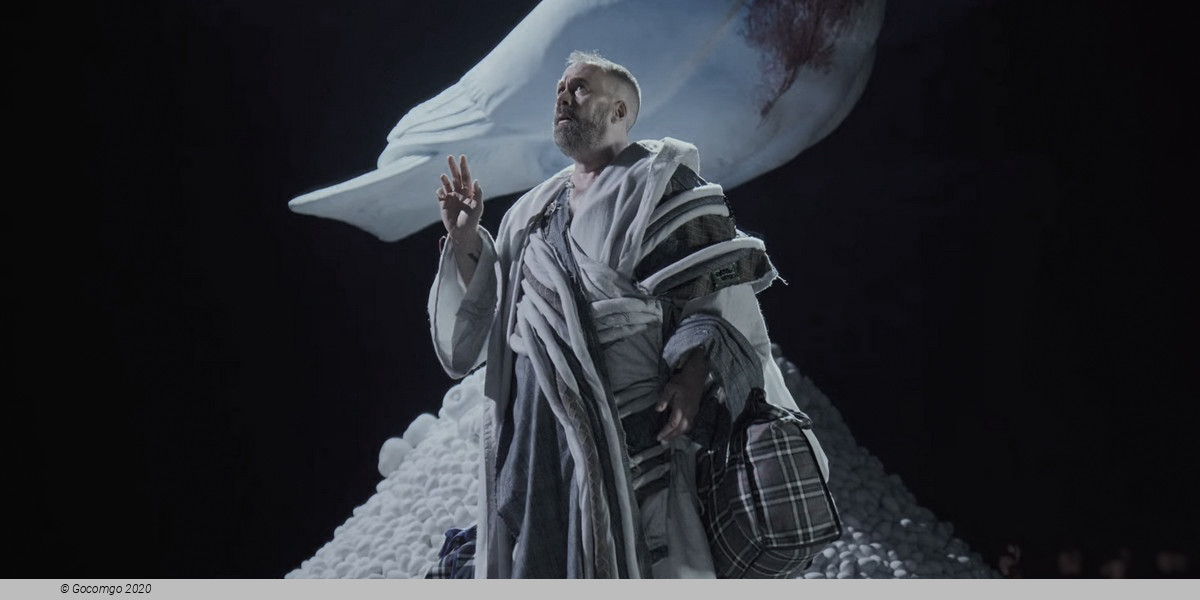
In the breadth of its worldview and the intensity of sensual experience that it contains – not to mention the sheer artistic audacity of its creator – Olivier Messiaen’s opera Saint François d’Assise occupies a position in the second half of the 20th century akin to that of Richard Wagner’s Tristan und Isolde in the 19th. It, too, is a major work of music history – indeed a key work of its time. These two stage works are also linked by the theme of love. It is in each case an immeasurable love that culminates in death, though in Wagner it is the love between a man and a woman, whereas in Messiaen it is the love of a man for Jesus Christ.

Even when he was a child, Messiaen was deeply religious and felt closely connected to the Roman Catholic Church. While his compositions were being performed by the most renowned orchestras of Europe and the USA, Messiaen spent decade after decade playing the organ for the services at the church of La Trinité in Paris. Throughout his life, he remained committed to this dual identity as a joyfully adventurous composer and a Christian steeped in his faith. We can already observe this duality in his outstanding piano cycle Vingt Regards sur l’Enfant-Jésus (Twenty contemplations of the Infant Jesus), which lasts over two hours and was composed in 1944, almost 40 years before the world premiere of his Saint François d’Assise.

But there was a third dimension to Messiaen the composer: his passion for ornithology. In 1952, he began to write down the music of birdsongs in what became dozens of little notebooks. He travelled across the continents, searching all the while for new birdsongs. They became a source of inspiration in his compositions for piano and for orchestra, and ultimately also – in their most perfect manifestation – in his only opera, which is appropriately dedicated to the saint who spoke to the birds.

Messiaen’s opera is an extraordinary work, not least in terms of the immense vocal and orchestral forces that it requires, and that are responsible for the rarity of its performances. 2026 marks the 800th anniversary of the death of St Francis of Assisi, though commemorating this event is just one of many reasons why we should engage with this monumental opera. Saint François d’Assise still has fundamental things to tell us today, and is a work that communicates an existential experience. To encounter St Francis is to enter into a spiritual sphere that makes the highest demands of us. For as Messiaen himself recognized, St Francis was astonishingly radical. This was revealed in his permanent break with his past and his family, in his striving for the most extreme poverty, in his celebration of both the beautiful and the ugly, of both life and death – and in his obsessive relationship with the sufferings of Christ, even to the point of wanting to live out those sufferings himself. This radicalism is far removed from the image of St Francis that the Church likes to convey to tourists, and far removed from those cloying depictions of him that understate the spiritual power and revolutionary energy of both the saint himself and what he has to tell us.

Messiaen’s engagement with St Francis was a process that took several decades, making this, his magnum opus, a consolidation of his entire life as a composer. The return of Saint François d’Assise to Salzburg opens up the Poverello’s ‘path of grace’ once more. It is now up to us to follow him and to accompany Messiaen in the footsteps of the man he questioned constantly in order both to understand him better and to love him more deeply.

This new production for Salzburg brings the director Romeo Castellucci and the conductor Maxime Pascal back to the Felsenreitschule. The baritone Philippe Sly is making his debut in a role that is unique in the operatic repertory, offering a deeply human experience and a metaphysical quest that is close to the Earth, to its stones and to the immensity that we carry within us.

 Christian Longchamp

Translation: Chris Walton

History
Premiere of this production: 28 November 1983, Palais Garnier, Paris

Saint François d'Assise: Scènes Franciscaines (English: Franciscan Scenes of Saint Francis of Assisi), or simply Saint François d'Assise, is an opera in three acts and eight scenes by French composer Olivier Messiaen, who was also its librettist; written from 1975 to 1979, with orchestration and copying from 1979 to 1983. It concerns Saint Francis of Assisi, the titular character, and displays Messiaen's devout Catholicism. The premiere was given by the Paris Opera at the Palais Garnier on 28 November 1983. The work was published eight years later in 1991. Messiaen's only opera, it is considered his magnum opus.

Synopsis

Place: Italy.
Time: 13th century.

The subject of each scene is borrowed from the Fioretti and the Reflexions on the Stigmata, books written by anonymous Franciscans of the 14th century. There are seven characters: Saint Francis, the Leper, the Angel, Brother Elias, and three Brothers especially beloved of Saint Francis—Brother Leo, Brother Masseo, and Brother Bernard. Throughout the work one can see the progress of grace in the soul of Saint Francis.

Act 1
Scene 1: The Cross

After a short instrumental introduction, Saint Francis explains to Brother Leo that for the love of Christ he must patiently endure all contradictions, all suffering. This is the "Perfect joy."

Scene 2: Lauds

After the recitation of Matins by the Brothers, Saint Francis, remaining alone, prays that he might meet a leper and be capable of loving him.

Scene 3: The Kissing of the Leper

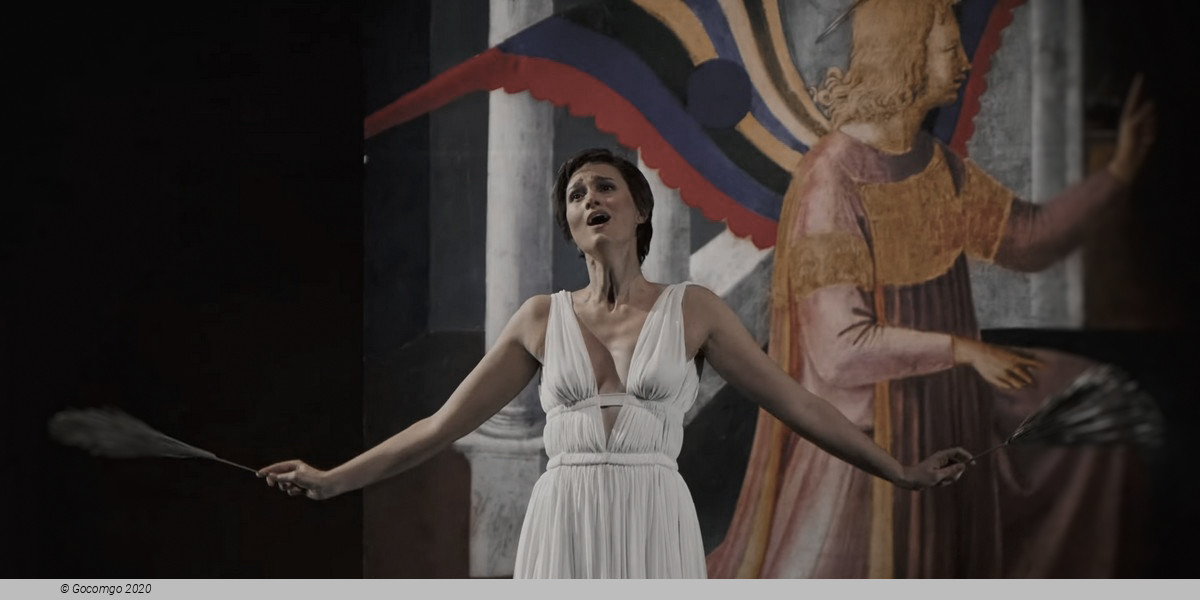
At a leper-hospital, a leper, horribly blood-stained and covered in pustules, rails against his disease. Saint Francis enters and, sitting close to him, speaks gently. An angel appears behind a window and says: "Leper, your heart accuses you, but God is greater than your heart." Troubled by the voice and by the goodness of Saint Francis, the leper is stricken with remorse. Saint Francis embraces him and, miraculously, the leper is cured and dances for joy. More important than the cure of the leper is the growth of grace in the soul of Saint Francis and his exultation at having triumphed over himself.

Act 2
Scene 4: The Journeying Angel

On a forest road on La Verna an angel appears, disguised as a traveler. His knocking on the door of the monastery makes a terrific sound, symbolising the inrush of Grace. Brother Masseo opens the door. The Angel asks Brother Elias, the vicar of the Order, a question about predestination. Brother Elias refuses to answer and pushes the Angel outside. The Angel knocks on the door again and puts the same question to Brother Bernard, who replies with much wisdom. The Angel having gone, Brother Bernard and Brother Masseo look at each other, Bernard remarking, "Perhaps it was an angel..."

Scene 5: The Angel-Musician

The Angel appears to Saint Francis and, to give him a foretaste of celestial bliss, plays him a solo on his viol. This solo is so glorious that Francis swoons.

Scene 6: The Sermon to the Birds

Set at Assisi, at the Carceri, with a large green oak tree in spring with many birds singing. Saint Francis, followed by Brother Masseo, preaches a sermon to the birds and solemnly blesses them. The birds reply with a great chorus in which are heard not only birds of Umbria, especially the blackcap, but also birds of other countries, of distant lands, notably the Isle of Pines, close to New Caledonia.

Act 3
Scene 7: The Stigmata

On La Verna at night in a cave beneath an overhanging rock, Saint Francis is alone. A great Cross appears. The voice of Christ, symbolized by a choir, is heard almost continuously. Five luminous beams dart from the Cross and successively strike the two hands, the two feet, and the right side of Saint Francis, with the same terrific sound that accompanied the Angel's knocking. These five wounds, which resemble the five wounds of Christ, are the divine confirmation of Saint Francis's holiness.

Scene 8: Death and the New Life

Saint Francis is dying, stretched out at full length on the ground. All the Brothers are around him. He bids farewell to all those he has loved, and sings the last verse of his Canticle of the Sun, the verse of "our sister bodily Death". The Brothers sing Psalm 141. The Angel and the Leper appear to Saint Francis to comfort him. Saint Francis utters his last words: "Lord! Music and poetry have led me to Thee in default of Truth dazzle me for ever by Thy excess of Truth..." He dies. Bells ring. Everything disappears. While the choir hymns the Resurrection, a patch of light illuminates the spot where the body of Saint Francis previously lay. The light increases until it becomes blinding; the choir altogether singing the word "joy". The curtain falls.

Venue Info

Felsenreitschule - Salzburg
Location   Hofstallgasse 1

The Felsenreitschule (literally "rock riding school") is a theatre in Salzburg, Austria and a venue of the Salzburg Festival.

History

A first Baroque theatre was erected in 1693–94 at the behest of the Salzburg prince-archbishop Johann Ernst von Thun, according to plans probably designed by Johann Bernhard Fischer von Erlach. Built in the former Mönchsberg quarry for conglomerate rock used in the new Salzburg Cathedral construction, it was located next to the archiepiscopal stables (at the site of the present Großes Festspielhaus) and used as a summer riding school and for animal hunts. The audience was seated in 96 arcades carved into the Mönchsberg rock on three floors. After the secularisation of the prince-archbishopric, the premises were used by the cavalry of the Austrian Imperial-Royal Army as well as by Bundesheer forces after World War I.

From 1926, the Felsenreitschule was used as an open-air theatre for performances of the Salzburg Festival. With the auditorium reversed, the former audience arcades now served as a natural stage setting. The first production was Carlo Goldoni's The Servant of Two Masters, directed by Max Reinhardt. In 1933, Clemens Holzmeister designed for Max Reinhardt the "Faust Town", a multiple-stage setting for Reinhardt's legendary production of Goethe's Faust.

In 1948 Herbert von Karajan first used the Felsenreitschule as an opera stage, for performances of Christoph Willibald Gluck's Orfeo ed Euridice. This was followed in 1949 by the premiere of Carl Orff's setting of the ancient tragedy Antigone by Sophocles, translated into German by Friedrich Hölderlin, conducted by Ferenc Fricsay. Between 1968 and 1970, the Felsenreitschule was again remodeled according to plans by Clemens Holzmeister and inaugurated with Ludwig van Beethoven's Fidelio under the baton of Karl Böhm.

Architecture

The stage has a width of 40 metres (130 ft), and 4 metres (13 ft) understage. Also renovated was the cantilevered grandstand with the underlying scene dock. A light-tight, rain tarp to dampen the noise and protect the stage was also added. This roof can be opened. The theater holds 1412 seats and 25 standing places.

Between the summers of 2010 and 2011 festival, the roof was renewed: The new design added 700 square metres (7,500 sq ft) of floor space for equipment and rehearsal rooms. The new pitched roof consists of three mobile segment surfaces and is on five telescopic arms and can be extended and retracted in six minutes. Suspension points on telescopic supports for stage equipment (hoists), improved sound and heat insulation, and two lighting bridges optimize the action on stage. The Felsenreitschule shares its foyer with the Kleines Festspielhaus (House for Mozart).

In popular culture
The Felsenreitschule was used as a location for the 1965 film version of The Sound of Music. It appears as the site of the Salzburg music festival from which the von Trapp family disappear.

Important Info
Type: Opera
City: Salzburg, Austria
Starts at: 17:00
Acts: 3
Sung in: French
Titles in: German,English
Top of page