
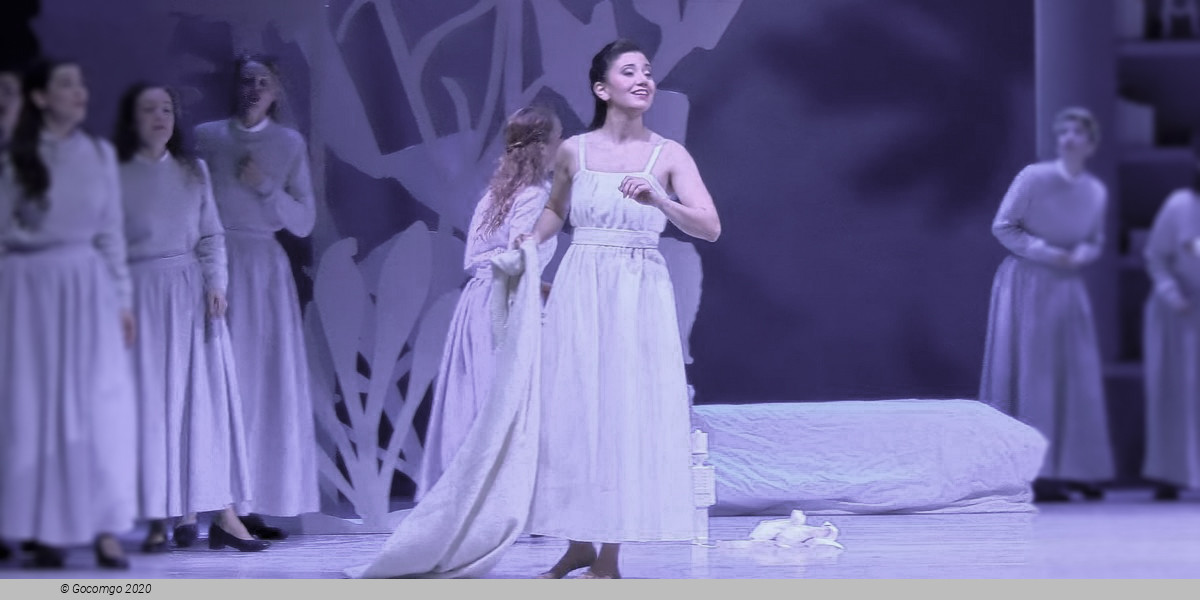
Felsenreitschule tickets 2 August 2026 - Lucio Silla (Semi-staged performance) | GoComGo.com

Lucio Silla (Semi-staged performance)

Felsenreitschule, Salzburg, Austria
All photos (1)
Select date and time
3 PM

E-tickets: Print at home or at the box office of the event if so specified. You will find more information in your booking confirmation email.

You can only select the category, and not the exact seats.
If you order 2 or 3 tickets: your seats will be next to each other.
If you order 4 or more tickets: your seats will be next to each other, or, if this is not possible, we will provide a combination of groups of seats (at least in pairs, for example 2+2 or 2+3).

Important Info
Type: Opera
City: Salzburg, Austria
Starts at: 15:00
Acts: 3
Sung in: Italian
Titles in: German,English

E-tickets: Print at home or at the box office of the event if so specified. You will find more information in your booking confirmation email.

You can only select the category, and not the exact seats.
If you order 2 or 3 tickets: your seats will be next to each other.
If you order 4 or more tickets: your seats will be next to each other, or, if this is not possible, we will provide a combination of groups of seats (at least in pairs, for example 2+2 or 2+3).

Cast
Performers
Conductor: Ádám Fischer
Tenor: Giovanni Sala (Lucio Silla)
Soprano: Lilit Davtyan (Celia)
Soprano: Martina Russomanno (Lucio Cinna)
Orchestra: Mozarteum Orchestra Salzburg
Choir: Salzburg Bach Choir
Soprano: Sara Blanch (Giunia)
Mezzo-Soprano: Xenia Puskarz Thomas (Cecilio)
Creators
Composer: Wolfgang Amadeus Mozart
Director: Birgit Kajtna-Wönig
Librettist: Giovanni de Gamerra
Overview

It was with his Mitridate in 1770 that the 14-year-old Mozart enjoyed his first operatic success before the Italian public. In March the following year, the Teatro Regio Ducale in Milan accordingly decided to commission another work from him, this time to open the 1772/73 carnival season: Lucio Silla. It was also intended to continue Mozart’s operatic success by linking up with the topic of Mitridate – after all, it had been the Roman general Lucius Cornelius Sulla (138–78 bc) who had kept Mithridates VI and his armies at bay. But the historical figure of Sulla (also known as ‘Silla’) is primarily remembered as a cruel dictator who publicly ostracized his opponents and caused their ruin. And it’s as a brutal tyrant that he is also initially portrayed in Mozart. The senator Cecilio has been ostracized but returns secretly to Rome. He wants to put an end to Silla’s rule and to free his fiancée Giunia, with whom the dictator has meanwhile fallen in love. The patrician Lucio Cinna aims to help Cecilio in his endeavours. One of his tribunes advises Silla to marry Giunia against her will, while Silla’s own sister Celia, who is secretly in love with Cinna, urges him to be lenient. Cecilio and Cinna’s attempts to assassinate Silla fail. And Giunia is not prepared to marry Silla, even if it will save Cecilio’s life. To the astonishment of all, Silla ultimately forgives his enemies and unites both pairs of lovers.

Giovanni de Gamerra was a newcomer to the field of libretto writing. He nevertheless occasionally went beyond the common-or-garden formulae of opera seria by creating more complex, larger-scale scenes. De Gamerra’s predilection for gloomy dungeon and cemetery scenes also gave Mozart an opportunity to experiment with new expressive possibilities. In Giunia’s virtuoso arias in particular, Mozart revealed an astonishing flair for crafting the psychology of a role through music. Lucio Silla was an impressive success, enjoying 26 performances, but was nevertheless destined to be Mozart’s last opera for Italy.

David Treffinger

Translation: Chris Walton

History
Premiere of this production: 26 December 1772, Teatro Regio Ducale, Milan

Lucio Silla is an Italian opera seria in three acts composed by Wolfgang Amadeus Mozart at the age of 16. The libretto was written by Giovanni de Gamerra, revised by Pietro Metastasio. It was first performed on 26 December 1772 at the Teatro Regio Ducale in Milan and was regarded as "a moderate success". Handel's opera Silla (1713) covered the same subject. Other operas with the same title were also composed by Leonardo Vinci (1723), Pasquale Anfossi (1774), and Johann Christian Bach (1776).

Synopsis

The story concerns the Roman dictator Lucio Silla (Lucius Sulla) who lusts after Giunia, the daughter of his enemy Gaius Marius. Giunia, on the other hand, loves the exiled senator Cecilio.

Act 1
Scene 1: A secluded spot on the banks of the Tiber'

The exiled Senator Cecilio meets his friend Cinna who tells him his betrothed Giunia mourns his death, a lie by the dictator Silla so that he can win her for himself. Cinna advises Cecilio to meet Giunia by the tomb of her father (murdered hero Gaius Marius). Cecilio is filled with joy at the idea and Cinna shares his joy and predicts the freedom of Rome (aria: "Vieni ov' amor t' inita").

Scene 2

Cecilio excited at the prospect of meeting his betrothed sings of his love (aria: "Il tenero momento").

Scene 3: Giunia's apartments

Silla seeks the advice of his sister Celia on his approach with Giunia and she advises subtlety and kindness (aria: "Se lusinghiera speme").

Scene 4

On Silla's approach, Giunia declares her love for Cecilio and her hate for Silla, her father's enemy (aria: "Dalla sponda tenebrosa").

Scene 5

Alone, Silla, insulted, decides to behave as a tyrant (aria: "Il desìo di vendetta, e di morte").

Scene 6

Cecilio waits by the tomb for Giunia.

Scene 7

Giunia arrives (chorus and ariosa: "Fuor di queste urne dolente").

Act 2
An archway decorated with military trophies

Silla is joined by Celia to whom he tells of his plans to wed Giunia and for Celia to wed her beloved Cinna on this day.

Scene 3

Cinna restrains Cecilio who has his sword drawn trying to follow Silla, believing he has been instructed by the spirit of Gaius Marius to seek revenge. Cinna tells him to consider Giunia and his rage is controlled (aria: "Quest' improvviso trèmito").

Scene 4

Giunia consults with Cinna who suggests she accept Silla's proposal and then murder him in their wedding bed. Giunia refuses, stating that vengeance is for Heaven alone to consider. She asks Cinna to make sure that Cecilio stays hidden from danger (aria: "Ah se il crudel periglio").

Scene 5

Cinna resolves to kill Silla himself (aria: "Nel fortunato istante").

Scene 6, Hanging gardens

Silla's love for Giunia starts to bring out his compassion.

Scene 7

Giunia's hateful face angers him again and he threatens her with death but not to die alone (aria: "D' ogni pieta mi spoglio").

Scene 8

With Cecilio, Giunia worries about Silla's words and they part.

Scene 9

Celia asks Giunia to accept Silla's proposal for the sake of happiness saying she is also to be married to Cinna (aria: "Quando sugl' arsi campi").

Scene 10

Giunia ponders her wretchedness.

Scene 11, the Capitol

Silla asks the Senate and the people of Rome to reward him as a hero of Rome with the marriage to Giunia.

Scene 12

When Cecilio appears, there is confrontation (trio: "Quell' orgoglioso sdegno").

Act 3
Scene 1: Entrance to the dungeons

Cecilio has been imprisoned. Cinna and Celia has gained access and Cinna asks Celia to convince Cecilio to repent and forget his love. Cinna promises to marry Celia if she is successful, for which she is hopeful (aria: "Strider sento la procella").

Scene 2

Whilst Cecilio accepts his fate Cinna tells him not to worry, Silla's heart over his head will bring about his own downfall (aria: "De' più superbi il core").

Scene 3

Silla has allowed Giunia one last visit to Cecilio and they say their farewells (aria: "Pupille amate").

Scene 4

Giunia alone with her thoughts of Cecilio's impending death thinks of her own (aria: "Frà I pensier più funesti di morte").

Scene 5: The audience chamber

Before the Senators and the people of Rome, to everybody's surprise, Silla declares that he wishes Cecilio to live and marry Giunia. When questioned on his silence, Cinna declares his hatred of Silla and his intention of killing him. Silla issues his "punishment" to Cinna that he should marry his beloved Celia. He further declares that he will step down as dictator and restore liberty to Rome. He explains that he has seen proof that innocence and a virtuous heart is triumphant over power and glory. The people of Rome celebrate liberty and the greatness of Silla.

Venue Info

Felsenreitschule - Salzburg
Location   Hofstallgasse 1

The Felsenreitschule (literally "rock riding school") is a theatre in Salzburg, Austria and a venue of the Salzburg Festival.

History

A first Baroque theatre was erected in 1693–94 at the behest of the Salzburg prince-archbishop Johann Ernst von Thun, according to plans probably designed by Johann Bernhard Fischer von Erlach. Built in the former Mönchsberg quarry for conglomerate rock used in the new Salzburg Cathedral construction, it was located next to the archiepiscopal stables (at the site of the present Großes Festspielhaus) and used as a summer riding school and for animal hunts. The audience was seated in 96 arcades carved into the Mönchsberg rock on three floors. After the secularisation of the prince-archbishopric, the premises were used by the cavalry of the Austrian Imperial-Royal Army as well as by Bundesheer forces after World War I.

From 1926, the Felsenreitschule was used as an open-air theatre for performances of the Salzburg Festival. With the auditorium reversed, the former audience arcades now served as a natural stage setting. The first production was Carlo Goldoni's The Servant of Two Masters, directed by Max Reinhardt. In 1933, Clemens Holzmeister designed for Max Reinhardt the "Faust Town", a multiple-stage setting for Reinhardt's legendary production of Goethe's Faust.

In 1948 Herbert von Karajan first used the Felsenreitschule as an opera stage, for performances of Christoph Willibald Gluck's Orfeo ed Euridice. This was followed in 1949 by the premiere of Carl Orff's setting of the ancient tragedy Antigone by Sophocles, translated into German by Friedrich Hölderlin, conducted by Ferenc Fricsay. Between 1968 and 1970, the Felsenreitschule was again remodeled according to plans by Clemens Holzmeister and inaugurated with Ludwig van Beethoven's Fidelio under the baton of Karl Böhm.

Architecture

The stage has a width of 40 metres (130 ft), and 4 metres (13 ft) understage. Also renovated was the cantilevered grandstand with the underlying scene dock. A light-tight, rain tarp to dampen the noise and protect the stage was also added. This roof can be opened. The theater holds 1412 seats and 25 standing places.

Between the summers of 2010 and 2011 festival, the roof was renewed: The new design added 700 square metres (7,500 sq ft) of floor space for equipment and rehearsal rooms. The new pitched roof consists of three mobile segment surfaces and is on five telescopic arms and can be extended and retracted in six minutes. Suspension points on telescopic supports for stage equipment (hoists), improved sound and heat insulation, and two lighting bridges optimize the action on stage. The Felsenreitschule shares its foyer with the Kleines Festspielhaus (House for Mozart).

In popular culture
The Felsenreitschule was used as a location for the 1965 film version of The Sound of Music. It appears as the site of the Salzburg music festival from which the von Trapp family disappear.

Important Info
Type: Opera
City: Salzburg, Austria
Starts at: 15:00
Acts: 3
Sung in: Italian
Titles in: German,English
Top of page