
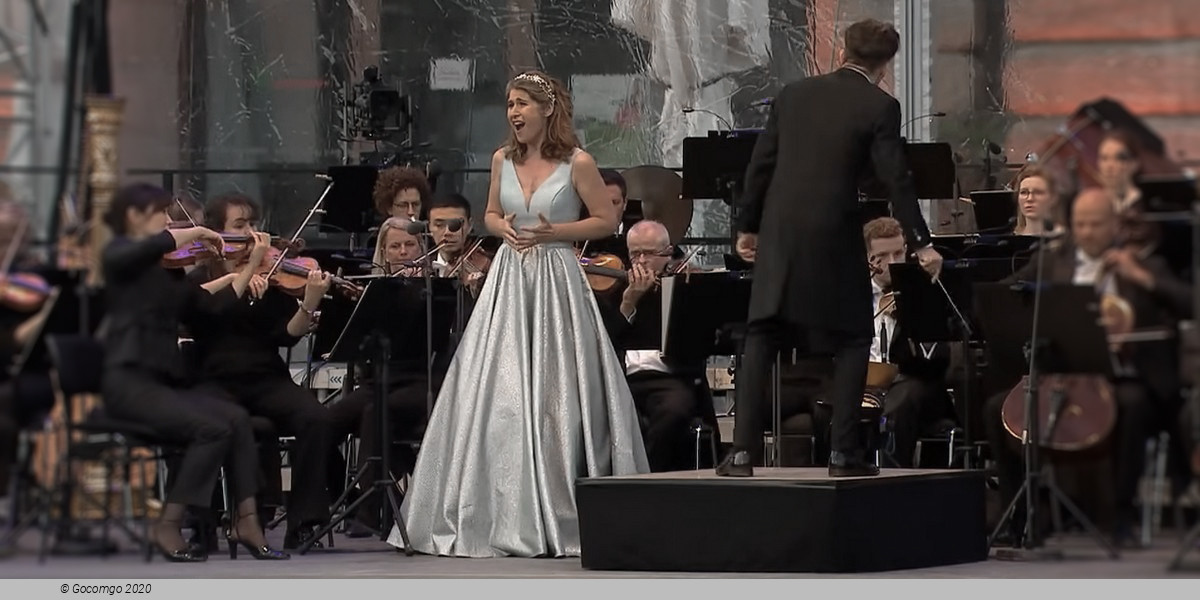
Felsenreitschule tickets 20 October 2026 - Der Prinz von Homburg (Concert performance) | GoComGo.com

Der Prinz von Homburg (Concert performance)

Felsenreitschule, Salzburg, Austria
All photos (1)
Select date and time
7:30 PM
From
US$ 86

E-tickets: Print at home or at the box office of the event if so specified. You will find more information in your booking confirmation email.

You can only select the category, and not the exact seats.
If you order 2 or 3 tickets: your seats will be next to each other.
If you order 4 or more tickets: your seats will be next to each other, or, if this is not possible, we will provide a combination of groups of seats (at least in pairs, for example 2+2 or 2+3).

Important Info
Type: Opera in Concert
City: Salzburg, Austria
Starts at: 19:30

E-tickets: Print at home or at the box office of the event if so specified. You will find more information in your booking confirmation email.

You can only select the category, and not the exact seats.
If you order 2 or 3 tickets: your seats will be next to each other.
If you order 4 or more tickets: your seats will be next to each other, or, if this is not possible, we will provide a combination of groups of seats (at least in pairs, for example 2+2 or 2+3).

Cast
Performers
Conductor: Ingo Metzmacher
Mezzo-Soprano: Tanja Ariane Baumgartner
Baritone: Georg Nigl
Soprano: Kathrin Zukowski
Baritone: Lauri Vasar
Tenor: Maximilian Schmitt
Orchestra: ORF Vienna Radio Symphony Orchestra
Creators
Composer: Hans Werner Henze
Overview

"And the firm belief grows within us that sentiment alone can save us!"

Opera in three acts and nine scenes (composed 1958—9, premiered in 1960)

Libretto by Ingeborg Bachmann after the drama Prinz Friedrich von Homburg by Heinrich von Kleist

Sung in German with German and English surtitles

The Battle of Fehrbellin is imminent. The Elector of Brandenburg, his retainers and his niece, Princess Natalie, are searching for General Prince Friedrich von Homburg. They find him sleepwalking in the garden of the palace, dreaming of his military victories and of marriage to Natalie. But in the ensuing battle, he disobeys his Elector’s orders, following his intuition instead. Although the army of Brandenburg emerges victorious from the fight, the Prince is sentenced to death for his disobedience. He pleads anxiously for his life, at which the Elector puts him to the test: If he considers the judgement of his court martial to be unjust, then he may go free. The Prince now has to decide between his feelings and the law. Ultimately, he accepts his death sentence with composure. Impressed by Homburg’s inner stature, the Elector is now also able to follow his own feelings and pardon him.

Hans Werner Henze and Ingeborg Bachmann hesitated for a long time before setting to work on Der Prinz von Homburg in 1958. This was because the original play by Heinrich von Kleist had been highly exploited by the National Socialists, who had interpreted it as a patriotic Prussian drama glorifying war. But it was precisely this misuse that had to be counteracted decisively. In her reworking of the text, Bachmann reduced the military tone of Kleist’s language. She also emphasized both the love story between the Prince and Natalie and the play’s conflict between sentiment and reasons of state. This contrast also permeates Henze’s composition. His juxtaposition of different tone colours and different formal and stylistic elements makes the duality between the world of dreams and the world as it really is directly tangible. Henze and Bachmann adopt a clear stance that situates them between these two poles. According to Henze, their opera is ‘about glorifying a dreamer and about destroying the concept of the classical hero; it’s against a blind, unimaginative application of the law and glorifies human kindness’.

David Treffinger · Translation: Chris Walton

Venue Info

Felsenreitschule - Salzburg
Location   Hofstallgasse 1

The Felsenreitschule (literally "rock riding school") is a theatre in Salzburg, Austria and a venue of the Salzburg Festival.

History

A first Baroque theatre was erected in 1693–94 at the behest of the Salzburg prince-archbishop Johann Ernst von Thun, according to plans probably designed by Johann Bernhard Fischer von Erlach. Built in the former Mönchsberg quarry for conglomerate rock used in the new Salzburg Cathedral construction, it was located next to the archiepiscopal stables (at the site of the present Großes Festspielhaus) and used as a summer riding school and for animal hunts. The audience was seated in 96 arcades carved into the Mönchsberg rock on three floors. After the secularisation of the prince-archbishopric, the premises were used by the cavalry of the Austrian Imperial-Royal Army as well as by Bundesheer forces after World War I.

From 1926, the Felsenreitschule was used as an open-air theatre for performances of the Salzburg Festival. With the auditorium reversed, the former audience arcades now served as a natural stage setting. The first production was Carlo Goldoni's The Servant of Two Masters, directed by Max Reinhardt. In 1933, Clemens Holzmeister designed for Max Reinhardt the "Faust Town", a multiple-stage setting for Reinhardt's legendary production of Goethe's Faust.

In 1948 Herbert von Karajan first used the Felsenreitschule as an opera stage, for performances of Christoph Willibald Gluck's Orfeo ed Euridice. This was followed in 1949 by the premiere of Carl Orff's setting of the ancient tragedy Antigone by Sophocles, translated into German by Friedrich Hölderlin, conducted by Ferenc Fricsay. Between 1968 and 1970, the Felsenreitschule was again remodeled according to plans by Clemens Holzmeister and inaugurated with Ludwig van Beethoven's Fidelio under the baton of Karl Böhm.

Architecture

The stage has a width of 40 metres (130 ft), and 4 metres (13 ft) understage. Also renovated was the cantilevered grandstand with the underlying scene dock. A light-tight, rain tarp to dampen the noise and protect the stage was also added. This roof can be opened. The theater holds 1412 seats and 25 standing places.

Between the summers of 2010 and 2011 festival, the roof was renewed: The new design added 700 square metres (7,500 sq ft) of floor space for equipment and rehearsal rooms. The new pitched roof consists of three mobile segment surfaces and is on five telescopic arms and can be extended and retracted in six minutes. Suspension points on telescopic supports for stage equipment (hoists), improved sound and heat insulation, and two lighting bridges optimize the action on stage. The Felsenreitschule shares its foyer with the Kleines Festspielhaus (House for Mozart).

In popular culture
The Felsenreitschule was used as a location for the 1965 film version of The Sound of Music. It appears as the site of the Salzburg music festival from which the von Trapp family disappear.

Important Info
Type: Opera in Concert
City: Salzburg, Austria
Starts at: 19:30
Top of page