
Beijing National Grand Theater (NCPA) tickets 1 March 2026 - Suzhou Pingtan Troupe “A Thousand Miles of Storytelling Sound·Guangyu Suzhou” | GoComGo.com

Suzhou Pingtan Troupe “A Thousand Miles of Storytelling Sound·Guangyu Suzhou”

Beijing National Grand Theater (NCPA), Concert Hall, Beijing, China
All photos (1)
Select date and time
7:30 PM
From
US$ 77

E-tickets: Print at home or at the box office of the event if so specified. You will find more information in your booking confirmation email.

You can only select the category, and not the exact seats.
If you order 2 or 3 tickets: your seats will be next to each other.
If you order 4 or more tickets: your seats will be next to each other, or, if this is not possible, we will provide a combination of groups of seats (at least in pairs, for example 2+2 or 2+3).

Important Info
Type: Opera Chinese
City: Beijing, China
Starts at: 19:30
Duration: 1h 30min

E-tickets: Print at home or at the box office of the event if so specified. You will find more information in your booking confirmation email.

You can only select the category, and not the exact seats.
If you order 2 or 3 tickets: your seats will be next to each other.
If you order 4 or more tickets: your seats will be next to each other, or, if this is not possible, we will provide a combination of groups of seats (at least in pairs, for example 2+2 or 2+3).

Overview

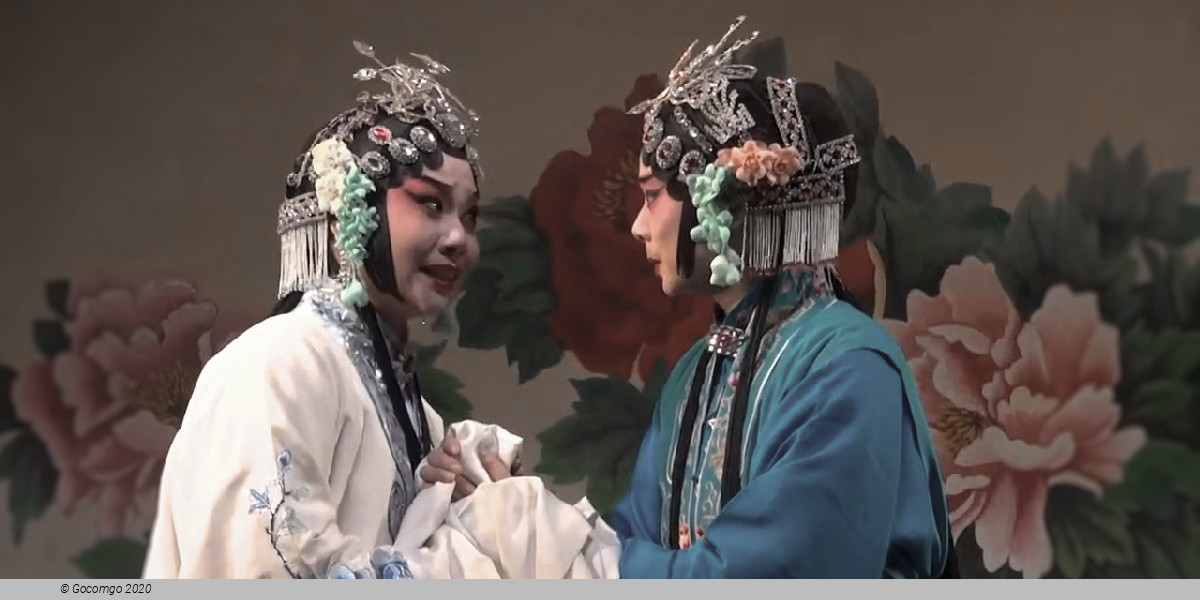
The Big-Footed Empressa medium-length Suzhou Pingtan opera adapted from a Peking opera of the same title by the Suzhou Pingtan Troupe, tells a story set in the reign of ZHU Yuanzhang, about people from all walks of life, including the emperor, ministers, eunuchs and scholars, expressing different opinions on the empress, MA Xiuying, who is born with big feet. In the story, ZHU Yuanzhang even threatens to kill WANG Yong, a scholar who dares to call “Big-Footed Empress”. But Empress MA makes much of her big feet to “admonish” the emperor, who thus thinks highly of this honest scholar and puts him in an important position. The entire story is quite amusing and hilarious.

Tanci Ensemble Twelve Colourful Butterflies

It’s excerpted from the 300 Yuan Songs. In the world depicted in the song, there seems to be a lovely spring scene where colourful butterflies are flying among flowers in full bloom. Listening to it, you will forget all troubles and just immerse yourself in leisure.

Songs from Tanci Opera YANG Naiwu·Plainly Evident

YANG Naiwu and Xiaobaicai, a full-length Tanci opera, is an excellent traditional piece of Suzhou Pingtan. Thematically designed to uncover the feudal judicial darkness and official corruption, it tells a convoluted story in which there are lively characters.

A Chapter from Tanci Opera Empress LYU of the Han Dynasty·Weiyang Palace

In the early Han Dynasty, LIU Bang orders CHEN Xi to go out to battle, but CHEN rises in revolt with secret instructions from HAN Xin, and collaborates from within with HAN to usurp power. Informed of this, LIU Bang entrusts the state affairs to Empress LYU and then leads troops to suppress the rebels. Empress LYU and XIAO He maneuver HAN Xin into the Weiyang Palace, intending to kill him...

Opening Song of Tanci Opera The Romance of West Chamber·Yingying Worships the Moon

It’s excerpted from the classical masterpiece The Romance of West Chamber, telling a story about CUI Yingying burning incense on a moonlit night to pray and express her mood. The Yangse Delta-style courtyard is depicted in detail in a mellow voice, revealing the character’s inner sentiments.

A Chapter from Tanci Opera MENG Lijun·Reunion of the Couple

MENG Lijun, a talented girl, disguises herself as a man and comes first in the highest imperial examination under the pseudonym of LI Junyu, in order to save her fiancé HUANGPU Shaohua and his whole family. She rises to the position of Prime Minister. “Reunion of the Couple” is one of the highlights, depicting how MENG Lijun and HUANGPU Shaohua deal with emotional conflicts and other troubles with wisdom in their wrong identities.

Songs from Tanci Opera The Pearl Pagoda·Reporting Good News at the Dressing Table

It’s a classic from the full-length Suzhou Tanci opera The Pearl Pagoda, known for its delicate character portrayal and witty dialogue. The story unfolds with FANG Qing coming first in the highest imperial examination and returning to Xiangyang. Three years ago, FANG Qing is humiliated for family poverty by his snobbish aunt, Mrs. CHEN, who is wealthy. Now he is disguised as a Taoist priest and returns to his aunt’s house. In the garden, he meets Caiping, the maidservant of CHEN Cui’e, the daughter of the CHEN Family. Caiping recognises him and goes upstairs to tell the young lady the good news.

A Chapter from Tanci Opera Fate in Tears and Laughter·Looking for SHEN Fengxi

After meeting SHEN Fengxi at Tianqiao, FAN Jiashu goes to her house at her invitation. Their psychological expectations for a reunion are depicted in detail, revealing their mixed emotions - as a young man and girl, they long to meet each other again, but they are swayed by consideration of gain and loss.

Venue Info

Beijing National Grand Theater (NCPA) - Beijing
Location   2 W Chang'an Ave

The National Centre for the Performing Arts (NCPA) is an arts centre containing an opera house in Beijing, People's Republic of China. The Centre, an ellipsoid dome of titanium and glass surrounded by an artificial lake, seats 5,452 people in three halls and is almost 12,000 m² in size. It was designed by French architect Paul Andreu. Construction started in December 2001 and the inaugural concert was held in December 2007.

The exterior of the theater is a titanium-accented glass dome that is completely surrounded by a man-made lake. It is said to look like an egg floating on water, or a water drop. It was designed as an iconic feature, something that would be immediately recognizable.

The dome measures 212 meters in east–west direction, 144 meters in north–south direction, and is 46 meters high. The main entrance is at the north side. Guests arrive in the building after walking through a hallway that goes underneath the lake. The titanium shell is broken by a glass curtain in north–south direction that gradually widens from top to bottom.

The location, immediately to the west of Tiananmen Square and the Great Hall of the People, and near the Forbidden City, combined with the theatre's futuristic design, created considerable controversy. Paul Andreu countered that although there is indeed value in ancient traditional Chinese architecture, Beijing must also include modern architecture, as the capital of the country and an international city of great importance. His design, with large open space, water, trees, was specially designed to complement the red walls of ancient buildings and the Great Hall of the People, in order to melt into the surroundings as opposed to standing out against them.

Internally, there are three major performance halls:

The Opera Hall is used for operas, ballet, and dances and seats 2,416 people.
The Music Hall is used for concerts and recitals and seats 2,017 people.
The Theatre Hall is used for plays and the Beijing opera. It has 1,040 seats.
The NCPA also distributes filmed and recorded performances of its concerts, plays and operas through the in-house label NCPA Classics, established in 2016.

The initial planned cost of the theatre was 2.688 billion yuan. When the construction had completed, the total cost rose to more than CNY3.2 billion. The major cause of the cost increase was a delay for reevaluation and subsequent minor changes as a precaution after a Paris airport terminal building collapsed. The cost has been a major source of controversy because many believed that it is nearly impossible to recover the investment. When the cost is averaged out, each seat is worth about half a million CNY. The Chinese government answered that the theater is not a for profit venture.

The government sanctioned study completed in 2004 by the Research Academy of Economic & Social Development of the Dongbei University of Finance and Economics, of the upkeep costs of the building were publicized in domestic Chinese media:

The water and electricity bills and the cleaning cost for the external surface would be at least tens of millions CNY, and with another maintenance cost, the total could easily exceed one billion CNY. Therefore, at least 80 percent of the annual operational costs must be subsidized by the government for at least the first three years after the opening, and for the rest of its operational life, at least 60 percent of the annual operational cost must be subsidized by the government.

The director of the art committee of the National Centre for the Performing Arts and the standing committee member of the Standing Committee of the Chinese People's Political Consultative Conference, Mr Wu Zuqiang (吴祖强) and the publicist / deputy director of the National Centre for the Performing Arts Mr Deng (邓一江) have announced that 70 percent of the tickets would be sold at low price for ordinary citizens, while 10% of the tickets would be sold at relatively expensive prices for separate market segments, and the 60% of annual operating cost needed to be subsidized by the government would be divided between the central government and the Beijing municipal government.

Important Info
Type: Opera Chinese
City: Beijing, China
Starts at: 19:30
Duration: 1h 30min
Top of page