
Beijing National Grand Theater (NCPA) tickets 8 February 2026 - Lan Huahua | GoComGo.com

Lan Huahua

Beijing National Grand Theater (NCPA), Opera House, Beijing, China
All photos (1)
Select date and time
2:30 PM
From
US$ 109

E-tickets: Print at home or at the box office of the event if so specified. You will find more information in your booking confirmation email.

You can only select the category, and not the exact seats.
If you order 2 or 3 tickets: your seats will be next to each other.
If you order 4 or more tickets: your seats will be next to each other, or, if this is not possible, we will provide a combination of groups of seats (at least in pairs, for example 2+2 or 2+3).

Important Info
Type: Opera
City: Beijing, China
Starts at: 14:30
Intervals: 1
Duration: 2h

E-tickets: Print at home or at the box office of the event if so specified. You will find more information in your booking confirmation email.

You can only select the category, and not the exact seats.
If you order 2 or 3 tickets: your seats will be next to each other.
If you order 4 or more tickets: your seats will be next to each other, or, if this is not possible, we will provide a combination of groups of seats (at least in pairs, for example 2+2 or 2+3).

Cast
Creators
Composer: Zhang Qianyi
Director: Xinyi Chen
Librettist: Zhao Daming
Overview

For thousands of years, folk songs have been passed down from generation to generation along with the development of the society.

They are brilliant treasures in the traditional Chinese culture, expressing the people’s feelings and recording their life. At first, the northern Shaanxi folk song LAN Huahua was just passed down orally among the common people in the form of Xintianyou, a local melody of northern Shaanxi. In the 1940s, it was artificially rearranged by musicians from the Yan’an Lu Xun Academy of Arts when they were collecting folk songs in northern Shaanxi. It then came into vogue, becoming a representative of northern Shaanxi folk songs and of Chinese national ballads. It has been interpreted in various artistic forms, enjoying high popularity among a big multitude of people.

LAN Huahua was the 13th opera to be commissioned by the NCPA, which began in 2011 and last six years. When composing this opera, composer ZHANG Qianyi leveraged his expertise in melody creation, giving full play to the symphonic and epic qualities of the operatic music. The opera was staged twice in 2017 and 2018, earning itself critical acclaim - “It caused so great a sensation in the music scene that professionals travelled to Beijing from across the country to watch the performance, giving it high praise.” “It presents new thinking about the century-long historical exploration of Chinese opera and embodies a new form of the theatre arts, one that boasts Chinese and Western fusion in the contemporary context.”

Creatively, the NCPA made a deeper exploration of this folk song in terms of artistic form and storyline, becoming the first to present it on the opera stage. From the perspective of LAN Huahua, a tragic female character, the opera unfolds with a deep probe into that tumultuous era, a special period of time, revealing how much people throughout the ages yearn for freedom, love and a better life. That’s why this story is still of profound social significance and high artistic value today.

Synopsis

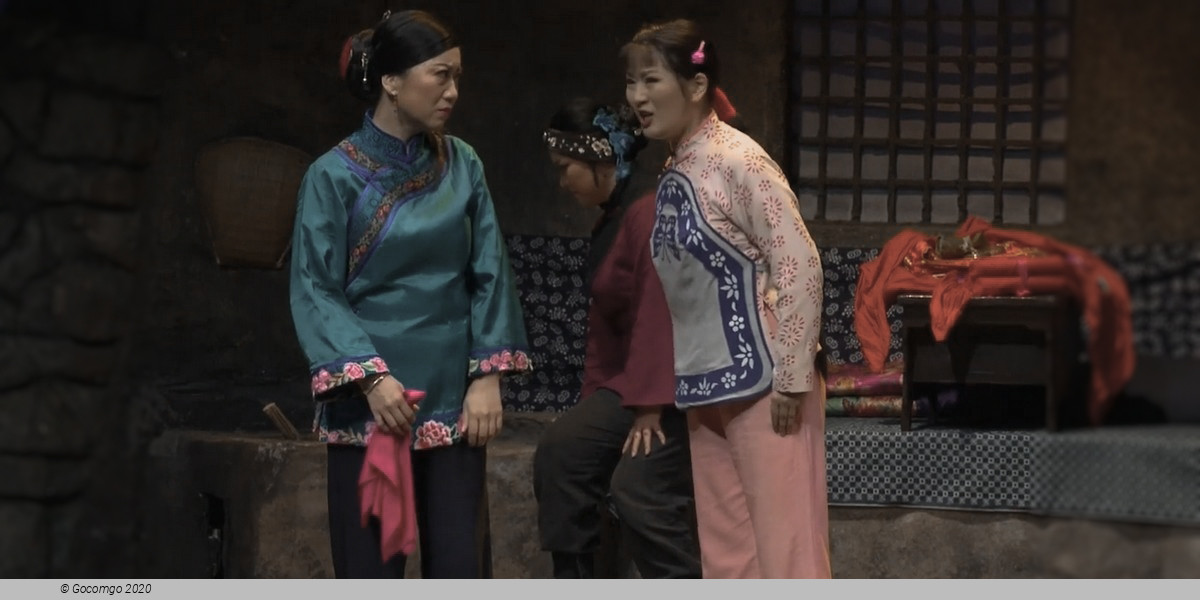
LAN Huahua, a beauty living in Lanjiahe Village, falls in love with “Luotuozi”, a young coachman who serves in an out-of-town caravan. They often date secretly in the fields. The villagers feel aggrieved at LAN Huahua's behaviour and regard her as a loose woman. In order to settle the issue, they invites the venerable squire ZHOU to uphold justice. And then Luotuozi is forced to leave the village.

However, LAN Huahua has been pregnant, and it’s Luotuozi’s. Her father is so exasperated that he wants to kill her. Squire ZHOU suggests that LAN Huahua marry his poor, silly shepherd “Ganyang”. For the fetus’s sake, she assents to their marriage regardless of humiliation.

Ganyang is to marry such a beautiful girl! This news causes a sensation in the village. But LAN Huahua refuses Ganyang to touch her. She tells Ganyang why she must get married. Ganyang is shocked and sad. Actually, squire ZHOU has wanted LAN Huahua for a long time, so he seizes the chance to tell LAN Huahua that he can make her live a better life, only if she does what he wants. LAN Huahua is disgusted and gives him a flat refusal.

Squire ZHOU says in public that LAN Huahua has someone else's baby. Hearing this, LAN Huahua’s father dies of shame and resentment while Ganyang breaks into a furious rage as nobody could expect, rebuking squire ZHOU for knowing everything but lying to him. Then, he leaves Lanjiahe. With indignation, LAN Huahua disputes that squire ZHOU is the one who really offends public decency. Also, villagers smell a rat in the matter. Squire ZHOU knows his moral and upright image has collasped, and he announces that Lanjiahe must drive LAN Huahua away.

Like Luotuozi, LAN Huahua is forced to leave her hometown at the end. She can find no way out but death, only leaves a song named LAN Huahua to be sung by generations.

Venue Info

Beijing National Grand Theater (NCPA) - Beijing
Location   2 W Chang'an Ave

The National Centre for the Performing Arts (NCPA) is an arts centre containing an opera house in Beijing, People's Republic of China. The Centre, an ellipsoid dome of titanium and glass surrounded by an artificial lake, seats 5,452 people in three halls and is almost 12,000 m² in size. It was designed by French architect Paul Andreu. Construction started in December 2001 and the inaugural concert was held in December 2007.

The exterior of the theater is a titanium-accented glass dome that is completely surrounded by a man-made lake. It is said to look like an egg floating on water, or a water drop. It was designed as an iconic feature, something that would be immediately recognizable.

The dome measures 212 meters in east–west direction, 144 meters in north–south direction, and is 46 meters high. The main entrance is at the north side. Guests arrive in the building after walking through a hallway that goes underneath the lake. The titanium shell is broken by a glass curtain in north–south direction that gradually widens from top to bottom.

The location, immediately to the west of Tiananmen Square and the Great Hall of the People, and near the Forbidden City, combined with the theatre's futuristic design, created considerable controversy. Paul Andreu countered that although there is indeed value in ancient traditional Chinese architecture, Beijing must also include modern architecture, as the capital of the country and an international city of great importance. His design, with large open space, water, trees, was specially designed to complement the red walls of ancient buildings and the Great Hall of the People, in order to melt into the surroundings as opposed to standing out against them.

Internally, there are three major performance halls:

The Opera Hall is used for operas, ballet, and dances and seats 2,416 people.
The Music Hall is used for concerts and recitals and seats 2,017 people.
The Theatre Hall is used for plays and the Beijing opera. It has 1,040 seats.
The NCPA also distributes filmed and recorded performances of its concerts, plays and operas through the in-house label NCPA Classics, established in 2016.

The initial planned cost of the theatre was 2.688 billion yuan. When the construction had completed, the total cost rose to more than CNY3.2 billion. The major cause of the cost increase was a delay for reevaluation and subsequent minor changes as a precaution after a Paris airport terminal building collapsed. The cost has been a major source of controversy because many believed that it is nearly impossible to recover the investment. When the cost is averaged out, each seat is worth about half a million CNY. The Chinese government answered that the theater is not a for profit venture.

The government sanctioned study completed in 2004 by the Research Academy of Economic & Social Development of the Dongbei University of Finance and Economics, of the upkeep costs of the building were publicized in domestic Chinese media:

The water and electricity bills and the cleaning cost for the external surface would be at least tens of millions CNY, and with another maintenance cost, the total could easily exceed one billion CNY. Therefore, at least 80 percent of the annual operational costs must be subsidized by the government for at least the first three years after the opening, and for the rest of its operational life, at least 60 percent of the annual operational cost must be subsidized by the government.

The director of the art committee of the National Centre for the Performing Arts and the standing committee member of the Standing Committee of the Chinese People's Political Consultative Conference, Mr Wu Zuqiang (吴祖强) and the publicist / deputy director of the National Centre for the Performing Arts Mr Deng (邓一江) have announced that 70 percent of the tickets would be sold at low price for ordinary citizens, while 10% of the tickets would be sold at relatively expensive prices for separate market segments, and the 60% of annual operating cost needed to be subsidized by the government would be divided between the central government and the Beijing municipal government.

Important Info
Type: Opera
City: Beijing, China
Starts at: 14:30
Intervals: 1
Duration: 2h
Top of page