
Beijing National Grand Theater (NCPA) tickets 21 February 2026 - Jingju Theatre Company of Beijing: GUAN Yu Walking a Thousand Miles and Riding Alone (Excerpts) | GoComGo.com

Jingju Theatre Company of Beijing: GUAN Yu Walking a Thousand Miles and Riding Alone (Excerpts)

Beijing National Grand Theater (NCPA), Theatre, Beijing, China
All photos (2)
Select date and time
7:30 PM
From
US$ 100

E-tickets: Print at home or at the box office of the event if so specified. You will find more information in your booking confirmation email.

You can only select the category, and not the exact seats.
If you order 2 or 3 tickets: your seats will be next to each other.
If you order 4 or more tickets: your seats will be next to each other, or, if this is not possible, we will provide a combination of groups of seats (at least in pairs, for example 2+2 or 2+3).

Important Info
Type: Opera Chinese
City: Beijing, China
Starts at: 19:30
Duration: 3h

E-tickets: Print at home or at the box office of the event if so specified. You will find more information in your booking confirmation email.

You can only select the category, and not the exact seats.
If you order 2 or 3 tickets: your seats will be next to each other.
If you order 4 or more tickets: your seats will be next to each other, or, if this is not possible, we will provide a combination of groups of seats (at least in pairs, for example 2+2 or 2+3).

Overview

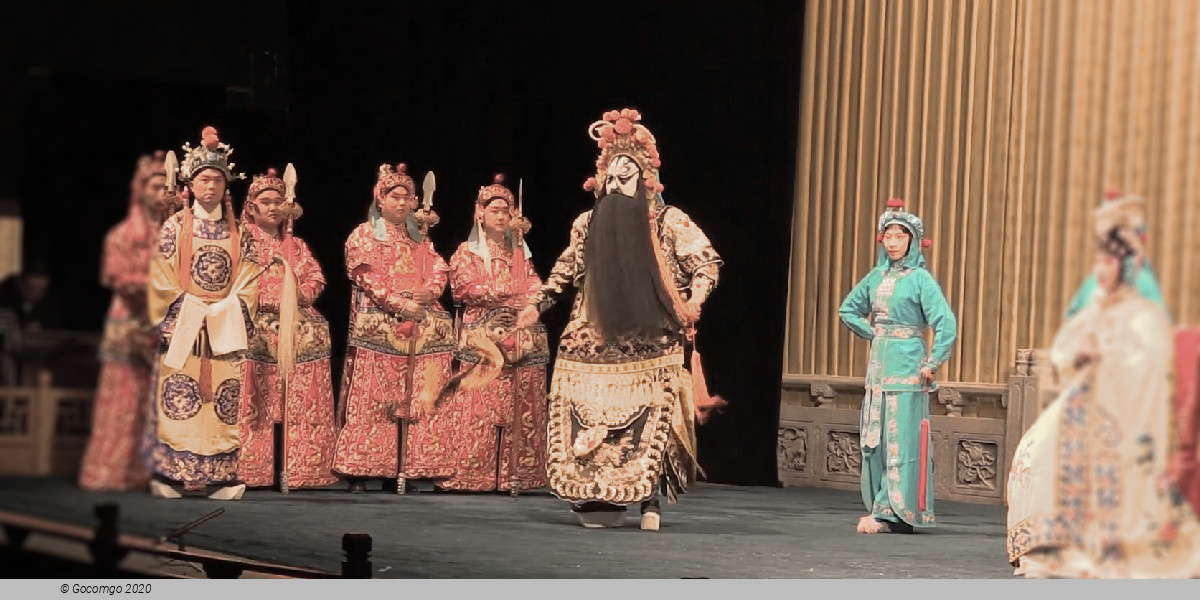
GUAN Yu leaves Xuchang and escorts his two sisters-in-law to Hebei. They pass through five mountain passes - Dongling, Luoyang, Sishui, Xingyang, and Yellow River Ferry, where GUAN Yu kills six military officers under CAO Cao - KONG Xiu, HAN Fu, MENG Tan, BIAN Xi, WANG Zhi, and QIN Qi, escaping from danger. Then, GUAN Yu and his companions cross the Yellow River Ferry, arriving at an ancient town. The young groom finds out that the ancient town is guarded by ZHANG Fei. GUAN Yu is rejoiced at the news and looks forward to reuniting with his brother immediately. Unexpectedly, ZHANG Fei refuses to open the gate because he suspects GUAN Yu, who has lived in CAO Cao’s barracks for a long time, has surrendered to CAO Cao. At the very moment, CAI Yang, a military officer in the CAO Army, is rushing over to GUAN Yu to revenge his nephew QIN Qi. Afraid of deception, ZHANG Fei beats the war drum three times for GUAN Yu and orders him to kill CAI Yang to confirm whether he has surrendered to CAO Cao. GUAN Yu kills CAI Yang, and ZHANG Fei, feeling terribly ashamed, personally welcomes GUAN Yu into the town. Late that night, ZHANG Fei visits GUAN Yu to admit his error and ask for punishment. GUAN Yu admonishes ZHANG Fei and tells ZHANG how he undergoes all conceivable hardships when looking for their eldest brother with their sisters-in-law under his protection. LIU Bei comes to plead for ZHANG Fei. Finally, the three brothers become reconciled.


GUAN Yu: LI Mengjia
CAO Cao: LI Yang
PU Jing: HUANG Chen
ZHANG Liao: WEI Boyang
Lady GAN: LIU Shuoyu
Lady MI: YOU Yaying
HU Hua: WANG Ruoding
CHEN Zhen: TAN Xiaoyu
QIN Qi: JIN Muxuan
Young Groom: LI Wei  

Drummer: XIAO Yongqiang
Jinghu rtist: CHEN Yuting
Flutist: WAN Peng
Stage Manager: WANG Bowen

After its establishment over 40 years ago, the Company has produced and launched a number of widely-loved newly adapted operas, of which Prime Minister LIU YongFinishing TouchOde to the Goddess of the Luo RiverMEI LanfangTongrentangHoly Soul: KONG Fansen, and Xialu Town, as well as little-theatre Peking operas Splashing Water in Front of the Horse and Six Chapters of a Floating Life, have won many national awards. LI Dazhao and XU Yunfeng, two new Peking operas produced recently, have been selected for the “Excellent Stage Art Works Festival for celebrating the 100th Anniversary of the Founding of the CPC” held by the state and Beijing, respectively, and shortlisted for the Ninth China Peking Opera Art Festival.

Founded in 1979, the Jingju Theatre Company of Beijing is a second-class public institution directly under the Beijing Municipal Bureau of Culture and Tourism and one of the key Peking Opera troupes named by the Ministry of Culture. Formerly known as the Beijing Peking Opera Troupe, Beijing Municipal Peking Opera Troupe and Beijing Experimental Peking Opera Troupe, the Jingju Theatre Company of Beijing boasts inestimable artistic treasures created by masters of Peking Opera including MEI Lanfang, SHANG Xiaoyun, CHENG Yanqiu, XUN Huisheng, MA Lianliang, TAN Fuying, ZHANG Junqiu, QIU Shengrong, and ZHAO Yanxia. The Company has 480 cast members, who assume well-defined duties in a mighty performance team and can play various roles of different genres. WANG Rongrong, DU Zhenjie, LI Hongtu, CHI Xiaoqiu, ZHU Qiang, ZHANG Huifang, and HU Wenge are the most influential Peking Opera artists today.

The Company consists of nine operational departments, including the Peking Opera Troupe, MEI Lanfang Peking Opera Troupe, Youth Ensemble, Performing Arts Training Centre, Stage Art Centre, Comprehensive Business Department, Creation (Research) Department, Market Development Department, and TAN-School Art Research Institute, as well as four administrative departments including Party-Masses Work Department, General Management Department, Financial & Assets Department, and Human Resources Department.

Based on tradition, the Jingju Theatre Company of Beijing never stops producing and launching new-type Peking operas that meet the contemporary aesthetic standards and are fired with the innovative spirit. For decades, the Company has kept expanding its repertoire with more than 300 operas incorporated into it, including more than 260 traditional ones, such as The Chinese OrphanThe Unicorn PurseImperial Concubine YANGThe Return of the Phoenix, etc., and more than 60 new ones. In 2019, the Company set up a traditional production studio, aiming to discover, revive, inherit and develop some traditional operas of different schools that are on the verge of loss. About 20 traditional operas have been revived over the past two years.

Venue Info

Beijing National Grand Theater (NCPA) - Beijing
Location   2 W Chang'an Ave

The National Centre for the Performing Arts (NCPA) is an arts centre containing an opera house in Beijing, People's Republic of China. The Centre, an ellipsoid dome of titanium and glass surrounded by an artificial lake, seats 5,452 people in three halls and is almost 12,000 m² in size. It was designed by French architect Paul Andreu. Construction started in December 2001 and the inaugural concert was held in December 2007.

The exterior of the theater is a titanium-accented glass dome that is completely surrounded by a man-made lake. It is said to look like an egg floating on water, or a water drop. It was designed as an iconic feature, something that would be immediately recognizable.

The dome measures 212 meters in east–west direction, 144 meters in north–south direction, and is 46 meters high. The main entrance is at the north side. Guests arrive in the building after walking through a hallway that goes underneath the lake. The titanium shell is broken by a glass curtain in north–south direction that gradually widens from top to bottom.

The location, immediately to the west of Tiananmen Square and the Great Hall of the People, and near the Forbidden City, combined with the theatre's futuristic design, created considerable controversy. Paul Andreu countered that although there is indeed value in ancient traditional Chinese architecture, Beijing must also include modern architecture, as the capital of the country and an international city of great importance. His design, with large open space, water, trees, was specially designed to complement the red walls of ancient buildings and the Great Hall of the People, in order to melt into the surroundings as opposed to standing out against them.

Internally, there are three major performance halls:

The Opera Hall is used for operas, ballet, and dances and seats 2,416 people.
The Music Hall is used for concerts and recitals and seats 2,017 people.
The Theatre Hall is used for plays and the Beijing opera. It has 1,040 seats.
The NCPA also distributes filmed and recorded performances of its concerts, plays and operas through the in-house label NCPA Classics, established in 2016.

The initial planned cost of the theatre was 2.688 billion yuan. When the construction had completed, the total cost rose to more than CNY3.2 billion. The major cause of the cost increase was a delay for reevaluation and subsequent minor changes as a precaution after a Paris airport terminal building collapsed. The cost has been a major source of controversy because many believed that it is nearly impossible to recover the investment. When the cost is averaged out, each seat is worth about half a million CNY. The Chinese government answered that the theater is not a for profit venture.

The government sanctioned study completed in 2004 by the Research Academy of Economic & Social Development of the Dongbei University of Finance and Economics, of the upkeep costs of the building were publicized in domestic Chinese media:

The water and electricity bills and the cleaning cost for the external surface would be at least tens of millions CNY, and with another maintenance cost, the total could easily exceed one billion CNY. Therefore, at least 80 percent of the annual operational costs must be subsidized by the government for at least the first three years after the opening, and for the rest of its operational life, at least 60 percent of the annual operational cost must be subsidized by the government.

The director of the art committee of the National Centre for the Performing Arts and the standing committee member of the Standing Committee of the Chinese People's Political Consultative Conference, Mr Wu Zuqiang (吴祖强) and the publicist / deputy director of the National Centre for the Performing Arts Mr Deng (邓一江) have announced that 70 percent of the tickets would be sold at low price for ordinary citizens, while 10% of the tickets would be sold at relatively expensive prices for separate market segments, and the 60% of annual operating cost needed to be subsidized by the government would be divided between the central government and the Beijing municipal government.

Important Info
Type: Opera Chinese
City: Beijing, China
Starts at: 19:30
Duration: 3h
Top of page