
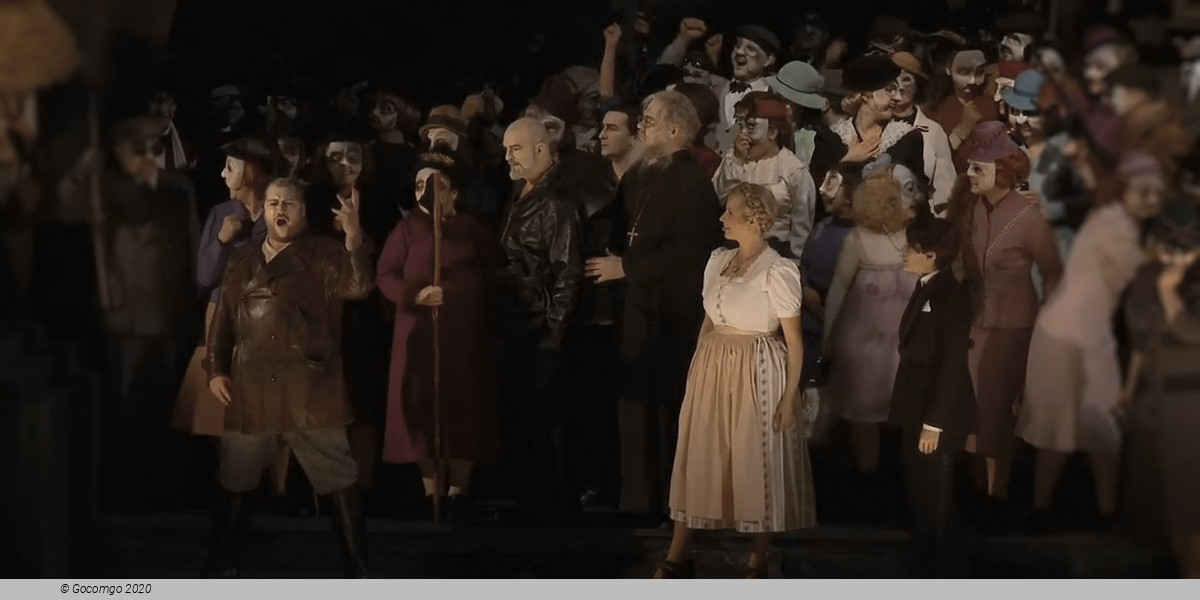
Bayreuth Festspielhaus tickets 26 July 2026 - Rienzi | GoComGo.com

Rienzi

Bayreuth Festspielhaus, Bayreuth, Germany
All photos (1)
Select date and time
4 PM
From
US$ 92

E-tickets: Print at home or at the box office of the event if so specified. You will find more information in your booking confirmation email.

You can only select the category, and not the exact seats.
If you order 2 or 3 tickets: your seats will be next to each other.
If you order 4 or more tickets: your seats will be next to each other, or, if this is not possible, we will provide a combination of groups of seats (at least in pairs, for example 2+2 or 2+3).

Important Info
Type: Opera
City: Bayreuth, Germany
Starts at: 16:00

E-tickets: Print at home or at the box office of the event if so specified. You will find more information in your booking confirmation email.

You can only select the category, and not the exact seats.
If you order 2 or 3 tickets: your seats will be next to each other.
If you order 4 or more tickets: your seats will be next to each other, or, if this is not possible, we will provide a combination of groups of seats (at least in pairs, for example 2+2 or 2+3).

Cast
Performers
Conductor: Nathalie Stutzmann
Bass: Andreas Bauer Kanabas (Steffano Colonna)
Tenor: Andreas Schager (Cola Rienzi)
Choir: Bayreuth Festsival Chorus
Orchestra: Bayreuth Festsival Orchestra
Soprano: Gabriela Scherer (Irene)
Soprano: Jennifer Holloway (Adriano)
Baritone: Michael Nagy (Paolo Orsini)
Creators
Composer: Richard Wagner
Director: Alexandra Szemerédy
Writer: Edward Bulwer-Lytton
Director: Magdolna Parditka
Librettist: Richard Wagner
Overview

Rienzi, Wagner’s third opera, was once his greatest success. The performance in Bayreuth is a unique opportunity to rediscover Wagner’s early triumph – where it has never been heard before.

The Bayreuth version for 2026 argues that, had a “final version” been created around 1871, Rienzi would certainly have found its place in the Bayreuth canon of works “from The Flying Dutchman onwards”. For the ten works of the so-called “Bayreuth canon” are not based on a will or authoritative formulations in the foundation deed of the Richard Wagner Foundation Bayreuth, but exclusively on passages from Wagner’s letters to King Ludwig II of Bavaria from 1882.

The team has strived for a version that has considered the aforementioned layers of tradition as carefully as the history of reception. Likewise, the Rienzi philology of recent decades has been meticulously taken into account. Furthermore, the team has attempted to uncover new sources and reconstruct parts of the score believed to be lost.

Form and design naturally lead inevitably to the question of cuts and processes. In this, too, the team followed the musical dramaturgy just as Wagner’s – also later – self-assessments. When Wagner 1871 writes, “they should see the fire in Rienzi; I was a music director and wrote a great opera; that this music director has given them such nuts to crack afterwards, that should surprise them”, one notices the value of this “fire”, which for the later “nuts” was just as indispensable as “every finale like a frenzy, a drunken nonsense of suffering and joy” (1878). But also self-critical things, like the “emptiness that one screws on when one can’t think of anything.” (1879) was taken into account in the version for 2026. Not only a comprehensible sequence of the plot lines was important to the team, but also the internal structure of the individual musical numbers. Here, too, the “unhealthy” relationship between Rienzi and his sister Irene plays an essential role. Not only because it refers to the later incest constellation in the Walküre, but also because it is fundamental to the emotional – and thus musically formed – triangle story Rienzi-Irene-Adriano. For the directorial concept, the question was therefore before their eyes where Wagner musically explored the psychology and emotionality of the characters in their depth. It seemed more important to investigate what politics does to people and not the other way around, and where the music-dramatic treatment of these questions can be found in the score. These emotional constellations – against a background of political history – are what generate the outstanding quality of the individual numbers and scenes in the first place.

Even if Wagner had only written Rienzi, the opera is a unique masterpiece sui generis, which would have found its place in the genre history of European musical theater even without the authorship of the later Bayreuth master.

History
Premiere of this production: 20 October 1842, Königliches Hoftheater, Dresden

The opera is set in Rome and is based on the life of Cola di Rienzi (1313–1354), a late medieval Italian populist figure who succeeds in outwitting and then defeating the nobles and their followers and in raising the power of the people. Magnanimous at first, he is forced by events to crush the nobles' rebellion against the people's power, but popular opinion changes and even the Church, which had urged him to assert himself, turns against him. In the end the populace burns the Capitol, in which Rienzi and a few adherents have made a last stand.

Synopsis

Overture

The opera opens with a substantial overture which begins with a trumpet call (which in act 3 we learn is the war call of the Colonna family) and features the melody of Rienzi's prayer at the start of act 5, which became the opera's best-known aria. The overture ends with a military march.

Act 1
Outside Rienzi's house

The patrician Orsini and his cronies attempt to kidnap Rienzi's sister Irene. Stefano Colonna, also a patrician but inclined to support Rienzi, prevents them. Raimondo appeals to the parties in the name of the Church to stop their fighting; Rienzi's eventual appearance (marked by a dramatic key shift, from D to E flat) quells the riot. The Roman people support Rienzi's condemnation of the nobles. Irene and Adriano realise their mutual attraction (duet "Ja, eine Welt voll Leiden" – Yes, a world of sorrows). A gathering crowd of plebeians, inspired by Rienzi's speeches, offers Rienzi the crown; he demurs, insisting that he wishes only to be a Tribune of the Roman people.

Act 2
A hall in the Capitol

The patricians plot the death of Rienzi; Adriano is horrified when he learns of this. Rienzi greets a group of ambassadors for whom an entertainment is laid on (a lengthy ballet). Orsini attempts to stab Rienzi, who however is protected by a vest of chain mail. Adriano pleads with Rienzi for mercy to the nobles, which Rienzi grants.

The act 2 ballet is noteworthy as Wagner made a clear attempt to make it relevant to the action of the opera (whereas in most Grand Operas the ballet was simply an entertaining diversion). The Rienzi ballet was intended to tell the tale of the 'Rape of Lucretia'. This storyline (in which Tarquinius, the last king of Rome, attempts to rape the virtuous Lucretia), parallels both the action of Rienzi (Orsini's attempt on Irene) and its background (patricians versus the people). In its original form the ballet lasts for over half an hour – in modern performances and recordings it is generally drastically cut.

Act 3
The Roman Forum

The patricians have recruited an army to march on Rome. The people are alarmed. Rienzi rouses the people and leads them to victory over the nobles, in the course of which Adriano's father Stefano is killed. Adriano swears revenge, but Rienzi dismisses him.

Act 4
Before the Lateran Church

Cecco and other citizens discuss the negotiations of the patricians with the Pope and with the Emperor of Germany. Adriano's intention to kill Rienzi wavers when Rienzi arrives together with Irene. Raimondo now announces that the Pope has laid a papal ban on Rienzi, and that his associates risk excommunication. Despite Adriano's urgings, Irene resolves to stay with Rienzi.

Act 5
Scene 1: A room in the Capitol

Rienzi in his prayer "Allmächt'ger Vater" (Almighty Father!) asserts his faith in the people of Rome. He suggests to Irene that she seek safety with Adriano, but she demurs. An apologetic Adriano enters and tells the pair that the Capitol is to be burnt and they are at risk.

Scene 2: The Capitol is ablaze

Rienzi's attempts to speak are met with stones and insults from the fickle crowd. Adriano, in trying to rescue Rienzi and Irene, is killed with them as the building collapses.

In the original performances, Rienzi's final words are bitter and pessimistic: "May the town be accursed and destroyed! Disintegrate and wither, Rome! Your degenerate people wish it so." However, for the 1847 Berlin performance Wagner substituted a more upbeat rhetoric: "Ever while the seven hills of Rome remain, ever while the eternal city stands, you will see Rienzi's return!".

Venue Info

Bayreuth Festspielhaus - Bayreuth
Location   Festspielhügel 1-2

The Bayreuth Festspielhaus or Bayreuth Festival Theatre is an opera house north of Bayreuth, Germany, built by the 19th-century German composer Richard Wagner and dedicated solely to the performance of his stage works. It is the venue for the annual Bayreuth Festival, for which it was specifically conceived and built. Its official name is Richard-Wagner-Festspielhaus.

Design

Wagner adapted the design of the Festspielhaus from an unrealised project by Gottfried Semper for an opera house in Munich, without the architect's permission, and supervised its construction. Ludwig II of Bavaria provided the primary funding for the construction. The foundation stone was laid on 22 May 1872, Wagner's 59th birthday. The building was first opened for the premiere of the complete four-opera cycle of Der Ring des Nibelungen (The Ring of the Nibelung), from 13 to 17 August 1876.

Only the entry façade exhibits the typical late-19th-century ornamentation, while the remainder of the exterior is modest and shows mostly undecorated bricks. The interior is mainly wood and has a reverberation time of 1.55 seconds. The Festspielhaus is one of the largest free-standing timber structures ever erected. Unlike the traditional opera house design with several tiers of seating in a horseshoe shaped auditorium, the Festspielhaus's seats are arranged in a single steeply-shaped wedge, with galleries or boxes along the back wall only. This is also known as continental seating. Many contemporary movie theaters have adopted this style of seating, which gives every seat an equal and uninterrupted view of the stage. The capacity of the Festspielhaus is 1,925 and has a volume of 10,000 cubic metres.

The Festspielhaus features a double proscenium, which gives the audience the illusion that the stage is further away than it actually is. The double proscenium and the recessed orchestra pit create – in Wagner's term – a "mystic gulf" between the audience and the stage. This gives a dreamlike character to performances, and provides a physical reinforcement of the mythic content of most of Wagner's operas. The architecture of Festpielhaus accomplished many of Wagner's goals and ideals for the performances of his operas including an improvement on the sound, feel, and overall look of the production.

The Festpielhaus was originally planned to open in 1873, but by that time Wagner had barely raised enough money to put up the walls of his theatre. He began to raise money by traveling and putting on concerts in various cities and countries throughout Europe. There are, however, some documents concerning the donation and aid (900 thaler) to Wagner for that matter by the Sultan Abdülaziz of the Ottoman Empire. Even after Ludwig began funding the project, Wagner had to continue putting on concerts to keep the building project financially afloat. The tours were very taxing on Wagner's health and would eventually be a key element to his death later on in 1883.

Orchestra pit

A significant feature of the Festspielhaus is its unusual orchestra pit. It is recessed under the stage and covered by a hood, so that the orchestra is completely invisible to the audience. This feature was a central preoccupation for Wagner, since it made the audience concentrate on the drama onstage, rather than the distracting motion of the conductor and musicians. The design also corrected the balance of volume between singers and orchestra, creating ideal acoustics for Wagner's operas, which are the only operas performed at the Festspielhaus. However, this arrangement has also made it the most challenging to conduct in, even for the world's best conductors. Not only is the crowded pit enveloped in darkness, but the acoustic reverberation makes it difficult to synchronise the orchestra with the singers. Conductors must therefore retrain themselves to ignore cues from singers.

The orchestra layout deployed at Bayreuth is unusual in three ways:

The first violins are positioned on the right-hand side of the conductor instead of their usual place on the left side. This is in all likelihood because of the way the sound is intended to be directed towards the stage rather than directly on the audience. This way the sound has a more direct line from the first violins to the back of the stage where it can be then reflected to the audience.
Double basses, cellos and harps (when more than one used, e.g. Ring) are split into groups and placed on either side of the pit
The rest of the orchestra is located directly under the stage. This makes communication with the conductor vital as most of the players are unable to see or hear the singers, but creates the huge, rich sounds Wagner sought to compose.

Recent history

In early 2012, Katharina Wagner mentioned the need for repairs to the building, with mention specifically of roof leaks and crumbling of the red brick facade. In 2014, funding for restoration was announced at a level of approximately 30M €, primarily from public funding shared between Germany and the state of Bavaria, with the German national government and the Bavarian state government holding majority shares.

Repairs were completed on 26 July 2015 and the building is fully restored.

Important Info
Type: Opera
City: Bayreuth, Germany
Starts at: 16:00
Top of page